

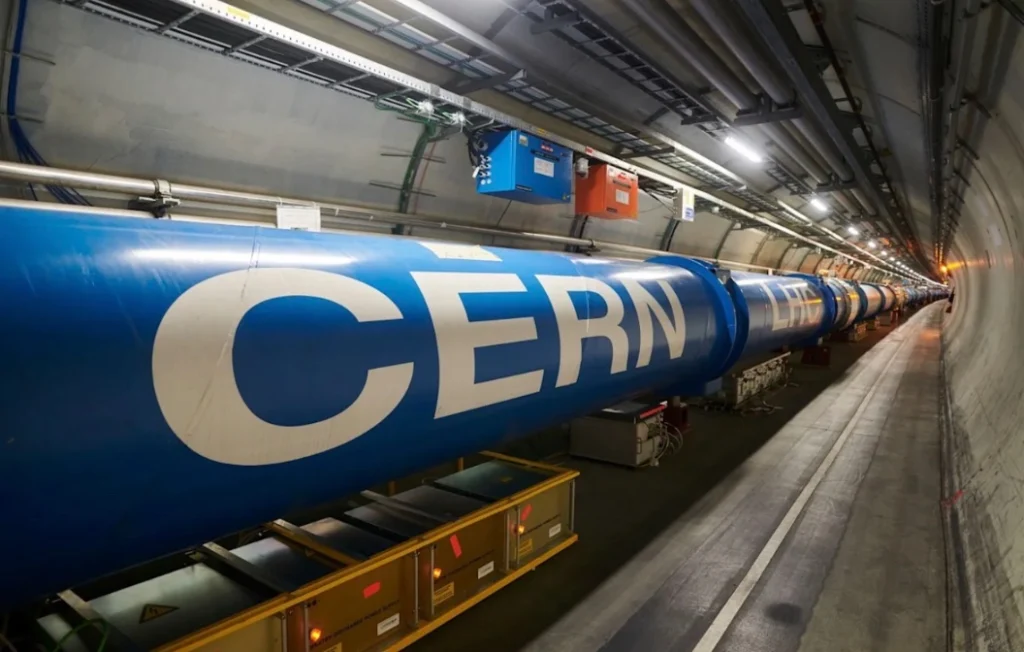
The Large Hadron Collider (LHC) at the European Organization for Nuclear Research (CERN) will be shut down this Monday to begin a complex and lengthy optimization process that will equip it with new capabilities.
[Russian Scientists Build 1st Domestic Quantum Computer With 7-Level Qubits: CERN Will Shut Down Its Particle Accelerator This Monday for Four Years](https://www.telesurenglish.net/cern-will-shut-down-its-particle-accelerator-this-monday-for-four-years/)
The center, which will undergo a four-year shutdown, is the world’s largest particle physics laboratory and is located on the border between Switzerland and France.
Once this disconnection is made, CERN will fully enter its High-Luminosity Large Hadron Collider (HL-LHC) project, which it has been working on for nearly two decades. This may seem like a long time from an ordinary perspective, but from a scientific point of view, it is what a project of such magnitude requires.
The LHC began operating in 2008, but in the meantime, physicists were already anticipating the next stage and advancing in the conception, design, and production of the new components that the HL-LHC will require, as explained to the press by project head Markus Zerlauth.
Timeout
Cern shuts down particle accelerators for several years+++The Large Hadron Collider, the largest particle accelerator in the world, is to be upgraded. The upgrade should significantly increase the chance of new discoveries
The world’s largest particle accelerator will… pic.twitter.com/JawqO8IMqG
— LiberlandPress (@PressLiberland) June 27, 2026
CERN’s ambitious project is based on the numerous contributions to the knowledge and understanding of particles made by the LHC in the last twelve years, starting with its most important and widely publicized discovery: the Higgs boson in 2012.
That was one of the most important scientific discoveries of the 21st century and led CERN to receive the Nobel Prize in Physics in 2013.
For the LHC to enter its new phase, approximately four years of work and preparations will be required, some of which began about eight years ago.
At that time, CERN undertook the excavation of two sections of underground galleries that are about ten meters above and connected to the 27-kilometer circumference closed-circuit tunnel that contains the collider and is at an average depth of 100 meters.
The galleries and their arms measure a total of about half a kilometer and are already operational.
Immediately, wiring will be launched from there, and access will be gained to the two sections of the collider that will be the only ones to undergo a radical change, representing less than 2 kilometers of the total 27 kilometers of the LHC.
The modifications will mainly involve replacing a group of magnets with a new generation to increase proton collisions by a factor of ten, while the data obtained will multiply by six.
Furthermore, in the new phase, computer systems will be able to determine in milliseconds which data is worth saving for analysis and which can be discarded, since the billions of collisions per second that will occur in the HL-LHC will generate data that would be impossible to store, even for a structure as gigantic and technologically advanced as CERN.
From teleSUR English via This RSS Feed.