

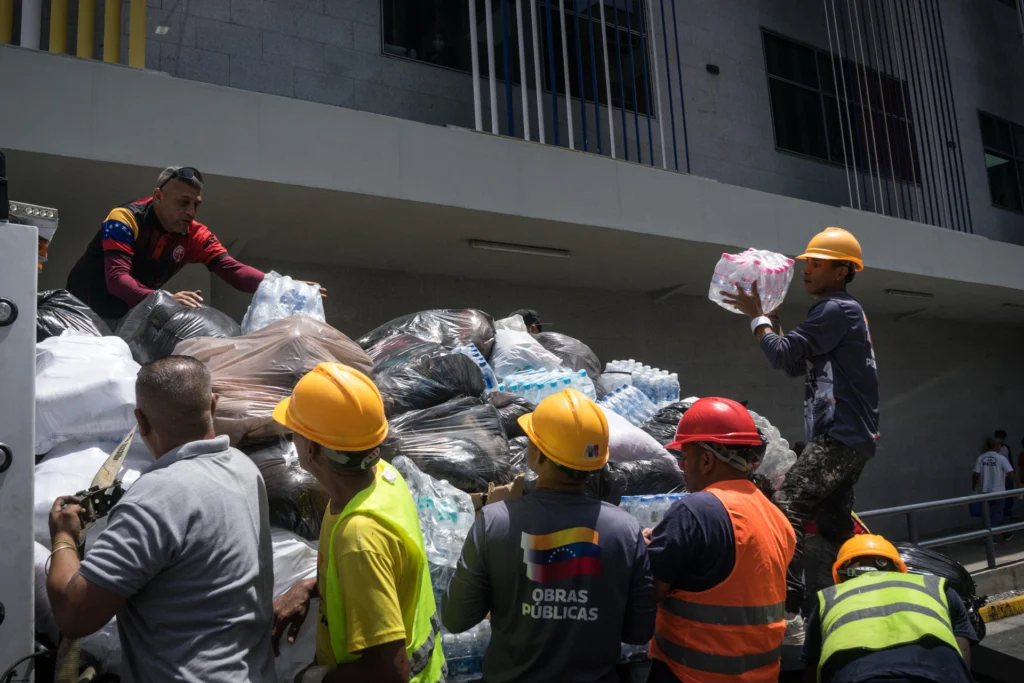
The Venezuela’s Government institutes unified registry to organize civilian aid and clear crucial supply routes after double earthquakes.
Venezuelan authorities implemented mandatory registration for civilian volunteers at the Poliedro of Caracas to coordinate relief operations in La Guaira following the recent destructive earthquakes.
The Bolivarian Government restricted unauthorized civilian transit to the affected coastal state starting June 26 at 8:00 P.M. local time. This crucial security measure, directed by the Minister of Interior, Justice and Peace, Diosdado Cabello, aims to clear vital roads. Private vehicle blockages previously delayed critical patient transfers and heavy machinery deployment on the main highways.
RELATED: Venezuela Restricts Travel to La Guaira to Prioritize Rescue Operations
Consequently, state security forces now execute continuous inspections along the Caracas-La Guaira highway. Officers will redirect any unauthorized citizen back to the capital if they lack official credentials issued at the Poliedro de Caracas.
To expedite this emergency mobilization, coordinators simplified the registration requirements. Volunteers only need to present their national identification card, motorcycle license plate if applicable, and a contact phone number.
A total of 2,697 people have registered as volunteers, allowing for organized reinforcement of rescue efforts during critical hours to find people alive under the rubble.
Ver esta publicación en Instagram
Una publicación compartida de teleSUR English (@telesurenglish)
Structured Relief Operations
Upon completing the swift process, registered brigaders receive a distinctive reflective vest. This garment serves as official identification before the checkpoints managed by the Bolivarian National Armed Forces (FANB, in Spanish). In addition to assisting La Guaira, authorities are assigning volunteer brigades to vulnerable, heavily damaged sectors within Caracas, including San Bernardino, El Paraiso and El Junquito.
This strict coordination responds directly to the critical need for rapid debris removal. Minister Diosdado Cabello emphasized that while rescue teams maintain hope of finding survivors, trapped bodies present potential public health risks. Therefore, technical protocols must strictly guide all civilian support to guarantee sanitary safety in the disaster zones.
#InPictures | Venezuelan Vice Minister for Europe and North America Oliver Blanco reported that the Bolivarian country has received more than 1,600 international rescuers, distributed across 17 flights, to assist the victims of the powerful earthquakes that struck on June 24th.… pic.twitter.com/ZLDakkDCZd
— teleSUR English (@telesurenglish) June 27, 2026
Furthermore, the President of the National Assembly, Jorge Rodriguez, reiterates his call for citizens to avoid traveling independently to the coast, explaining that institutional stockpiling of food and medical supplies remains centralized at La Carlota and the Almacenadora Caracas in Catia. This logistical strategy ensures resources are managed without disrupting emergency transit.
This reorganization of civilian help coincides with the arrival of extensive foreign technical assistance. The current emergency stems from the devastating double seismic activity of magnitude 7.2 and 7.5 that struck the country on June 24. The shallow depth of 13.2 kilometers caused massive destruction, leaving 1,430 dead, 3,238 injured and 3,142 affected families.
Organized international assistance, including 2,242 rescuers from 21 international delegations and over 30,000 national specialized personnel, continues to work alongside Venezuelan authorities.
Ver esta publicación en Instagram
Una publicación compartida de teleSUR English (@telesurenglish)
Victim Support and Assistance
The Acting President Delcy Rodriguez reported this Friday that, in parallel with the operations of debris removal and time-sensitive search for missing persons, the priority extends strategically towards containment, the mental health and emotional support of the civilian population in the midst of mourning.
In this sense, the Government activated a massive comprehensive psychological assistance plan to mitigate the severe emotional scars and trauma resulting from the devastating double earthquake that shook the north-central region of the South American nation.
Rodriguez detailed that the containment approach will be articulated through the Program for Democratic Coexistence and Peace, structuring brigades with groups of psychologists, psychiatrists and academic experts from national universities to provide priority care for children affected by the impact of the geological crisis.
Ver esta publicación en Instagram
Una publicación compartida de teleSUR English (@telesurenglish)
The state mission directs its operational capabilities on the ground to consolidate temporary shelters and ensure institutional support for specialists, ensuring the protection of Venezuelan families and social stabilization against the immediate psychological consequences of the seismic event.
From teleSUR English via This RSS Feed.