

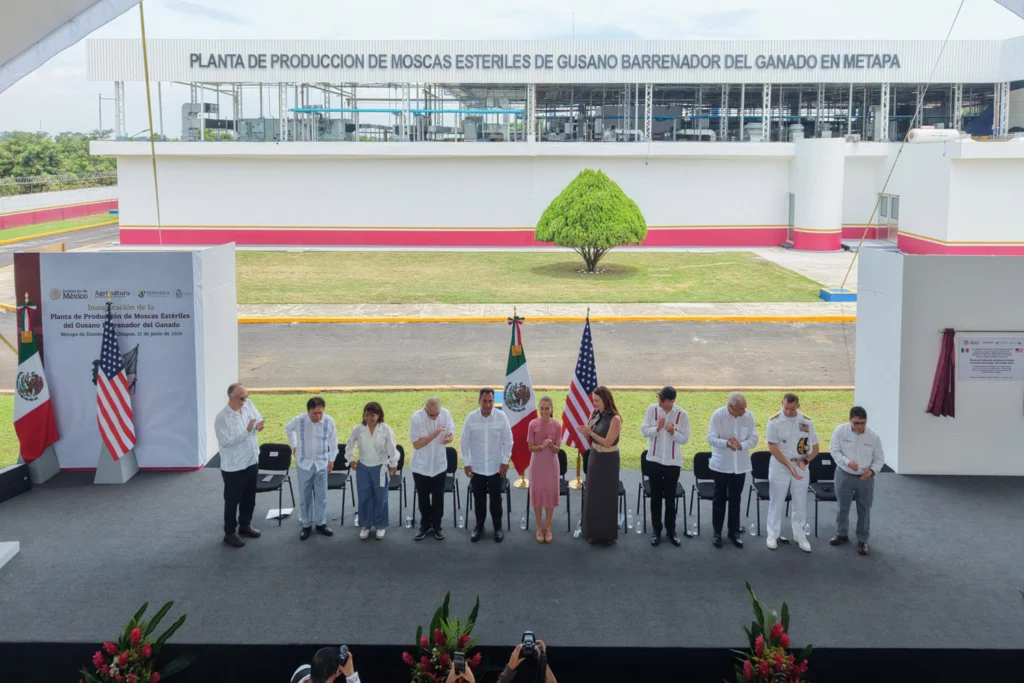
Mexican President Claudia Sheinbaum, together with US Secretary of Agriculture Brooke Rollins, inaugurated a sterile fly production plant this Saturday in the state of Chiapas, in the southeast of the country, whose “strategic” objective is to combat the screwworm on both sides of the border and in Central American countries.
[U.S. and Mexico Complete Final Round of Talks Ahead of USMCA Review: Mexico and the US Inaugurate Sterile Barren Worm Fly Plant in Chiapas](https://www.telesurenglish.net/mexico-and-the-us-inaugurate-sterile-barren-worm-fly-plant-in-chiapas/)
“Panama, Mexico and the United States unite in the same cause. This plant represents much more than an infrastructure project, it represents the capacity of science to offer intelligent, effective and sustainable solutions,” said the president during this inauguration in the municipality of Metapa de Domínguez.
In her speech, Sheinbaum elaborated that the relationship with the northern neighbor must be based on “very clear principles”: mutual respect, dialogue, cooperation and recognition of sovereignty.
“From Chiapas, where Mexico begins, we send a message to the world: cooperation between sovereign countries will always be more powerful than confrontation when it comes to protecting the well-being of our peoples,” the president concluded in a context marked by tensions between the two countries.
Inauguración de planta productora de moscas estériles. Metapa, Chiapas https://t.co/YRPBn8GrD2
— Claudia Sheinbaum Pardo (@Claudiashein) June 27, 2026
For their part, Rollins and the United States Ambassador to Mexico, Ronald Douglas Johnson, agreed that the inauguration of this work will allow – almost five decades later – both nations to combat the screwworm again.
The US official highlighted Sheinbaum as an “extraordinary ally”, with whom, in 12 months, the plant financed by the US Government was built, whose investment will amount to 83.8 million dollars.
“We are commercial partners and our agricultural relationship helps feed millions of families on both sides of the border (…) so this problem (of the screwworm) is not just an agricultural issue, it is a food security issue,” said the US foreign minister.
This plant will progressively reach a production of one hundred million sterile flies per week, the volume will be added to the Pacora plant in Panama to reinforce the control and eradication strategy of the parasite that reaches from the north of the continent to Central America.
In the facilities, sterile flies will be bred using “advanced technological processes” and thus act as a biological shield, since when the insects are released they will mate with wild flies without leaving offspring and thus “nip the reproductive cycle of the pest in the bud.”
“These sterile flies are to the screwworm what vaccines were in the fight against covid, without them we can mitigate the problem, but only with them can we truly eradicate the plague,” said the coordinator and advisor for International Agri-food Affairs, Julio Berdegué.
The Secretary of Agriculture and Rural Development (SADER), Columba Jazmín López, reported that, to date, 5.3 million heads of cattle have been inspected, more than 84,000 shipments verified and almost 7,000 million sterile flies released.
The plant is part of the joint strategy of Mexico and the United States to contain the advance of the screwworm, a parasite whose larvae feed on the living tissue of warm-blooded animals, mainly livestock.
On November 21, 2024, a few days after Claudia Sheinbaum assumed the presidency, the first case of screwworm in cattle was registered in Chiapas.
Since then, the state has become the epicenter of the plague, with 7,123 accumulated cases, according to agricultural authorities.
The spread led the United States to impose temporary restrictions on imports of Mexican livestock, with losses for the livestock sector and new commercial frictions between both countries.
From teleSUR English via This RSS Feed.
That headline definitely took a second to parse.