

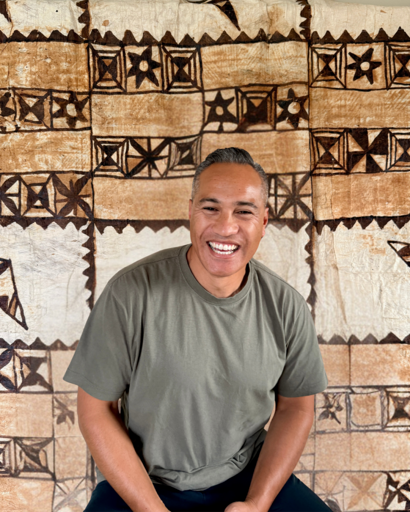

Jason Tiatia, author of Sāmoan Made Simple, is a former NZ Sevens Rugby player who later played professional rugby in Italy and France. (Photo: Shiloh Amituanai)
Jason Tiatia’s mum was right when she told him that speaking Sāmoan would bring him blessings one day — and the proof of that isn’t only in his first book, Sāmoan Made Simple*.*
It’s also in his appreciation of how language can strengthen identity and belonging and deepen connections — and, as he found during his years of playing professional rugby in Italy and France, where he picked up some conversational Italian and French, it could also make life more interesting. Here’s his talanoa with Dale.
Talofa lava e te rangatira! Gun sportsman and now a gun author! Good on you, brother. Can I start by asking your full name? And would you be kind enough to speak of the kōrero behind some of the ingoa you carry?
My name is Jason Apelu Tiatia. Apelu is Sāmoan for Abel, and it’s my grandpa’s name. Tiatia is a matai or chiefly title from Lalomanu in Aleipata, Sāmoa — my dad’s side.
Mum thought I needed a Pālagi name when they first arrived in New Zealand, so that’s where Jason comes from. I don’t like Jason. I prefer Jase, and that’s what my mates call me.
You mentioned your mum and dad came over, so I’m assuming you’re New Zealand-born. Let’s acknowledge your mum and dad, please, and all the villages that you refer to when you stand to deliver your pepeha.
My dad is Lavata‘i Tiatia, and he’s from the villages of Lalomanu and Ulutogia in Aleipata, which is on the main island of Upolu. He also represents Sa‘anapu and Safata, which are my grandparents’ villages. And then my mum, Sara, is from Nofoali‘i in A‘ana, not too far from the airport.
They travelled to Auckland in the late 1960s or early 1970s, and then migrated here to Christchurch, where I was born and bred. I grew up on the east side of the city. Our street had maybe 10 Sāmoan families living in it, and we loved being Pacific in the east.
So, Christchurch-born, but Sāmoan-hard. I married my high school sweetheart, Tate. She’s Ngāti Kahungunu.
It’s interesting that you ended up in Ōtautahi. How and why did the whānau move there?
It was all mahi. Dad came down to Christchurch first. He got an apprenticeship with the railways, then became a bus driver, and that’s when Mum came down from Auckland. They built a house with a couple of friends. We lived in Aranui for a long time. And then, after I came back home from playing rugby overseas, we started a new life with them. They live with us now in Burwood, so we’re still in the east.
So the main reason was jobs, but also to get out of Auckland, which was a bit challenging at the time, especially with the Dawn Raids. They were looking for new opportunities and people, so they migrated to the south, even though it was colder.
And I’m so thankful that they did, because we have a strong foundation here. Back then, the phone book had only one Tiatia in it, and that was us. And now there are so many Tiatias here. We love that more and more of our families are living in the South Island, and especially Ōtautahi.

Jason and Tate (Ngāti Kahungunu) on their wedding day in Ōtautahi Christchurch, in 2006. (Photo supplied)
I’ve had many rich kōrero over the years about the sacrifices that our parents and grandparents made to create better opportunities for those who follow in their footsteps. And I suppose your success on the rugby field and the education career you’ve pursued — this is what they dreamed of. The fact that they built their house with their own hands is pretty special. It says a lot about the character of those who came from the islands to try a new way in a foreign land, āe?
Absolutely. Our parents had this strong work ethic, often working two or three jobs just to pay the bills and feed the family. I still remember eating plain white bread with no butter. It was a really simple life, but we were happy.
I’m an only child, which is pretty rare for a Sāmoan family, but Mum couldn’t have any more kids after me. She keeps saying she got it right the first time, which is pretty cool. Even though she really wanted a daughter.
She took me everywhere and exposed me to the community. I had a really great upbringing. That’s the thing about that generation. They instilled in us values that we want to pass on to our own kids and whoever we come into contact with.
The main thing for that generation was service, and making sacrifices so their kids would be better off than them. I expect my kids to be way better than me in this world where you’ve got to navigate and move quickly and be agile.
Can we talk about reo at home for you, because we know that for a lot of urban-raised Pasifika people, it was commonplace to speak the reo in the whare but not at school. How did the language transfer and transition occur in your house?
When Mum and Dad got married here at the PIC church in Christchurch, the minister said: “When you have your kids, make sure you speak the Sāmoan language in your family.” That stayed with Mum the whole time, and if I started speaking English at home, she’d tell me to speak Sāmoan. I would plead with her: “But Mum, they call me fresh at school and a fob, and I really want to socialise in English.” And she’d say: “Well, you can do that later. But in this home, it’s fa’a-Sāmoa.”
You hate it at the time as a kid, but when you grow up, you realise: “Oh, there’s a big picture here.” Your identity is your strength. And I’ve seen it firsthand in sport, where I’ve been able to connect with others or translate for friends.
I remember at school, I translated something for another Sāmoan boy. He had no English, so he appreciated that, because he just didn’t feel connected to the school. And I was thinking: “Far out, I’ve done something special.”
Mum and Dad really instilled in me the Sāmoan way, the fa’a-Sāmoa, and going to the EFKS Sāmoan church really helped, too. The youth groups and the customs were strong in those spaces. But today it’s a little more challenging, of course, with so many other options.
That’s why I loved the fact that my parents chose to speak Sāmoan at home. You’ve gotta take your hat off to them. They had no English, but they could still get jobs, build a house, get a car, and navigate the school system. I think that’s amazing.

Jason was in the NZ Rugby Sevens team for five years. He’s pictured here in 2004, before he left to play for clubs in Italy and France. (Photo supplied)
In the 1970s, people looked down their noses at the new arrivals from the Pacific. It was pretty cruel, to be honest. And even though you were born in Ōtautahi, I suppose you couldn’t escape that bias. Did you cop some of that as a young fellow?
Oh, absolutely. You may not realise it as a kid, but then you reflect back on some of the things that were happening to us as Pasifika people. It was normal to make sure your eyes were down, and you were extra cautious about how you behaved. Even using the English language was risky. If you said something that was different, you’d be ridiculed or bullied.
But for me, I’m a happy-go-lucky guy. I’d just walk away and laugh about it and focus on something else. Some of my family or friends would confront it face-to-face, and maybe even hand-to-hand. But the real challenge was educating other people that this wasn’t right.
Back then, it was also pretty challenging in the workplace. My dad had to change his first name to Fred. I asked him once: “Who’s this guy, Fred Tiatia, who gets all this mail, Dad?”
“Oh, that’s me, son.”
“Why are you calling yourself Fred?”
“Because it’s easier.”
I was like, okay, maybe that’s just the way of the world that you have to change your name so you can get by. But I knew it wasn’t right.
Now we’re so proud that our kids have the longest names, full of meaning. We have ways to represent ourselves now — stories, ancestral connections, and all those things. Slowly, slowly, there’s some space for people to be a bit more open-minded.
Tell us how you became involved in sports education.
I was looking at what to do after school, and sport was number one. So I studied to be a fitness instructor and personal trainer, and I continued that through correspondence while I was overseas in Italy and France. When I came back, I was looking at becoming a teacher, or at least a tutor at tertiary level. I got a diploma in adult teaching, and then a bachelor’s in sports and coaching management at Otago Polytechnic. That’s where I learned to teach.

Jason graduated in 2019 with a Bachelor of Applied Management (Sports Management) from Otago Polytechnic. (Photo supplied)
Aranui had a strong Māori population, too. I suppose you couldn’t escape the issues of Māori language revitalisation, either. It was different for you because you had this strong sense of identity fostered at home, but you can see the need for language revitalisation in an urban environment, particularly as tangata whenua try to regain lost ground.
What parallels do you see in the approaches that you’re taking to share aspects of the reo Hāmoa (Sāmoa) with what’s happening in the Māori revitalisation space?
I’m very fortunate. Aranui High School had a whānau class at the time. They had a Sāmoan class as well. So it wasn’t something that was hard for me to understand.
When you’re playing overseas, if you’re playing in France, you’re expected to speak French. In Italy, Italian. When I came back to Aotearoa, I realised I needed to start speaking te reo. My wife is Ngāti Kahungunu-hard, so she was always saying: “Hey, this is our land. Make sure you speak the language.”
As Pacific people, we have to cultivate our own identity, but also respect the people of the land. We also have that connection with Māori because, once upon a time, we walked alongside each other.
I’ve learned so much from te reo and the Māori worldview, and that’s helped me to grow in my own language. We’ve encouraged our kids to use both languages, and they’re now trilingual. I’m so proud that they can jump from one to the other. They’re able to use concepts from both cultures and come up with their own solutions for what suits them as young people.
People have tried so many times to separate Māori from Pacific people, but we know now more than ever that we’re stronger together. And that’s my passion, to make sure my kids are prepared for both worlds.

An ‘ava (kava) ceremony in 2025. Daughter Amaleila is the taupou in the front doing the palu ‘ava, and son Amasio is to her right at the back. (Supplied)
Let’s celebrate your sporting endeavours, too. You were a NZ Rugby Sevens player before you played in Italy and France, and would have been exposed to other cultures during that time. But it might have compromised your ability to use your mother tongue. How did you maintain your reo for the years that you were away travelling? Use it or lose it, as the saying goes.
Really good question. I think when you’re young, and you’re focused on your career and enjoying life, you don’t really think about it. It’s only when you come back to the community, or you speak to your parents or go to church, that you realise: “Oh my gosh, I actually can’t remember that word,” or “I’m not sure what the right practice is here.”
Like you said, if you don’t use it, you lose it. I was trying to learn French for the first six months I was in France, because if you didn’t speak it, you were pretty much stuck in a smaller community of English speakers, and you hung out with the same people.
But we were there to experience the whole culture, the language, the food, how they think and breathe, and how they build relationships. And if you had the language, man, you could see that was a big connector. You could have deep and meaningful conversations.
I still remember a time when Radio Sāmoa called me and my cousin while we were in Italy. We were playing for the same team, in a place called Parma, where they make prosciutto ham and parmesan cheese and beautiful wines. And they rang us and asked us what we were eating and doing, and if there was any Sāmoan food. It was all in Sāmoan, and my cousin froze because he could understand the language but couldn’t respond.
That’s when I realised we needed to be speaking Sāmoan more, because that’s our real identity. And actually, there were heaps of Sāmoan players overseas, so we could speak Sāmoan among ourselves and use some of the banter words and jokes and storytelling — and that was an important part of keeping the language alive.
I was in Europe for about four years. Two years playing in Parma and two years in Grenoble, in France. I loved my time there, but now it’s all about getting back to our communities here.
I take my hat off to you with your authorship and other kaupapa that you’ve been involved in. I work a lot with Scotty Morrison, and I can’t help but note the similarity of approach with your book and Māori Made Easy. Is this your first book, Jase?
Correct. I’d been teaching the language at Christchurch Polytechnic (now called ARA Institute of Canterbury) and in the community, and then I got a phone call from Penguin. They asked if I’d be keen to make the Sāmoan version of Māori Made Easy. And I was like: “Are you sure you’ve got the right guy? Because there are a lot of Sāmoan teachers out there who could do this.” But they said I’d been recommended, so I’m like: “Okay. I’m a yes man, so let’s have a go at it.”
The first two people I called were Scotty and Stacey. And they said: “Look, have a go. Honestly, just do your best. Make sure you get the right people around you to moderate, to edit, to look after your work.” They’ve been my mentors behind the scenes.
They’ve always said to people who are learning te reo: “Engari te ngaringari,” which means “something is better than nothing”. What you produce will get better and better as you go, and hopefully, the next version, or whoever takes on this pathway, will carry that on.
I’ve always sought to teach the language in a way that’s uplifting. Our Sāmoan people can be very critical and proud. We don’t compromise our culture or language. But the evolution of our Sāmoan language needs to be there, too. And this is where I come in. Whatever I know, what’s new, what’s hot, and what’s needed for our community, that’s what I share.
I remember going to a Pacific conference, and there was a Sāmoan orator there. And I thought: “I’m going to ask this guy to be my mentor or coach.” We were at a social event, and I went up to him and said: “Talofa. Mālō le soifua, afioga. O fea toa le faga?” Which means: “Sir, where are you from in Sāmoa?”
And he said in Sāmoan: “If I told you, you wouldn’t even know, would you?”
And I was thinking: “What just happened here?”
I walked away from that conversation like I was five years old again. Coming back to Christchurch, I asked some other Sāmoan experts: “Why do people do that? Is it a Sāmoan thing?” My mentor here in Christchurch basically said: “Look, there are people who think they’re gatekeepers. They hold on to the knowledge because they’re afraid it will be taken from them. They’re just protecting themselves.”
Those are people you don’t want to be mentored by. You want people who want to give confidence to others. That’s the type of mentor I want to be. And I hope Sāmoan Made Simple will help build confidence in our young people, rather than them feeling whakamā or carrying that trauma of not having a go, because they have every right to be Sāmoan in any way possible.

“I hope ‘Sāmoan Made Simple’ will help build confidence in our young people, rather than them feeling whakamā or carrying that trauma of not having a go, because they have every right to be Sāmoan in any way possible.” The book, published by Penguin Books, was launched in May. (Photo supplied)
So many of us have these mixed relationships now — Tongan, Māori, Sāmoan — and I’m very conscious that some of the kupu that exist in the Sāmoan language and Tongan language could be very helpful as a way to acknowledge the old people in the room in their own tongue. So, you know, you might not be seeking intense fluency, just a basic understanding of some of the touchstones for respect and manners, which would be useful for all of us.
So, I’m hoping it’s not just young Sāmoans who will be picking up your book, but people of many cultures who are conscious of the environment we find ourselves in, where there are people from Sāmoa and the wider Pacific here.
That’s right. I mean, we know our young Pacific population is vast. They’re young, they’re brown, and they’re proud. We’re successful in our own right, whether it’s in politics, sports, music, or the arts, and I think the language will stay alive if we keep using it.
I went to a pōwhiri in Taranaki, and one of the rangatira spoke Sāmoan. My eyes and ears lit up, as he used these proverbs and salutations in the correct way to formally greet a Sāmoan orator. And then he broke out in te reo, and I was thinking: “Wow, this is powerful stuff.”
And from then on, I’ve used te reo in many ways, whether it’s in a pōwhiri or in a mihi whakatau. It’s a way of showing the connection between our people, but also it shows a lot about the person. It’s not just ticking the box. It’s part of “le vā fealoa‘i”, which is our relationship.
A lot of non-Pacific people are keen to learn the Sāmoan language because it’s the third most-spoken language in Auckland, and it’s a growing language here in Aotearoa. We can see the beauty of that when they use the language here, especially when they come into Sāmoan spaces and communities.
Tongans, man, they do it, too. Their language is really strong, and they’re proud of it. And if you can use their language, you’re gonna make so many more friends and stronger connections with the community.
So, yes, those things are in the book, about when to use certain language. There are lots of activities in the book, and there are also online resources that readers can use for audio pronunciation. There are so many cool things that people are putting out there on TikTok, Instagram, and YouTube, too, to support the language.
What do the fans think of Jase the author, instead of Jase the stepping swerver?
The feedback so far has been really positive. I’m also prepared for the not-so-good feedback. Like I said, we’re very critical in our community, but at the same time, I’m focusing on the people who really want to learn the language.
I’ve spoken to a couple of professors, and one in particular, Dr Dion Enari, who’s done some research on Pacific people in sport. I wasn’t sure how the book would be received, and he said: “Look, those who criticise, you’re a threat to them, but also those who criticise, the book isn’t made for them.”
I take my hat off to people like Dion, who’s outspoken and has the expertise to support his views. Not only for encouraging someone like me who’s going on this new journey as an author, but also generally encouraging others to go outside the box, because there’s more than one way to be Sāmoan or Pacific or Māori.
I think that’s what our ancestors would say to us. You know, don’t just be the typical thing, but go out and exceed expectations and keep navigating that space.

The Tiatia ‘āiga. Front: Son Amasio with Jason’s parents, Sara and Lavata‘i Tiatia. Back: Jason and Tate with daughters Amaleila and Amanika. (Photo supplied)
It’s been a pleasure talking with you, Jase, and I look forward to more contributions, because next there might be Sāmoan Made Not So Simple. Is there anything else you want to add, bro?
Just a few acknowledgments. I said at my book launch that although I’ve got my name on the book, it’s more of a “we” thing than a “me” thing.
So I want to thank all my community who’ve backed me, particularly in Christchurch. Especially Lepule Leuma Gali, who helped me edit the Sāmoan parts and gave me some tips and suggestions. And FAGASA, the Sāmoan Educators Teachers Association, for their work and support.
And, of course, my family. My aunties and uncles, and especially my parents, who’ve always had faith in what I do. And my wife, Tate, and our kids — Amaleila (19), Amasio (17), and Amanika (13), who also helped put this book together. Their voices are on the audio parts. So it’s one of those legacy things.
(This interview has been edited for length and clarity.)
The post Jason Tiatia: Your identity is your strength appeared first on E-Tangata.
From E-Tangata via This RSS Feed.