

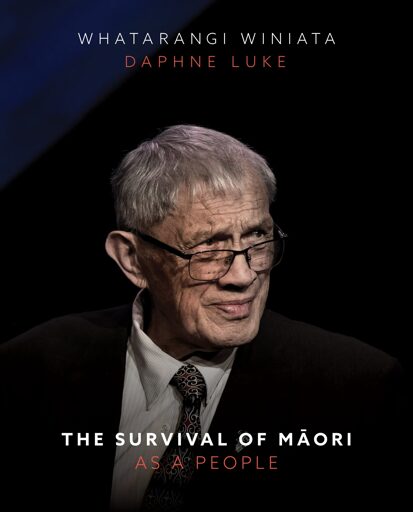

Professor Whatarangi Winiata, who passed away on June 3, 2026, aged 90. A giant of the Māori world, he was described as “he tahiwha hikuroa”, a taniwha with a long tail, and “a towering intellect with a soft voice”. (Photo: The Survival of Māori as a People, Huia Publishers)
Professor Whatarangi Winiata was a giant of the Māori world, writes Tainui Stephens. His enduring legacy is cultural, educational, and political. He was a taniwha with a very long tail. His tangihanga showed us why.
“Hey, Matua, do you want a peach crumble?”
The question came from a polite young teenager standing at the end of a long buffet table. It was festooned with stunning savoury kai, but the eager rangatahi was in charge of pudding and couldn’t wait to use her big spoon to fill my plate. I had to have seconds of the delicious beef stew first, and then I let her. Auē! So good.
At a tangihanga, partaking of kai isn’t just a delicious act of sustenance. It’s a ritual in which food erases the essence of death, allowing you to return to the world of the living.
I was at Ngātokowaru marae in Hōkio to farewell an astonishing man of Ngāti Raukawa and Ngāti Pareraukawa. Whatarangi Winiata started out as an accountant but ended up as an architect. One of our greatest. He designed magnificent premises for the Māori mind.
He was the driving force behind Whakatupuranga Rua Mano in 1975, a tribal survival strategy for the confederation of Te Ātiawa, Ngāti Raukawa, and Ngāti Toa — or ART. His articulation of the vision of the elders of the time inspired similar existential action in many other tribes.
Whatarangi’s thriving legacy was on my mind earlier that day, as I drove to the designated parking at the local golf club. The marae access was too limited for the hundreds of cars, utes, vans, and buses that would deliver thousands of mourners. I joined the swelling crowd waiting for the shuttle service and saw many leading thinkers, speakers, and kaumātua of the Māori world. There was a cross-section of ages and iwi. Every one of them was well aware of the prodigious mana of the man they had come to grieve and celebrate. They, too, are a vivid part of his legacy.
I was enjoying a catch-up with a friend when a convoy of empty vans arrived for pick-ups. A call went out to the crowd, saying that any speakers for the pōwhiri had to take the first van. The 9am pōwhiri was only half an hour away. Decisions were made on the spot, and the van filled up with people who had words on their minds. Me and my Whanganui mate were gently ushered to the next waka for kaumātua. He’s better than I am at saying no, but he still ended up on board.
At the drop-off for those who could walk the short road to the marae, a treat was in store. The way was lined with multiple Tino Rangatiratanga and He Whakaputanga flags, familiar to anyone who drives through the local Kuku settlement on the highway. Ngāti Tukorehe had lined the route to the tangi with their symbols of resistance and unity. Whatarangi was all about resistance to oppression and unity through a return to the marae. It was a building complex that the architect cherished above all others.

“Ngāti Tukorehe had lined the route to the tangi with their symbols of resistance and unity. Whatarangi was all about resistance to oppression and unity through a return to the marae.” (Photo: Tainui Stephens)
Several hundred of us converged near the entrance to the marae. Uniformed and highly efficient Māori wardens guided us to seating, water stations, and toilets.
I manoeuvred my way through the big crowd, looking for my sister and nephew, and came across some of the orators who were in the first van. They stood in small groups defined by the iwi or organisation they represented. They needed information about the order of speakers. Their eyes scanned all the other small groups to see who would make the first move.
At some point, a voice of undisputed mana would grab the people’s attention. A dignified kaumātua in an immaculate suit soon stepped forward to do so. He had no need to persuade anyone. We simply awaited his thoughts. He told us he would be near the top of the speaking order, because his group was bringing the kawe mate or memory of one of Whata’s closest longtime colleagues who had died the previous week.
A plan was set for the order of speakers. Anyone with cash or preloaded envelopes swarmed towards the one designated to be last. His job was to put down the koha. His challenge was to have enough pockets for all the love.
I found my sis and my neff, and we stood before a short tunnel that would lead us and a thousand mourners into the domain of Hine-nui-i-te-pō, the deity of death.
It was, in fact, a cleverly scaffolded marquee that would shield us from the incessant rain. We were poised to make our way to the remarkable man lying in state in the meeting house. He had lived a long life of service that had touched us all. His equally remarkable children and their families were beside him, with their own veils of sadness, awaiting us.
The power of those facts was driven home by the compelling chorus of kai karanga, whose words rippled in overlapping layers. A quivering wall of sound grew as visitors were drawn into the tunnel. Each voice of these learned women wove a cloak of tears from the grief of the moment.


“There was a cross-section of ages and iwi. Every one of them was well aware of the prodigious mana of the man they had come to grieve and celebrate. They, too, are a vivid part of his legacy.” (Photo: Libby Hakaraia)
We moved forward. The women’s voices on our side immediately rose in response. The confines of the tunnel amplified all the keening and weeping. The sound was intense and immense. It was one of the most electrifying things I’ve ever experienced. It focused every Māori heart on why we were there.
In time, we all took our seats, some inside the whare and some in the tunnel. A PA system carried the speeches so all could hear. Many other people who’d already been welcomed stood in groups around the marae, listening in. Each group of manuwhiri offered up to four hours of oratory. Over the full duration of the tangi, details of Whatarangi’s life would be retold in many ways through speech, sermon, and song — in public with the paepae, informally in the whare kai, or privately in the quiet moments.
Whatarangi was fortunate to have lived a long and fruitful life. He passed away on June 3 at the age of 90, surrounded by his loved ones. Yet many are taken cruelly before their time. Some deaths are lonely. Speeches also referred to others who had just passed on, some in the most tragic circumstances. Always, when we gather to farewell the dead, we’re sensitive to anyone coping with their own terrible loss.
The personal and the profound of any person’s life are laid bare when they are mourned at a tangihanga. It’s the ultimate chance for those who have lived with the deceased to measure a life. The good and the difficult will be traversed. The lows and the highs will be revealed. The best and the most loving will prevail.
Scores of speakers stood at Ngātokowaru. Some of our most eloquent and witty. Connections were celebrated. All the metaphorical and rhetorical flourishes were evident. Histories, genealogies and yarns were uttered and hung on the walls of the whare, where they remain. Whata was referred to as “he taniwha hikuroa”. He truly was a taniwha of our times, with a long tail reaching into the future through our people. He warranted the attention.


“As each farewelled him with karanga, haka, or thankful thoughts, we were all of one mind about what we knew to be true. If it wasn’t for the man in that box, we wouldn’t be able to do what we were doing in that very moment, farewelling him in our language and with our traditions.” (Photo: Libby Hakaraia)
In 1973, after a successful academic career in the US and Canada, the professor of accountancy returned home with his wife, Francie, and their young family. Their minds had been expanded by their interactions with Indigenous nations on Turtle Island.
One of the core beliefs of the Whakatupuranga Rua Mano vision was the revival of te reo Māori. At that time, of about 30,000 members of the ART Confederation, only one person under 30 spoke the language. In 1974, at a language regeneration conference in Auckland, Whatarangi was told by a linguist that “the horse had bolted” and that the language wasn’t coming back. Whatarangi refused to accept this. He then asked the expert what it would take to revive the language. He was told te reo might return if the children spoke it better than the parents, and if it stayed that way for five generations.
Within three Christmases, Whatarangi’s children spoke te reo better than he did. The children have extended that commitment within their own families. Over 50 years, the entire ecosystem created by Whakatupuranga Rua Mano has fostered a healthy Māori-speaking population within the Ōtaki community and far beyond. We know that the Māori language is absolutely central to our ability to manage our lives in a Māori way.
Whatarangi was a visionary architect who knew how to structure institutions to be Māori in form and function. He brought an accountant’s eye for scrutiny to what was described at the tangi as his “towering intellect with a soft voice”. He deployed unassailable logic and an irresistible spirit.
His efforts led directly to the creation of Te Wānanga o Raukawa, which in turn inspired other centres of Māori intellectual excellence. He was behind the establishment of Te Taura Whiri i te Reo Māori. He changed the constitution and thereby the place of Māori within the Anglican Church. He was the first president of the Māori Party.
The layers of our society that Whatarangi touched over his long life are still evolving. His influence made them wider and deeper. The confidence of his own people is surging. The superb planning and execution of this most complex of human interactions, a tangihanga, was clear evidence of that.
I watched Whata’s coffin leave the whare. He was borne out in honour, surrounded by hundreds of people who loved and respected him. As each farewelled him with karanga, haka, or thankful thoughts, we were all of one mind about what we knew to be true. If it wasn’t for the man in that box, we wouldn’t be able to do what we were doing in that very moment, farewelling him in our language and with our traditions.
He knew that te reo Māori is a treasure, and that people remain our greatest resource. One of the aspirations of Te Wānanga o Raukawa is expressed in this whakataukī: “E kore au e ngaro he kākano i ruia mai i Rangiātea.” I will never be lost, for I am a seed sown in a realm of vast potential.
Every single one of us is unique. We’re incredibly lucky to be here. The various combinations of our parents’ DNA meant there were millions of possible ways to make each of us. At birth, we’ve already won the most important raffle there can be. But we don’t realise that until later, as we unfurl over time and become ourselves.
We know what Whatarangi Winiata’s life story was and what he gave us. I wonder what the young kōhine in charge of the pudding will become. What will her story be? Will she, too, be a taniwha with a long tail? She has every right to be.

The Survival of Māori as a People, by Whatarangi Winiata and Daphne Luke, published in June 2022 by Huia Publishers, is a collection of 25 papers by Professor Whatarangi Winiata and co-authors spanning more than 40 years, commenting on Māori spirituality, social development, education and political affairs.
In 2022, Matua Whatarangi published a book called The Survival of Māori as a People. He wrote simply: “The way to reclaim our rangatiratanga is to live as if we never lost it.”
At his tangihanga, we saw the full flowering of that rangatiratanga. We experienced powerful acts of love and humanity. We enjoyed impressive organisation and flawless hospitality. The very same thing is happening, right now, in every corner of the land where our people are mourning the loss of one of their own. They’re weeping and speaking to their dead and to each other. They will bow their heads in devotion. They will break bread together and start anew.
If we are to survive as a Māori people, there must be honour when we die. It seems to me it’s working so far. Thanks, Matua.
Ko koe tērā kua riro ki tua
Haere ki tō makau
Haere ki te pō nui ki te pō roa
Ki te pō matirerau, te whaiwhai ariki
Oti atu ai e . . .
Nau mai e te ao.
Tainui Stephens, of Te Rarawa, has been fully engaged in the film and television industry since 1984, working with a range of genres and content. He is particularly attracted to compelling Indigenous stories that critique and celebrate the human condition. Tainui lives in Ōtaki with his wife and fellow filmmaker Libby Hakaraia. Together, they and a small whānau team run the Māoriland Film Festival.
The post Whatarangi Winiata: He taniwha hikuroa appeared first on E-Tangata.
From E-Tangata via This RSS Feed.
You must log in or # to comment.
Ah yes. War and slavery. Such beauty and tradition. Cosplaying asshats.
