

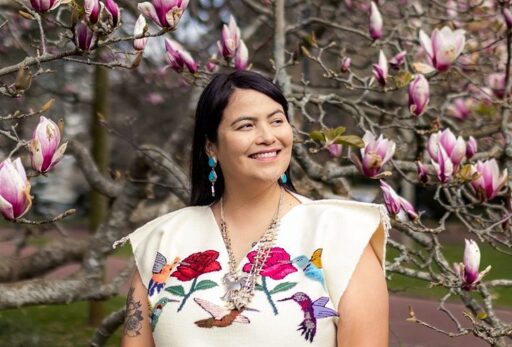

Sandra Yellowhorse, a Diné woman from New Mexico, came to study in Auckland after being inspired by the work of Māori scholars. She is pictured here in Navajo dress — known as a Bííl — woven by master weaver Florence Riggs, which represents her family’s Diné story. (Image supplied)
Studying in Aotearoa led Sandra Yellowhorse, a Diné woman from New Mexico, US, on a journey to reclaim her ancestors’ knowledge of disability and to use her own experience as a mother to help others caring for autistic children.
The lands I grew up in couldn’t be more different from the whenua that nurtures me today. I’ve heard people say that the sky in New Mexico seems bigger and bluer than anywhere else in the world, and I tend to agree.
I grew up alongside stunning ochre ridges that lit up at sunset, in high-desert country dotted with sagebrush. The monsoon blessings not only brought much-needed water but also produced a fragrance like no other — red earth, sagebrush, sun, and rain entwined together. One of my greatest taonga is a small bottle of pressed sagebrush oil, given to me by a childhood friend. I wear it on days I miss home most.
I never imagined that I would learn to be anywhere other than my homeland of Diné Bikéyah (Navajo land).
Born into humble circumstances, we didn’t have much, but my father made sure to invest in a subscription to National Geographic for his children. I’ve been in love with the world since those early days of photographic enchantment. In elementary school, I remember writing a list of places that I wanted to visit, and Aotearoa New Zealand was one of them.
Like many Indigenous and Native children of my generation, I didn’t grow up in a home where higher education was a regular topic for discussion. Few Native families I knew had access to information about university, nor the means to pave a pathway there for their children. I’m glad to say this is now changing, but when I attended a small college branch in my hometown, it was out of necessity.
At the time, I was a young mother, working long, painful hours as a pizza delivery driver, earning the outrageous minimum wage of just under $3 an hour because of the inequitable tipping culture in the US.
My young child had recently been diagnosed with autism. I was overwhelmed by the negative, deficit-based characterisations of this way of being, as I struggled to fight for her rights in the school system.
Choosing to pursue higher education allowed me to take a momentary breath from the sinking weight of poverty. I also saw it as a matter of justice during what was a devastating time in my life.
I was Indigenous, and I felt easily dismissed because of my lack of education and social standing. The hardship of these early days was made worse by being expected to be thankful for what little we were given.
I quickly learned that higher education gave me skills I desperately needed. I needed to understand the law, how to read it, and what steps I had to take in bureaucratic systems that are difficult to navigate.
I needed to learn how to speak with professionals who refused to hear me, and I needed to find a way to resource and build a world of support around a child who was being left at the mercy of systems that saw her through the lens of stigma and cost, as an allocation of funding, not as a human being.
There were countless days I cried in my car, angry at myself for not getting my point across in important meetings that never seemed to end well.
I felt unheard, and defeated.
I would replay difficult interactions with the school in my mind. I would tell myself: Speak! Tell them! They don’t understand. Tell them who she is beyond her diagnosis, and beyond the “challenges” that educators and school officials focus on. She is deserving of an education, of support, of a place to be. She is deserving of it all.
Why can’t I speak? Why am I so afraid? Tell them who she is!
I needed them to know that she is not just an autistic person, whose identity is defined solely by diagnostic criteria. I knew she was more than this before I could articulate it in ways they would understand.
In our Diné world, my daughter is Nihookáá Diyin Dine’é — a five-fingered Holy Earth Surface Person. She is the descendant of ancestors who brought knowledge of the universe into the world we know today, the Glittering World, through a bamboo reed.
She is Kiinyaa’aani, one of the first clans of the Diné people. She is a leader, an artist, and a fierce and powerful Diné person. She is connected infinitely across time and space, to people, lands, water, and rain, to ancestors, and to an abundance of cousins and mother-aunties who love her dearly.
She is a treasured child of the Diné people. Because this is who she is, she will always have a place to be and belong, within a system of relationships that will live on forever, beyond us all. This is what I believe it means to live as a Diné person.
These foundations have been the anchor and driving force for my work today as a researcher at Waipapa Taumata Rau*,* the University of Auckland, where I dedicate myself to elevating Indigenous perspectives that combat the social stigma surrounding disability and autism.
I work alongside autistic people, their families, and parents like me — who need to be heard because we know other ways of thinking about difference, care, community and responsibility.
I also try to reach teachers before they enter the classroom, to introduce cultural perspectives on disability and care systems that foster understanding, inclusion, community and a sense of belonging — all of which mean the world to diverse learners.
Today, I find healing and a sense of purpose in working with educators to combat the colonial narratives that saturate systems, where people are still treated as financial and service allocations.
I try to bring us back to a place of sacred identity and reciprocal care for one another — to build a world that loves, respects, protects and cares for all our diverse learners and their many ways of being. A world that is just.
I never planned to move to Aotearoa.
But I was passionate about land-based learning for Indigenous disabled learners, and I knew Aotearoa was the place to do it. I’d been exposed to Māori scholarship throughout my educational journey. In 2017, during my master’s programme, I had the opportunity to travel here and met several Māori scholars, who encouraged me to connect with Professor Te Kawehau Hoskins, head of Te Puna Wānanga, the School of Māori and Indigenous Education. Te Kawehau agreed to supervise my PhD study.
My family and community helped raise funds, and with two scholarships, I moved across the world with my daughter. From here, we experienced the life-changing impact of manaakitanga, under the guidance and care of mana wāhine and tangata Tiriti scholars.
They encouraged me to recover the ancestral teachings of my Diné people, and to explore how our ancestral wisdom approaches disability.
I never imagined this would come full circle. I’ve been able to serve my Diné people from 7,000 miles away from home, by sharing how Diné knowledge and kinship systems strengthen social relations and provide the care and belonging needed by disabled and neurodivergent people globally.
My work comes at a time that feels so precarious. DEI (diversity, equality and inclusion) initiatives are being rolled back across the world, and there is a push towards hyper-independence and disconnection from our origins, relationships, knowledge, and responsibilities to one another. This only deepens the divide, both back home and in Aotearoa.
Yet, this is a place of world-building. This whenua, and the amazing people I’ve met on this journey, have nurtured me and my daughter in abundant ways.
The work I do today exists because of these life-changing relationships. I also believe it is because of kaupapa Māori, and the incredible example te ao Māori has set for Indigenous peoples globally. Māori have led the way for so many to step into their own cultural realms to transform systems and knowledge, and to shift the power relationships that continue to keep us marginalised.
It’s because of the manaakitanga I’ve experienced in this special place, where I’ve been cared for as manuhiri and tangata Tiriti, that I have become one of the next generation of Indigenous scholars.
I continue to learn from my daughter and live in gratitude for how she teaches me what it means to be authentically oneself, free, rooted in relationships, and truly self-determined.
I still hear echoes in others’ stories today of her beginnings. I hear how disabled people and their families are treated like burdens, presumed to be “taking away” from others.
These stories break my heart. They make me more determined in my work to uplift Indigenous peoples lived experience of disability and autism, and to lead with these stories to create change.
Today, I stand strong in our struggle, knowing the power of who I am and the unexpected beauty of where our journeys can lead us.
Shí ié Sandra Yellowhorse yínishií. Kinyaa’aani nishłí adóó Bílligáana báshíchiin. Tachiinii dashichei adóó Kin’łichní dashináli. Nani’zhoozhí di shiʼdizhch. Tāmaki Makaurau Aotearoa déé naasha.
Ko Tzoosdził te maunga.
Ko wai te koraha.
Ko Diné te iwi.
Ko Sandra Yellowhorse tōku ingoa.
Ko Navajo Nation ahau.
Ko tangata Tiriti ahau.

Sandra with her daughter Tifa. (Image supplied)
Sandra Yellowhorse is a research fellow at Waipapa Taumata Rau, the University of Auckland. She has a PhD in education and is a critical Indigenous disability studies scholar and community-based researcher. She is a Cobell Scholar and recipient of the University of Auckland Doctoral Scholarship. She journeys alongside Indigenous peoples from Aotearoa to Turtle Island (North America) to uplift cultural perspectives of disability. She is a mother and aunt to powerful Kiinyaa’aani people who are the reason for her work and her life’s joy.
The post The incredible example Māori set other Indigenous peoples appeared first on E-Tangata.
From E-Tangata via This RSS Feed.