

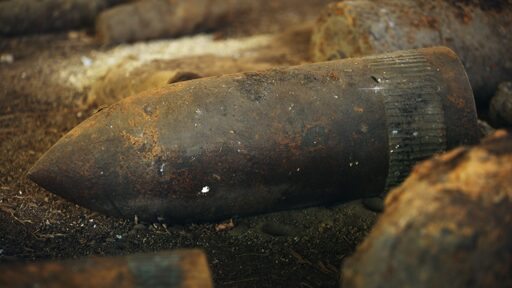

Unexploded ordnance, or UXOs, are bombs, shells and grenades that have been fired, launched or dropped but haven’t detonated. It is estimated that these buried bombs kill 20 people each year and disable an unknown number. (Photo: Nine Islands Media/Solomon Islands Local Media Agency: The War Below)
More than 80 years after World War Two ended, bombs continue to kill and maim people in the Solomon Islands. A new documentary, The War Below: Restoring Hope in the Solomon Islands*, by Auckland journalists Tuki Laumea and Cleo Fraser, aims to raise awareness and galvanise support for victims.*
Here’s Tuki and Cleo having a kōrero with Atakohu Middleton.
Solomon Islander Maeverlyn Pitanoe will never forget May 9, 2021. It was a hot Mother’s Day in Honiara, the country’s capital, and she and other members of her church were cooking over a fire under a large mango tree, preparing meals for a fundraiser.
Something beneath the fire started hissing. Suddenly, Maeverlyn’s world exploded in pain. An American-made, 105mm artillery shell buried in the soil had detonated.
Two men nearby were badly injured and later died. Maeverlyn suffered severe injuries to her arms, legs, and torso, and spent 53 days in hospital.
She lost the index finger of her left hand and most of two other fingers. Angry scars mark her arms and legs. Maeverlyn joined the long list of victims of a war her people never fought.

This still from The War Below shows Maeverlyn Pitanoe standing at the spot where, in 2021, her life changed forever. “In a matter of seconds, my family and I went from living a normal day to facing unimaginable pain, loss, and a long journey of healing,” she says. “We were not soldiers. We were ordinary Solomon Islanders whose lives were shattered by a weapon left behind from a war we never fought.”
(Photo: Nine Islands Media/Solomon Islands Local Media Agency: The War Below)
Now 54, the teacher and mum of two is sharing her story in a new documentary, The War Below, made by Auckland-based journalists Tuki Laumea and Cleo Fraser.
The pair, partners in life and work, hope the film, playing at the Doc Edge Festival from today (June 28), will raise awareness of the Second World War’s ongoing legacy in the Solomon Islands and prompt better support for victims and their families.
Unexploded ordnance, or UXOs, are bombs, shells and grenades that have been fired, launched or dropped but have not detonated. It is estimated that these buried bombs kill 20 people each year and disable an unknown number. There are no formal statistics on the toll.
“These are our neighbours, these are our cousins, it’s our backyard,” says Tuki. But outside the Solomons, he says, “no one’s really talking about it, and it turns out no one really cares about it. That’s the most shocking thing.”
Also shocking, says Cleo, is that “there is no burns unit in the Solomon Islands. There’s no money or resources available for survivors and their families, including counselling. I think that’s what disturbed us most.”

Tuki Laumea and Cleo Fraser, the Auckland-based journalists and documentary-makers who made The War Below, a sobering look at how the Second World War is still destroying lives in the Solomon Islands.
Tuki and Cleo met through a mutual friend in 2019. They’re both experienced journos who’ve followed similar paths in their careers.
Tuki, 43, is of Croatian and Sāmoan descent (Fagaloa, Poutasi, Lotofaga and Vaiala). He worked for TV3 and TVNZ before moving to Qatar to work for Al Jazeera English.
Cleo, 40, is Te Arawa (Ngāti Pikiao) from the coastal settlement of Tirohanga, near Ōpōtiki in the Bay of Plenty. She started out as a print journalist before working for TV3, TVNZ, and then Al Jazeera English in Qatar.
The War Below came about after NZ On Air and Pacific Cooperation Broadcasting Limited (an entity funded by our Ministry of Foreign Affairs and Trade to foster media relationships across the South Pacific) launched a project pairing Aotearoa-based Pasifika producers with those in the islands.
Tuki partnered with Solomon Islands journalist Elizabeth Osifelo, who suggested exploring the impacts of unexploded ordnance. They were joined by Cleo, who produced the film, and assisted by Dorothy Wickman, another Solomon Islands journalist.
The resulting documentary is a sobering look at how the Second World War is still destroying lives.
In 1942, three years into the war, Japan invaded the Solomon Islands, leading to fierce battles on land and sea between Japan and Allied forces, centred on the island of Guadalcanal, where the capital Honiara is located.
When the war ended, bombs were dumped or buried, and the troops — and their governments — walked away. For more than 80 years, Solomon Islanders living in the former battlegrounds have lived in fear that the ground might explode beneath them.
The risk of stepping on UXOs is growing as towns expand. As the explosives corrode, heavy metals and explosive residues are released into the air, soil, water and sea.
A recent United Nations Development Fund report says that more than half of known UXO sites in the Solomon Islands are within one kilometre of the coast, where intense storms driven by climate change are exposing more bomb dumps.
Chemicals from the bombs have been found in marine life, including shellfish. Health centres are seeing a rise in rashes, fevers, vomiting and skin irritations after eating seafood.

Once Solomon Islanders report unexploded ordnance, the local police step in. Between 2011 and 2025, police recorded 7,773 callouts about bomb finds, most involving live explosives. Police store the explosives until they can safely detonate them. (Photo: UNDP)
The governments of the US, Canada, Australia, New Zealand, the UK, Korea, and Japan are assisting the Solomon Islands police in mapping and removing UXOs, but the police lack the resources to deal with the munitions in a timely way. The problem is simply too big.
Between 2011 and 2025, police recorded 7,773 callouts about bomb finds, most involving live explosives. Police store the explosives until they can safely detonate them.
The War Below takes us to the bomb store at a place called Hells Point, which had been an Allied munitions depot during the war. It’s a surreal segment of the film as the policeman in charge, wearing his dark-blue uniform but no protective gear, stands beside various explosive devices lying scattered on the dirt. Some are mortars, some are grenades. Some are American, some are Japanese.
Off-camera, Tuki asks: “So these ones are still alive?”
“Still alive,” responds the officer, nonchalantly.
Tuki, his voice incredulous, says: “No chance of them blowing up?”
The officer gazes at the shells as if he’s seeing them for the first time, then turns back to Tuki, laughing awkwardly.
Tuki says there are so many items awaiting detonation that police can’t dispose of them fast enough. “It was very normal for him to be in there, around that stuff lying around everywhere. It wasn’t for us.”
Cleo adds: “It was absolutely and totally terrifying being in that stockpile.”
That scene is one of several moments in the documentary when you feel that not enough is being done, and certainly not quickly enough.
Kids still die picking up pieces of metal sticking out of the earth to play with. Fishermen still blow their hands off trying to open the bombs to get at the powder to make their own bombs for “dynamite fishing”, which is illegal. People light fires on the ground — a very banal and everyday activity — unaware that it will be the last thing they do.

Maeverlyn Pitanoe founded Bomb Free Solomon Islands to educate communities and support victims. “For many people around the world, World War Two is a chapter in a history book,” she says. “For us in Solomon Islands, the war is still beneath our feet, in our gardens, near our homes, and in our seas. It is a hidden danger that continues to take lives, injure our people, and create fear in communities.”
In the film, Dorothy Wickham notes that there is no counselling for traumatised bomb victims. Churches tend to care for the bereaved or injured.
Maeverlyn Pitanoe is hoping to fill that gap. Her involvement with the documentary has been a catalyst for her to set up the first charity devoted to assisting victims.
In July last year, she registered Bomb Free Solomon Islands as a charitable trust. It has a Give a Little page, which Cleo is helping to administer as the crowdfunding site requires a New Zealand bank account.
Donations fund victim support, including paying school fees and medical costs, raising awareness of the threat in schools and communities, printing safety materials, and running programmes to help survivors rebuild their lives.

The launch of The War Below in Honaria, Tuki Laumea and Cleo Fraser in front. (Photo: Nine Islands Media/ Solomon Islands Local Media Agency: The War Below)
Maeverlyn told me, over WhatsApp, that the documentary is “the voice of those who have suffered in silence. Having this documentary travel around the world means that our stories are finally being heard.”
She has a clear strategy for Bomb Free Solomon Islands. In the short term, she wants to ensure communities are educated about safety and can build a network of survivors and victims for mutual support.
In the medium term, she wants survivors to move from being seen only as victims to playing a more active role — so their voices are heard when decisions are made about bomb education and disposal, and services for survivors.
The long-term dream, Maeverlyn says, is “a Solomon Islands where the legacy of war no longer threatens our future. A country where our land and seas are safe.”
Tuki and Cleo hope to get Maeverlyn and Dorothy Wickham to the Wellington screening on July 21 andarrange meetings for them with local people and organisations interested in munitions clearance in the Solomon Islands.
Maeverlyn says she doesn’t want audiences who see The War Below to feel sorry for her — she wants them to help “Awareness must lead to action: stronger commitment to clearance, better support for survivors, and a future where no child in the Solomon Islands grows up playing on land that may hide a deadly reminder of the past.”

Cleo Fraser, Dorothy Wickham and Tuki Laumea at the Honiara community screening of The War Below. (Photo: Nine Islands Media)
- Watch the trailer for The War Below: Restoring Hope in the Solomon Islands here. The documentary screens at the Doc Edge Festival in Auckland on June 28 and July 10, and in Wellington on July 21. It will also be available online from July 27 to August 10. Book here.
- Donate to Bomb Free Solomon Islands here.
- Tuki and Cleo’s most recent work, the four-part documentary Fight for the Pacific, explores the Chinese campaign for influence in the region through the eyes of everyday people in 10 Pacific countries. It’s available here.
Dr Atakohu Middleton (Waikato, Pākehā) isE-Tangata’sarts editor. She is a journalist whose lengthy career has included outlets as diverse asRadio Waatea*, theGuardian(UK),*theNew Zealand Listener, theSunday Star-Times, and theNew Zealand Herald. She lives in Tāmaki Makaurau. Her bookKia Hiwa Rā!, on Māori journalism in Aotearoa, was published in 2024.
The post The war beneath their feet appeared first on E-Tangata.
From E-Tangata via This RSS Feed.