

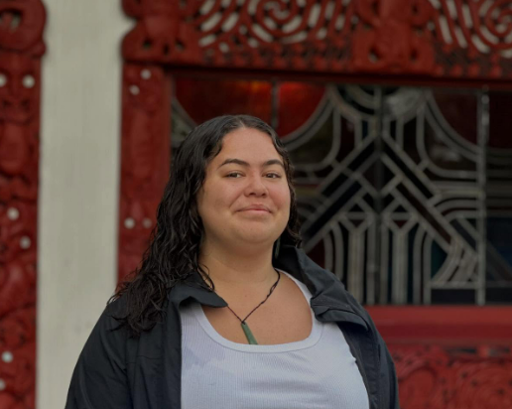

“Te reo is not diminished by being shared, but it is diminished when whakapapa connections go unacknowledged,” writes Taea Staples. (Image supplied)
Pākehā students of te reo Māori should not say the language belongs to them — there are better ways to reflect the relationship, writes Taea Staples.
I was in my reo Māori class the other night, and one of the Pākehā students, as well as the Pākehā teacher acknowledged everyone who had come along to strengthen, as they put it, “tō tātou reo”.
Phrasing it this way means “our language”, inclusive of both the person speaking and their audience.
In the class I attend, I’m one of about seven Māori. The rest are Pākehā. It already feels isolating to be one of the few Māori. So when I heard the Pākehā tauira claim that te reo Māori is “our reo”, I almost lost my shit. I left class early that night.
Before leaving, I had a private chat with the kaiako, the teacher, telling him that neither he nor the tauira should have said “tō tātou reo”, for it is not “their” reo.
He told me he used to avoid saying “our reo” for that reason, but now he seems to interpret “tō tātou reo” as effectively saying: “We are on this reclamation journey together, Pākehā and Māori.”
Yes, we are all on a reclamation journey. But Māori and Pākehā have different roles on that journey. One is mokopuna, a descendant of the language, and the other, Pākehā, is manuhiri, a guest of the language.
Categorising us all as “on the same journey” erases the rangatiratanga of Māori as descendants of te reo. It homogenises our distinct journeys, motivations and struggles with te reo. So, while some may agree with my kaiako’s counter-argument, I strongly do not.
“Tō tātou reo” felt like Pākehā claiming something that isn’t theirs, which seems to be a recurring pattern among some Pākehā who assume they have a special insider position in te ao Māori. They might have a Māori partner and kids, for example, or they’re a good ally, and they’re proficient in te reo me ōna tikanga. Or they might have grown up in te ao Māori.
But to make a claim on te reo Māori is simply entitlement.
It’s well understood by Pākehā students that they wouldn’t go to my marae or my urupā and say “tō tātou marae” or “tō tātou urupā”— “our” marae, “our” urupā. Nor would I, as Māori, go to another iwi or hapū marae and claim it is “our marae”, for that would be claiming a relationship I don’t have a whakapapa entitlement to.
There are many variations Pākehā can use instead of “tō tātou reo”:
Tō koutou reo — your reo (belonging to another).
Whakakaha i te reo Māori — strengthen te reo Māori.
Whakakaha i te reo o Aotearoa — strengthen the language of Aotearoa.
None of these examples claims ownership of or belonging to te reo Māori, but they still acknowledge a journey of reclamation.
I’m not arguing that Pākehā can’t learn te reo Māori. Anyone can learn te reo Māori, speak te reo Māori, and have a relationship with te reo Māori. But only Māori can claim te reo as “ours”.
Māori and Pākehā are, in fact, two different groups of people, with different rights, different access, and different needs. That’s not a matter of separatism — that is a matter of fact. If we don’t recognise our distinctive roles, we risk large-scale homogenisation.
Many Māori scholars and leaders have shed light on how notions of “equality”, meaning we must all be the same, create further marginalisation of minority groups through cultural erasure.
When Pākehā claim “our reo” as their own, they are effectively claiming whakapapa in te ao Māori, as if they are tangata whenua with rights to belong to the Māori community. The very notion of whakapapa becomes meaningless.
Māori are the Indigenous people of Aotearoa. The taonga guaranteed to us in Te Tiriti o Waitangi includes our reo.
As reinforced by the Waitangi Tribunal in 1986, the Crown has a duty to protect te reo Māori, and Māori have the right to retain tino rangatiratanga over te reo. This distinction is important. Having access to learn the reo and a responsibility to look after it are not the same as an entitlement to claim it.
Some will respond to this argument by saying “tō tātou reo” are just “words” and that it doesn’t really matter. But the reality is that words and language have been key tools of colonisation worldwide.
When Pākehā claim “tō tātou reo”, it places Māori in the position of having to defend our belonging to our language. That burden is exhausting, and one Māori carry far too often.
There are many ways for Māori and Pākehā to build meaningful relationships. But that relationship is fractured the moment Pākehā claim te reo Māori as their own.
Te reo is not diminished by being shared, but it is diminished when whakapapa connections go unacknowledged.
Nō reira,
Ko au te reo Māori, ko te reo Māori ko au,
Āke, Ake, Ake.
Taea Staples (Ngāti Tūwharetoa | Ngāpuhi) is a Māori studies and history graduate, and a tutor at Te Herenga Waka — Victoria University of Wellington. Her creative and critical work has been published in Salient and Awa Wahine.
The post It’s not “our” reo if you’re Pākehā appeared first on E-Tangata.
From E-Tangata via This RSS Feed.