

As this essay continues an examination of the limits of Noam Chomsky’s anti-imperialism, readers are encouraged to consult the earlier installments in this series:
- Introduction: Colorless Green Ideas Sleep Furiously
- Chomsky’s Linguistics Theories of Nothing
- Chomsky: The Acceptable Dissident
- Chomsky: The Moderate Rebel
As the 2026 war with Iran rages — with U.S. and Israeli strikes, Iranian retaliation, proxy escalations, and the Strait of Hormuz disrupted — segments of the left still hail Noam Chomsky as the supreme anti-imperialist voice. Yet he has been relatively quiet during this active conflict. This fits the pattern documented in earlier parts of this series. Even when Chomsky has addressed Iran, such as his 2022 support for the protest movement, he has lent legitimacy to what amounted to color revolution dynamics — effectively backing regime-change efforts dressed up as popular uprisings. His reputation as the gold standard of anti-imperialism is undeserved. He denounces U.S. wars after the bodies are buried and the book tours begin. During the manufacturing-of-consent phase, he repeatedly accepts—or softens—Washington’s core premises.
In the next series of articles, we will examine Chomsky’s statements and behavior during and after some of the most significant U.S.-led invasions of the 20th and 21st centuries, beginning with Iraq. His reactions to the 1990–91 Gulf crisis are textbook examples of him accepting Washington’s premises without independent fact-checking. Instead of advancing a strong moral case that could rouse genuine opposition, he softened the anti-imperialist critique into dry international legalism.
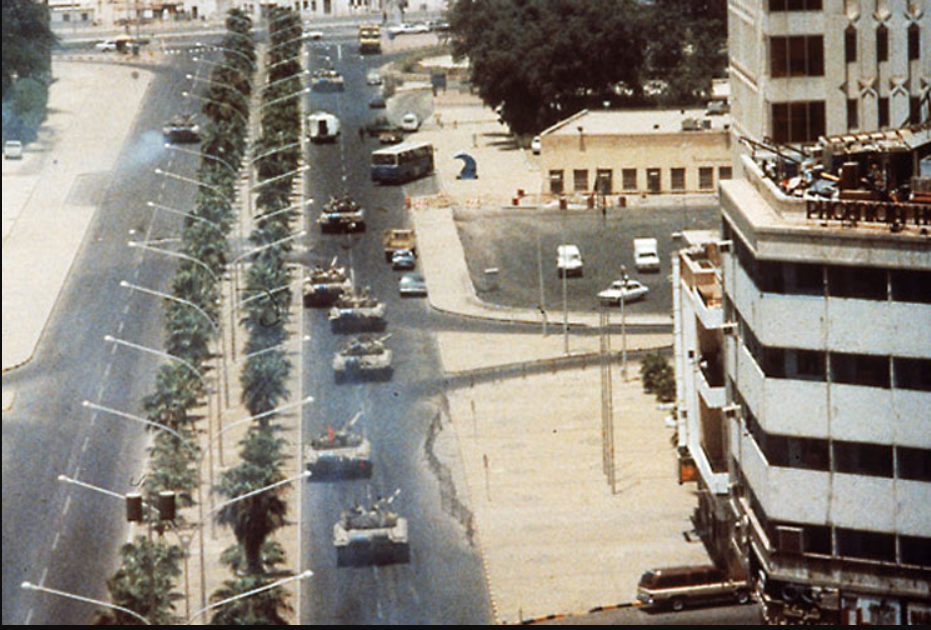
On August 2, 1990, Iraq invaded Kuwait. Within days, U.S. media flattened the event into “Saddam Hussein the megalomaniac aggressor.” Elevated as the official dissident on MacNeil/Lehrer, Chomsky did not puncture the frame — he endorsed it: “We and the world should adhere to the principle that acquisition of territory by force… is illegitimate and, in fact, unlawful.”
British-drawn borders—arbitrary instruments of imperial control that the West condemns everywhere else—suddenly became sacred when they shielded a rentier monarchy in Kuwait, built on kafala slavery and oil rents. He conceded the “Iraqi threat” absent solid evidence and legitimized U.S. troop deployments: “That reaction was legitimate… there was reason to believe that Iraq might have been planning to move on to further aggression.”
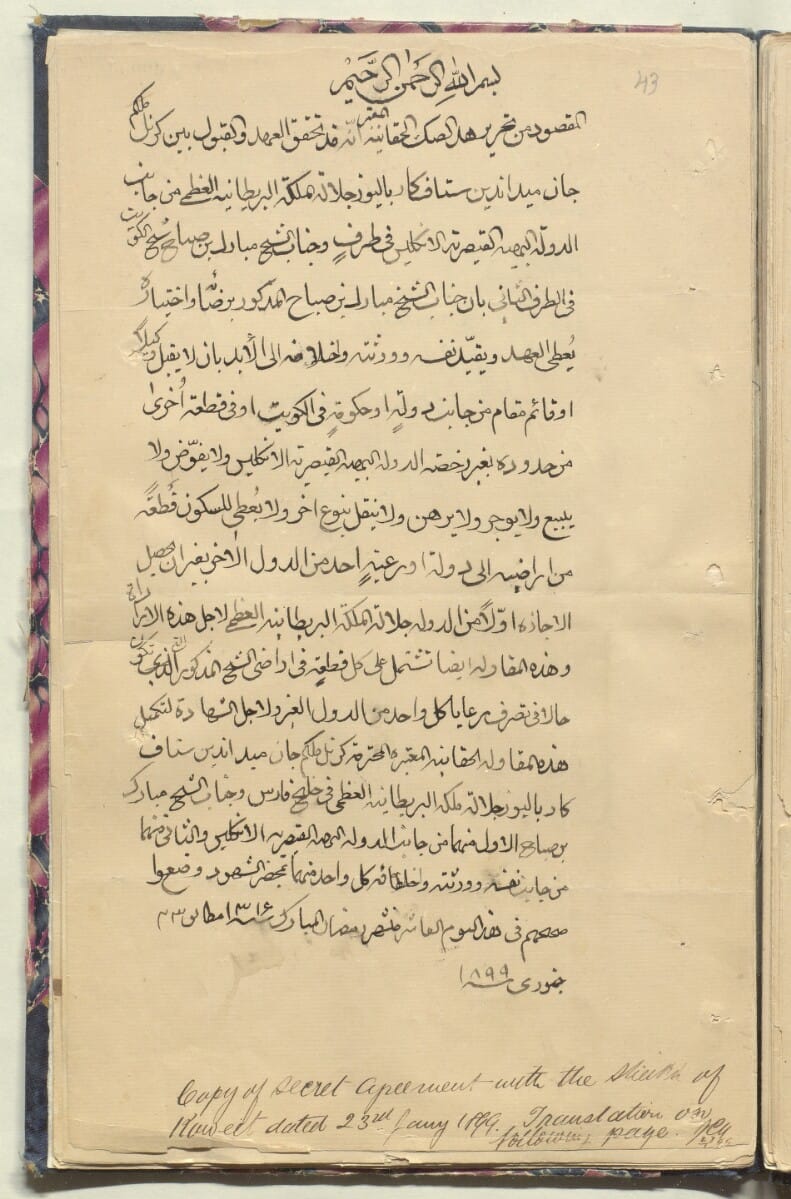
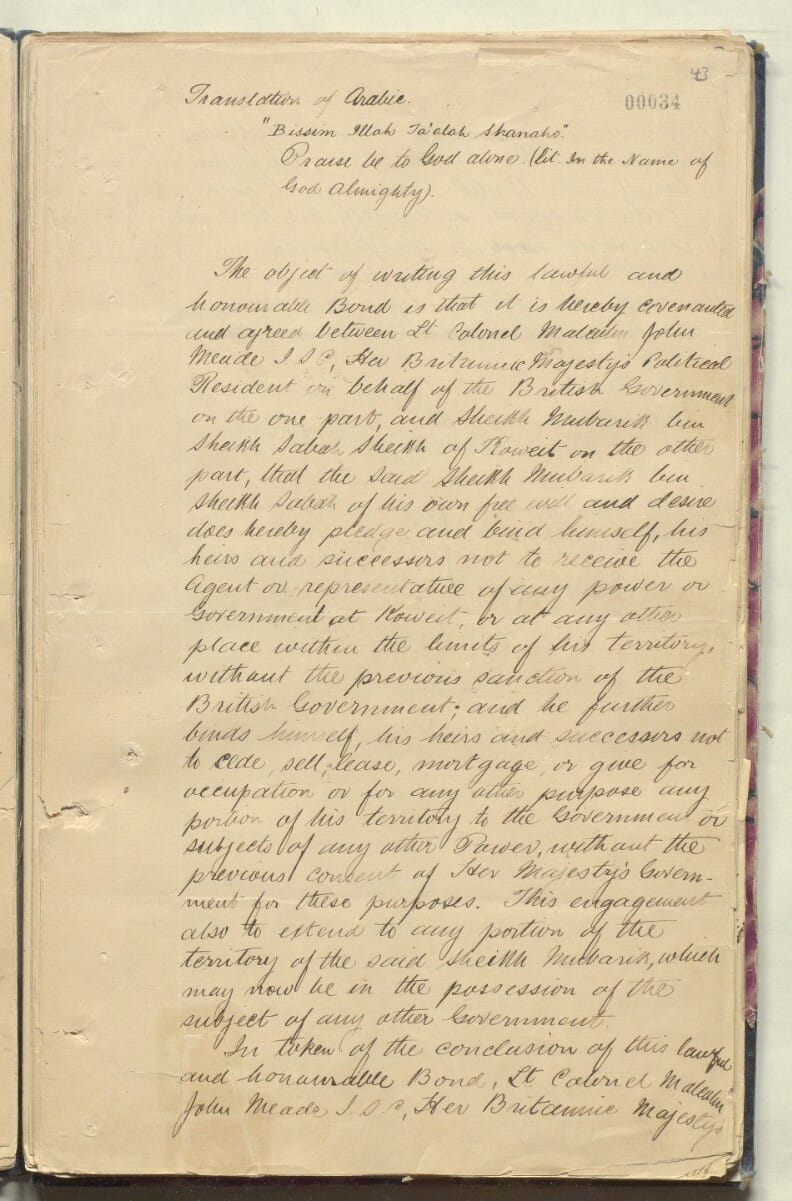
English and Arabic Copies of the Anglo-Kuwait Agreement from 1899
As for his solution, Chomsky stated: “I think that the organization of economic pressures and measures such as the embargo is definitely legitimate, in my view.” These are the same embargoes later responsible for the deaths of half a million Iraqi children—Madeleine Albright would famously declare them “worth it” in her 60 Minutes interview with Lesley Stahl.
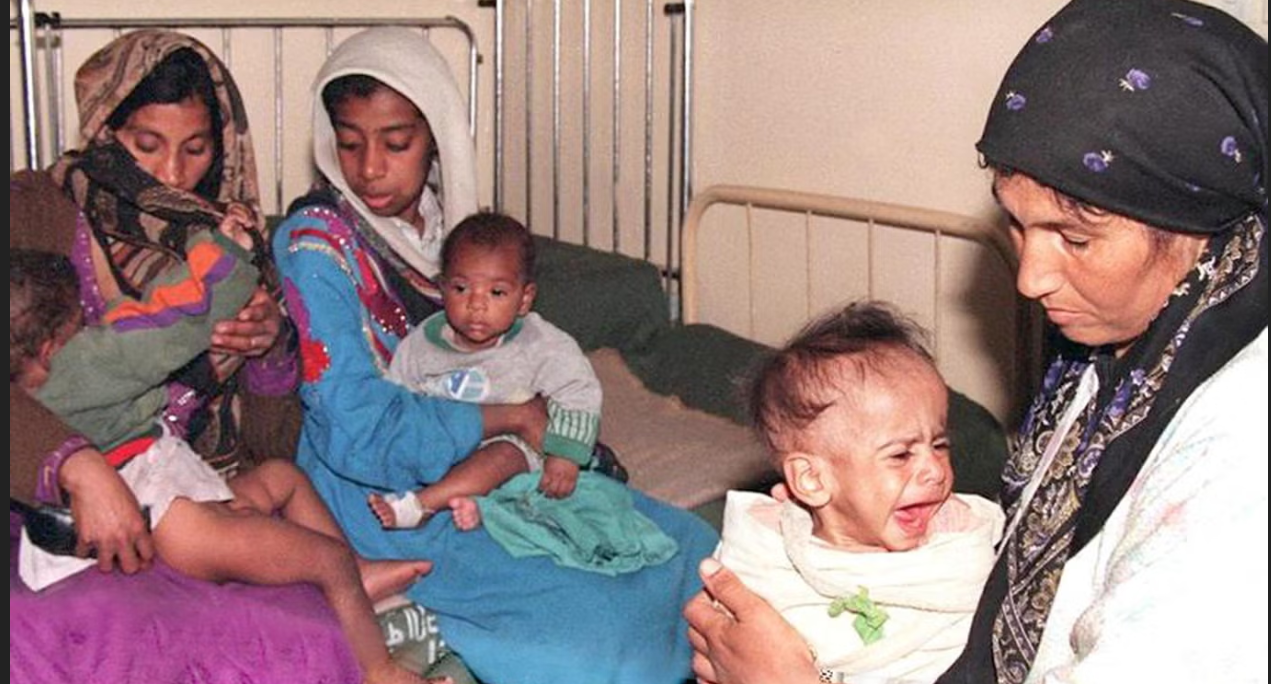
Iraqi women in a hospital in 1998 after Sanctions
On the use of force, he offered only procedural refinement: not unilateral U.S. action, but a UN-approved international effort to enforce the Charter. Sanctions were presented as the humane alternative—collective punishment inflicted on a society already shattered by the Iran-Iraq War, which the U.S. and Gulf monarchies had helped finance and arm. He never demanded reparations for the proxy war Iraq had fought on their behalf. He never mentioned the April Glaspie diplomatic green light. He never questioned why Kuwait’s abandoned migrant majority suddenly became the moral cause worth defending with military force.
The result was classic containment: the crisis was disciplined back inside imperial legality. Structural causes—colonial cartography, debt traps, oil geopolitics—vanished. The only debate permitted was how hard to punish the aggressor. Sanctions, not withdrawal with reconstruction, became the “restraint.”
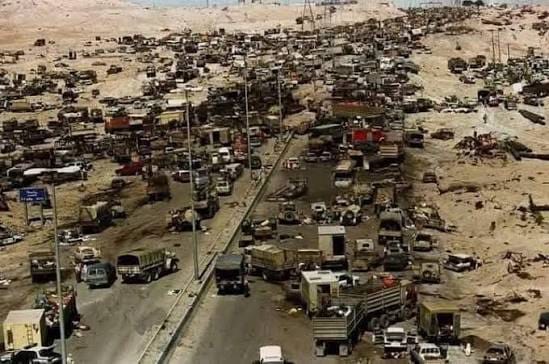
Disturbing images of dead Iraqi troops being killed as they fled.
After the Highway of Death and half a million dead Iraqi children under sanctions, Chomsky later published Deterring Democracy—meticulous on U.S. crimes, yet silent on his own earlier role in legitimating the premises that made them possible.
By early 2002, the propaganda emerging from the White House and mainstream U.S. press operated on two tracks simultaneously. The first was the sophisticated, technocratic track: satellite imagery of alleged weapons facilities, Colin Powell’s theatrical performance at the UN Security Council in February 2003, the claim that Saddam could deploy chemical weapons within 45 minutes, and the since-debunked assertion that Iraq had sought yellowcake uranium from Niger. These were designed to persuade the persuadable—foreign governments, liberal internationalists, and the serious press.
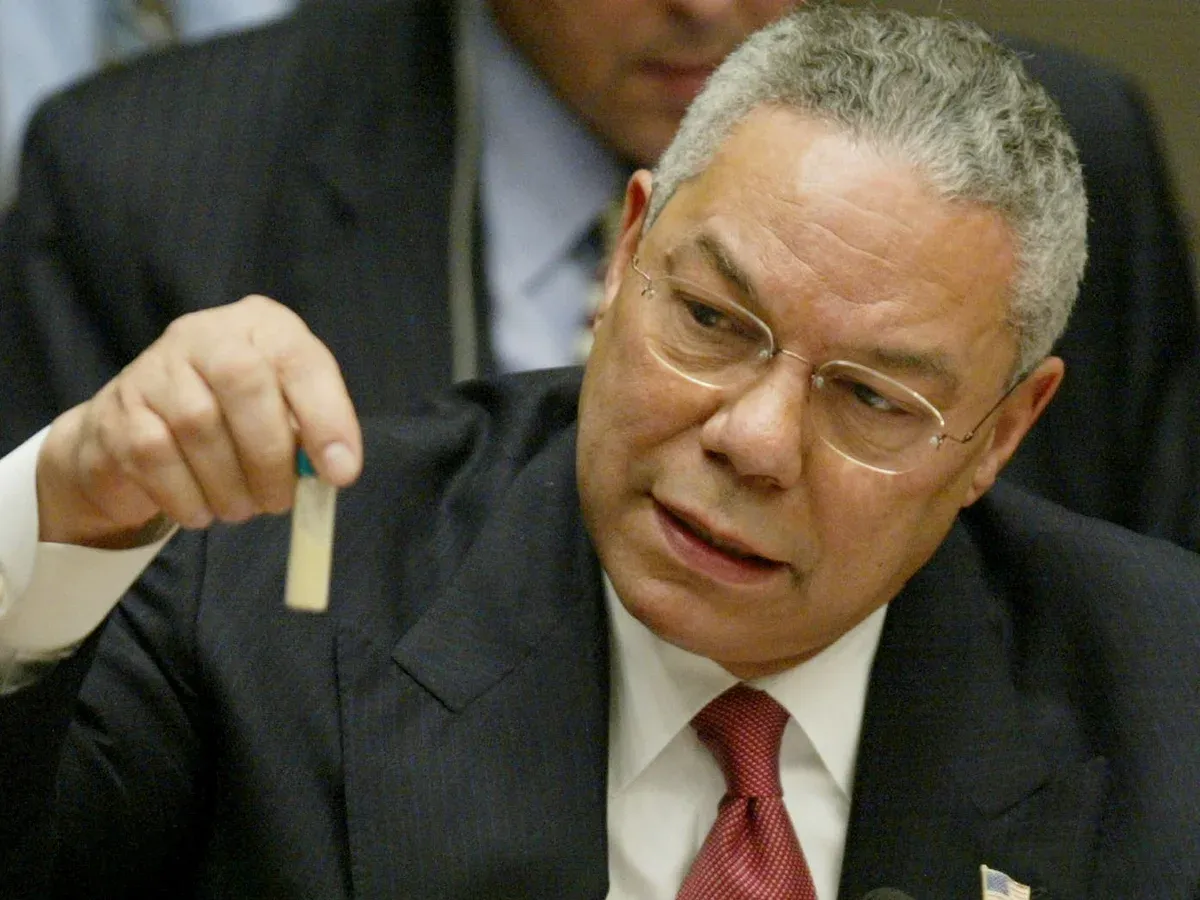
Colin Powell claiming the imaginary Vile of Anthrax he had could kill everyone in the room at the U.N.
The second track targeted middle America and dispensed with subtlety entirely. This was the world of Saddam’s human shredding machines—industrial devices, it was claimed, into which regime opponents were fed feet-first, their remains collected below as a warning to others. It was the world of rape rooms and acid baths, of a dictator who gassed his own people (with chemical precursors Washington had itself supplied during the Iran-Iraq War, a detail carefully omitted). Kenneth Adelman promised the invasion would be a “cakewalk.” Dick Cheney declared that American troops would be “greeted as liberators.”
Both tracks, sophisticated and grotesque, served the same function: to make the question of whether to remove Saddam feel less important than the question of how and when. The frame was set. Saddam was a monster. The only debate permitted was procedural.
In this environment, Chomsky actively reaffirmed the demonization propaganda against Saddam Hussein. He stated: “Saddam Hussein is a monster, there’s no doubt about that. Getting rid of him would be a boon to the people of Iraq and the world.”
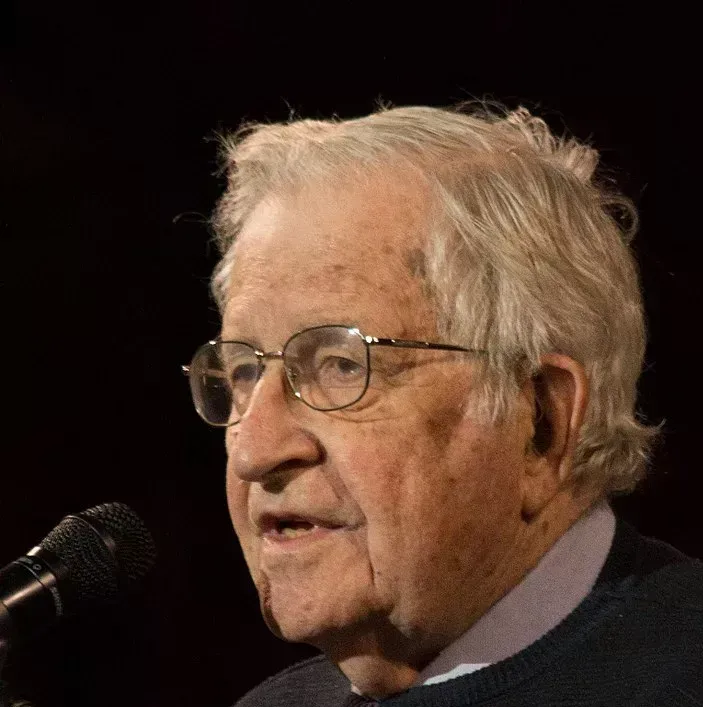
Chomsky Claiming that Getting Rid of Saddam Hussein would be a Bon to the World.
He went further on the weapons of mass destruction issue. In the same September 2002 interview, Chomsky explicitly cited Scott Ritter — the UN weapons inspector who was publicly and compellingly demolishing the entire WMD case — acknowledging that “weapons inspection appears to have been highly effective.” And yet, having cited the man who was telling the world there was nothing there, Chomsky proceeded to summarize as follows: “WMD programs make the world a more dangerous place, Saddam’s in particular. The problem should be addressed in such a way as to make the world safer.” He had access to the dissenting literature. He chose to straddle both positions simultaneously — inspections seem to have worked, and Saddam’s WMD program is dangerous — leaving the reader with the impression of an active, threatening program that needed to be managed or dismantled.
His entire case therefore rested on procedural objections: no UN mandate, sanctions instead of invasion, inspectors instead of bombs. But procedure is not principle. If Saddam Hussein is a monster who feeds opponents into human shredders, whose removal would be a boon to the Iraqi people and the whole, and who is actively developing weapons of mass destruction — and who was supplied with weapons of mass destruction by the U.S. and Britain—then what exactly is the anti-war case?
As we have covered here, Iraqis were far worse off after Saddam Hussein was removed. Immediately after the invasion, 1.5 million Iraqis lost access to clean water, and for the first time since the 1950s, the country experienced major outbreaks of cholera and typhoid. The U.S. privatized water and awarded contracts to Bechtel, causing prices to soar.
The invasion drove over 60% of Iraqis into joblessness. Many became desperate. One welder who had enjoyed a middle-class lifestyle was reduced to earning $1.25 a day. Wages collapsed across the board.
Poverty and desperation hit Iraq’s children hardest. Under Saddam Hussein, Iraq spent six percent of its GDP and 20 percent of its national budget on schools, teachers, and literacy programs. That level has never been matched since.
Privatization and the theft of oil resources were only part of the problem. Paul Bremer’s de-Baathification order disbanded the entire Iraqi army—roughly 400,000 trained soldiers, mostly Sunni, thrown into unemployment with their weapons and their humiliation. They formed the backbone of the Sunni insurgency and, later, ISIS. In 2008, the U.S. paid and armed Sunni tribal militias—known as the “Sons of Iraq” or Sahwa—to fight Al-Qaeda in Iraq, with the explicit promise of integrating them into the national security forces. The Shia-dominated, U.S.-backed Maliki government refused to integrate them, cut off their salaries, and began arresting their leaders. Many subsequently joined ISIS.
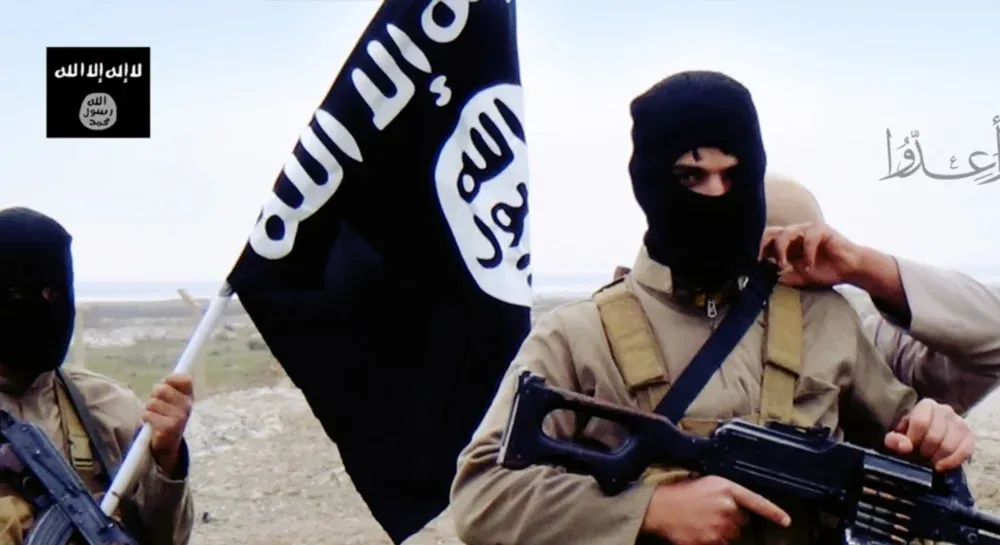
ISIS Troops during their Reign of Terror
Under Saddam Hussein’s secular Ba’athist government, Iraq was home to one of the oldest and most diverse religious landscapes in the world. Christians (Chaldeans, Assyrians, Armenians) numbered approximately 1.5 million and were integrated into public life. Tariq Aziz, Saddam’s foreign minister and one of the regime’s most visible international faces, was himself a Christian. Yazidis, Mandaeans, Shabaks, Druze, and others coexisted alongside the Muslim majority in a state where Ba’athist secular nationalism kept religious sectarianism subordinate to state authority. Women attended university, worked professionally, and enjoyed legal protections that were the envy of the region. The invasion produced the systematic annihilation of this world.
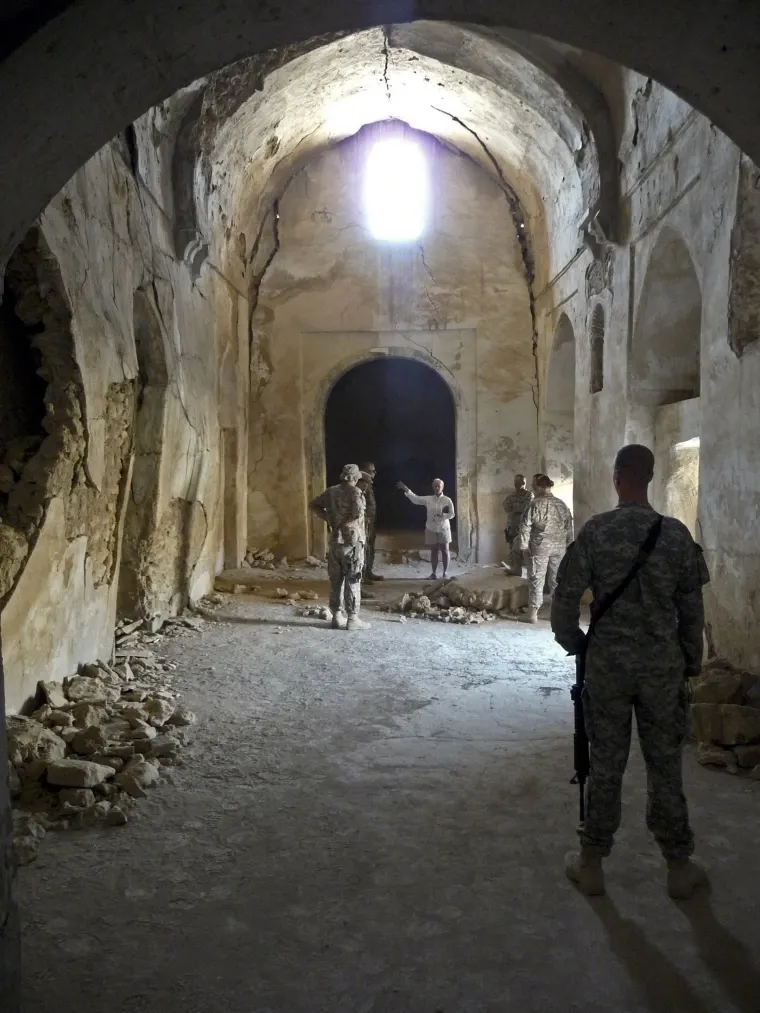
Isis destroying the oldest Christian Monastery in the World
By the mid-2010s, Iraq’s Christian population had collapsed from 1.5 million to under 300,000—a near demographic extinction achieved not by Saddam’s (non-existent) human shredders, but by the sectarian chaos the invasion deliberately unleashed. In August 2014, ISIS swept into the Yazidi heartland of Sinjar. Men were massacred. Women and girls were enslaved and sold openly in markets, their prices published in ISIS pamphlets. The United Nations formally designated what happened to the Yazidis as genocide. The Mandaeans—one of the oldest continuous religious communities on earth, tracing their roots to ancient Mesopotamia—were driven out of Iraq almost entirely.
These outcomes were predictable. As we previously documented, oilfield production was restored ahead of schedule while water treatment plants were not. The destruction of Iraq’s pluralist social fabric was the logical result of dismantling the state, arming sectarian factions, and abandoning those who had cooperated with the occupation.
Chomsky later criticized the execution of the war, calling Bush incompetent and attacking the administration’s imperial ambitions. He described the invasion as driven by the desire for “a unipolar world in which the United States has no peer competitor” and labeled it a criminal act. Yet this post-facto critique does not erase his earlier statements made during the crucial manufacturing-of-consent phase.
Exposing this is irritating liberalism. It is holding a supposed anti-imperialist to account for lending moral and intellectual legitimacy to the foundational premises of a war of aggression. No, Saddam did not have operational human shredders. And no, removing him was not a boon. Iraqis got cholera instead of clean water, mass unemployment instead of stable order, child labor instead of functioning schools, and ISIS instead of the previous system — however repressive it may have been. The man who helped topple Saddam’s statue later wished he could put it back.
Chomsky’s post-invasion books meticulously catalog the crimes. There has never been a reckoning with how his pre-war framing helped keep opposition inside acceptable bounds: yes to regime change, just do it with a UN mandate and nicer rhetoric. This is precisely what makes him an incomplete anti-imperialist.
If you’ve made it this far, and found our article illluminating, please remember we are 100% reader supported. If you think this work matters, throw us a few dollars so we can keep going. The empire certainly isn’t funding us.
Every penny counts.
From Historic.ly via This RSS Feed.