

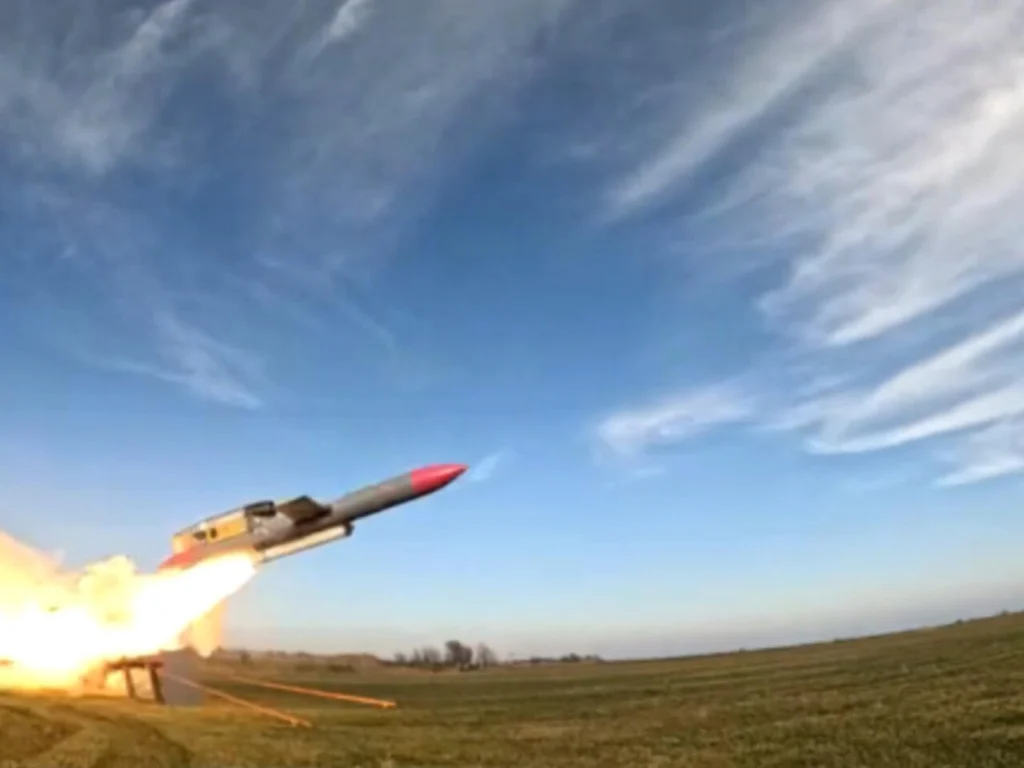
Flamingo missiles Ukraine reportedly hit a Russian arms factory in Volgograd, as Zelenskiy says the strike targeted a key military-industrial site.
Related: Russia To Continue Massive Strikes on Ukraine: Lavrov
Flamingo missiles Ukraine were used in a strike that reportedly hit a Russian military-industrial plant in Volgograd, according to President Volodímir Zelenski. He said the FP-5 “Flamingo” cruise missiles successfully reached the Titan-Barikady factory, a major site where Russia produces artillery systems and specialized military equipment.
Flamingo missiles Ukraine and the Volgograd strike
Zelenski said in a Telegram message and on social media that he is grateful to the people behind Ukraine’s technological and military development. The Ukrainian president confirmed that the Flamingo missiles struck the Titan-Barikady plant in Volgograd, about 400 kilometers from the Russian-Ukrainian border. The attack, he said, caused a fire inside the facility.
According to Zelenski, every Russian defense installation participating in the war against Ukraine is a legitimate target for Ukraine’s long-range sanctions. He argued that the reach of those sanctions is expanding constantly and that this pressure is helping create the conditions for what he called a dignified peace.
The Ukrainian leader’s statement suggests that Flamingo missiles Ukraine are becoming part of a broader strategy to hit deep inside Russian territory. The target, Titan-Barikady, is described by Ukrainian officials as a major industrial complex producing artillery systems and components for missile launchers used in attacks on Ukrainian civilians.
Before Zelenski’s confirmation, Serguí Sternenko, an adviser to Ukraine’s Defense Ministry, had already said on Telegram that Flamingo missiles had struck one of the key facilities in the Russian military-industrial complex in Volgograd. He later identified the target as the Federal Research and Production Center “Titan-Barikady”, where missile launchers and artillery systems are manufactured
The strike fits into a pattern of long-range Ukrainian attacks aimed at degrading Russian military infrastructure. That pattern has become more visible as Ukraine seeks to expand its strike capacity farther beyond the front line.
Flamingo missiles Ukraine and the war of long-range pressure
The use of Flamingo missiles Ukraine underscores how the war is increasingly being fought through deep-strike capabilities, industrial disruption, and pressure on logistics. By targeting military production sites far from the front, Kyiv is trying to raise the cost of Russia’s war machine and reduce the flow of weapons into the conflict.
Zelenski framed the operation as part of Ukraine’s evolving long-range strategy. He said the geographical range of Ukraine’s long-range sanctions is constantly expanding, indicating that more Russian facilities could be targeted in the future. In his view, that sustained pressure is necessary to force Moscow toward negotiations.
The Volgograd strike also highlights the political dimension of Ukraine’s domestic defense industry. Zelenski thanked the engineers and military developers behind the Flamingo program, presenting the missiles as evidence of Ukraine’s ability to build advanced weapons under wartime conditions. That message is meant both for domestic audiences and for international partners watching the war’s trajectory.
The Titan-Barikady plant has symbolic and practical value because it is linked to artillery and missile-launch systems, the very tools Russia has used heavily in the war. Hitting such a site is intended not only to damage production but also to show that Russia’s industrial rear is no longer immune.
The statement also reflects a broader wartime logic: attack the infrastructure that feeds the battlefield. In that sense, the Flamingo missile strike is less about a single explosion and more about a campaign to disrupt the systems that sustain Russia’s military capacity.
Geopolitical context
Flamingo missiles Ukraine carries broader implications for the regional balance of the war and for long-range strike doctrine worldwide. Ukraine’s ability to hit a Russian military plant hundreds of kilometers from the border shows how the conflict has entered a new phase, one in which industrial targets and rear-area logistics matter as much as frontline combat. That changes how both sides must plan defense and retaliation.
The episode also matters for international security because it demonstrates how domestic arms development can reshape battlefield dynamics. If Ukraine can continue producing or deploying longer-range missiles, Russia will face a larger defensive burden across its interior regions. That may affect everything from factory security to air-defense deployment and broader escalation calculations.
This dispute now sits at the intersection of war, technology, and strategic deterrence. If long-range strikes continue to expand, they may push the conflict further from a static war of attrition toward a broader contest over industrial endurance and strategic reach. That is why the Volgograd strike is being read not as an isolated event, but as part of a wider shift in the war.
From teleSUR English via This RSS Feed.