

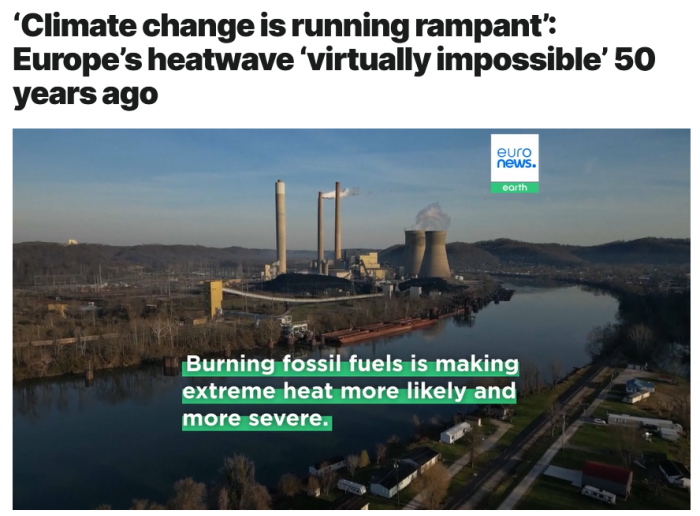
Euronews (6/26/26) shows how easy it is to link extreme weather to climate change, and climate change to fossil fuels.
Severe weather has gripped the globe this week, with record-shattering, deadly heat in Western Europe. In the US, heat, wind and drought conditions fueled wildfires in the Southwest, while heavy thunderstorms, wind and floods caused destruction in eastern and central states.
Scientists attribute these extremes to fossil fuel–driven climate change. Europe’s heatwave would have been “virtually impossible to occur at this time of year” 50 years ago, scientists from the World Weather Attribution group reported. The project’s Theodore Keeping of Imperial College London told reporters (EuroNews, 6/26/26):
The science of how climate change is worsening heatwaves is settled…. Continued fossil-fuel emissions are directly responsible for the disruption people are experiencing this week in their homes, schools and workplaces.
With extreme weather events worsening each year, and the world on track to surpass by 2030 the Paris Agreement’s attempt to limit global heating to 1.5°C above pre-industrial levels, connecting these disruptive and deadly events to climate change is a key part of the story.
Yet on the evening of Tuesday, June 23, despite leading their shows with severe weather headlines, nightly news shows on NBC, ABC and CBS failed to mention climate even in passing.
Cropping out climate
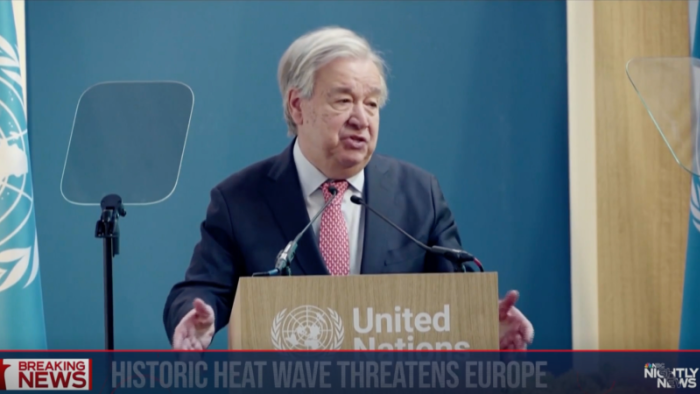
NBC Nightly News (6/23/26) had a tight shot of UN Secretary General Antonio Guterres…
Substitute anchor Hallie Jackson began the NBC Nightly News (6/23/26) by describing apocalyptic scenes around the globe:
Tonight, the dangerous triple weather threat with fires, floods and deadly heat affecting millions. The flash flood emergency here at home: Fast-moving waters trapping drivers and washing out roads. Wildfires exploding out West. Plus, overseas, a record-shattering heatwave in Europe leaving dozens dead.
The broadcast covered heavy rains in Oklahoma, wildfires in Utah and Nevada, and heat and fire in Miami disrupting World Cup events. In France, it was so hot, Paris shut down the Eiffel Tower Tuesday, and Wednesday was expected to reach a 102°F record. More than 40 people were believed to have drowned in France’s rivers and beaches while trying to escape the heatwave that began last week.
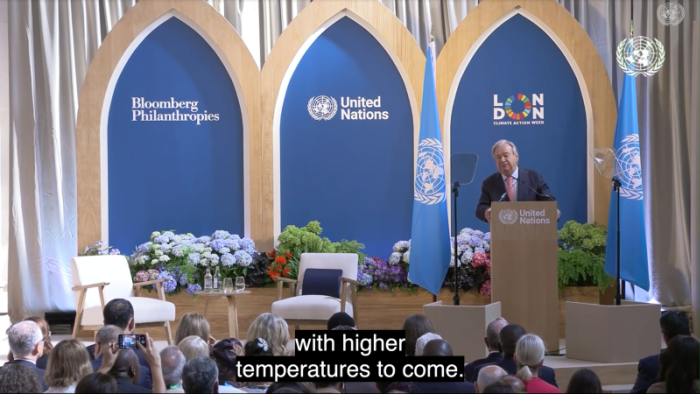
…when a wider shot would have revealed that he was speaking at London Climate Action Week.
In London, NBC’s Danielle Hamamdjian reported record highs in the city on Tuesday, with even higher temperatures anticipated to come.
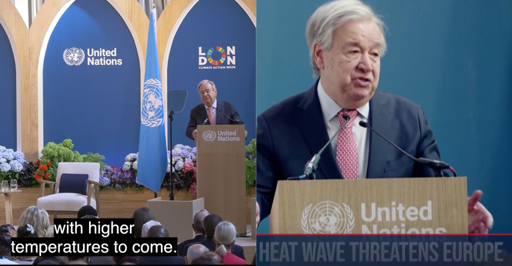
The broadcast then cut to a clip of UN Secretary General Antonio Guterres saying, “And today this city—and far beyond—are experiencing the hottest day of the year—with higher temperatures to come.”
The event that he was speaking at—London Climate Action Week—was not identified. In fact, a banner with the London Climate Action Week logo that was behind Guterres was cropped out of the shot. The soundbite NBC featured was excised from Guterres’ longer remarks about the severity of climate change and the critical necessity of quickly and justly transitioning from fossil fuels:
We have just lived through the 11 hottest years ever recorded. And today this city—and far beyond—are experiencing the hottest day of the year—with higher temperatures to come. London isn’t just calling—it’s cooking. Around the world, climate disasters are becoming more frequent, more destructive and more costly. And the World Meteorological Organization has warned we ain’t seen nothing yet. El Niño is not just knocking on the door. It risks blowing the house down. Turning up the heat. Disrupting food and water systems. And hitting the vulnerable the hardest. Ten years ago, world leaders agreed in Paris to limit global temperature rise to 1.5 degrees Celsius. Now scientists say average annual temperatures will exceed that threshold in the coming years.
Later in the speech, Guterres demanded that AI companies publicly disclose their energy usage and commit to powering data centers with renewables by 2030.
From a speech entirely about climate change and its tangible impacts, NBC Nightly News managed to cherrypick a soundbite of Guterres essentially saying nothing more than “it’s hot.” While the segment linked together these extreme weather events in Europe and the US as a global phenomenon, climate change didn’t even get a passing mention.
Records broken by unknown force
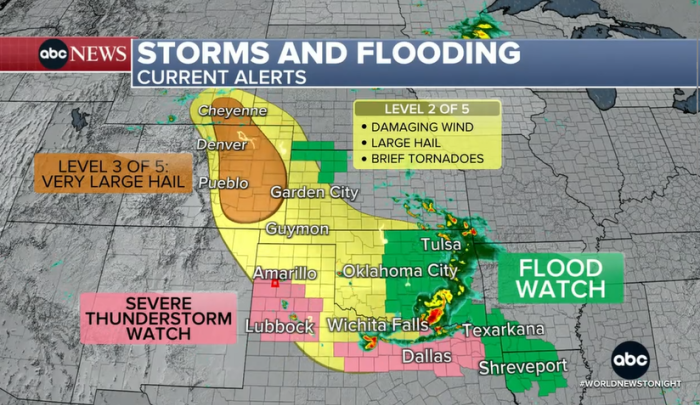
ABC World News Tonight (6/23/26) reported on weather like there was no such thing as climate.
ABC World News Tonight (6/23/26) with David Muir followed suit. Raising the alarm about tornadoes and flood watches in the east, severe storm threats in Texas, Oklahoma, Colorado and Wyoming, extreme heat in the southwest and heatwaves in France, England, Italy and Spain, the broadcast didn’t mention the word “climate” once.
“We’ve lived here for 20 years and I’ve never seen anything like this,” a Fairfax County, Virginia, man said of the winds and storms that sent trees into cars and homes in the area.
CBS Evening News (6/23/26) led with fires, droughts, floods and storms across the US, spotlighting Utah, where one wildfire was the size of San Francisco. “The outbreak follows the state’s warmest winter on record and one of the driest, with just a fifth of normal snowpack,” said host Tony Dokoupil.
In the next segment, correspondent Leigh Kiniry reported from London about record temperatures across Europe. Uniquely among the corporate networks’ evening newscasts, this report alluded vaguely to climate change, noting that “the continent is warming faster than any other.” But viewers were given no clue as to how or why: Direct mentions of climate change were nonexistent throughout the entire broadcast.
‘Not one government is making progress’
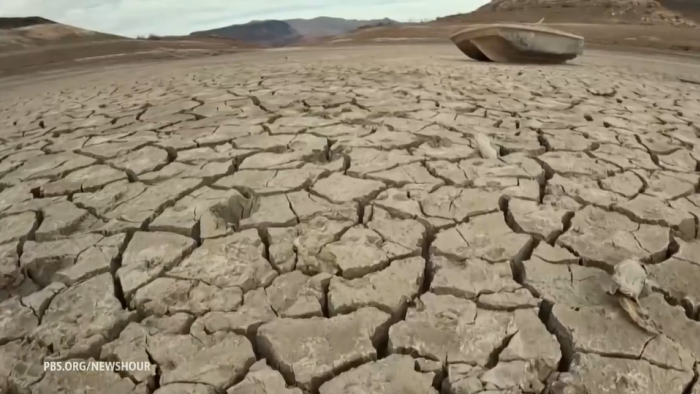
PBS NewsHour (6/23/26): “But with the changing climate, what hope is there for family farmers?”
The lone exception to the erasure of climate change on the nightly news broadcasts was PBS NewsHour (6/23/26). While the show didn’t lead headlines with extreme weather, its segment about the European heatwave included a soundbite from a Paris resident expressing dissatisfaction with how governments have ignored climate change. “Paris when temperatures go high is just hell on earth,” she said:
It’s catastrophic. I’m worried for the coming years. We have known about climate change for a while, and not one government is making progress on this issue.
Later in the broadcast, PBS dedicated a segment to droughts in the Southern US affecting farmers in Georgia. The report was part of an ongoing PBS series called Tipping Point, which focuses on the impacts of climate change and communities’ efforts to adapt.
Rachel Cleetus of the Union of Concerned Scientists explained:
Climate change is making these more frequent, both the short-duration kinds of droughts that we’re seeing in some places, but also the longer megadroughts like the Southwest is experiencing. The unpredictability of it, the extremes, both the droughts and then the whiplash with extreme rainfall events, that makes it very difficult to plan for these kinds of conditions.
The report went on to describe precision irrigation systems as a possible mitigation—though noting that their cost is often prohibitive. The segment points to “policy steps worth considering,” like helping farmers obtain these technologies through grants and low-cost loans.
PBS deserves credit as the only nightly broadcast that mentioned climate change at all. But while it addressed the issue of adaptation, it avoided the more fundamental question of causation; the burning of fossil fuels, and its connection to the segment’s weather horror stories, wasn’t mentioned at all.
FAIR (7/18/23) has previously documented that even when TV news connects extreme weather events to climate change, it seldom connects climate change to fossil fuels—but the industry seems to have taken a step backward.
The lack of climate coverage in legacy media follows a trend media analysts have been tracking since President Donald Trump’s second term began. A Media Matters study (3/4/26) found that ABC, CBS and NBC aired 35% less climate coverage in 2025 than in 2024. A FAIR study (4/14/26) found that trend mirrored in online news. But as coverage decreases, climate change’s effects only increase in frequency and severity.
From FAIR via This RSS Feed.