

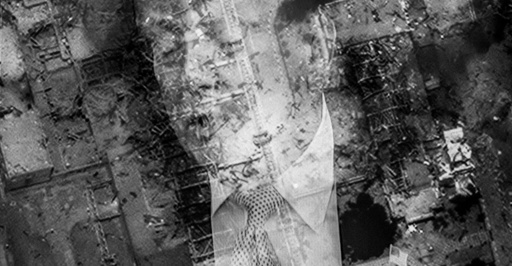
“Iran has insisted for decades that it was not developing a nuclear weapon, even as it pursued the bomb,” the Washington Post (6/15/26) editorialized. “Why would anyone now trust a promise not to pursue a bomb?” Rather, why should anyone trust the Washington Post when it has for decades asserted without evidence that Iran is pursuing a nuclear bomb?
The criminal US/Israeli war of aggression against Iran has killed upwards of 3,500 Iranians (Al Jazeera, 4/19/26; BBC, 4/23/26), injured more than 32,000, razed 22 schools, and damaged or destroyed 17 health facilities (Bloomberg, 4/21/26; Arab Center, 6/3/26). It hit a UNESCO World Heritage site, along with a vast array of civilian infrastructure (BBC, 4/7/26).
A healthy media ecosystem might soberly reflect on this carnage, and contemplate how the US and Israel should compensate Iran. In such a media context, perhaps news outlets would even welcome the strategic defeat the US and Israel have suffered in Iran (Middle East Eye, 6/9/26) as a victory for a besieged Global South nation defending itself from militarily superior attackers, and as deterrent for prospective aggressors embarking on future assaults.
Instead, the editorial boards of the New York Times (6/15/26), Wall Street Journal (6/16/26), Washington Post (6/15/26) and Bloomberg (6/17/26) provided often hallucinatory reflections on imperial management strategy. At the center of corporate media’s delusions is a contradiction: Iran is at once a behemoth that threatens the Middle East and the United States, and yet somehow also so weak that the US can and should dictate how it operates.
‘Terrorist proxies’
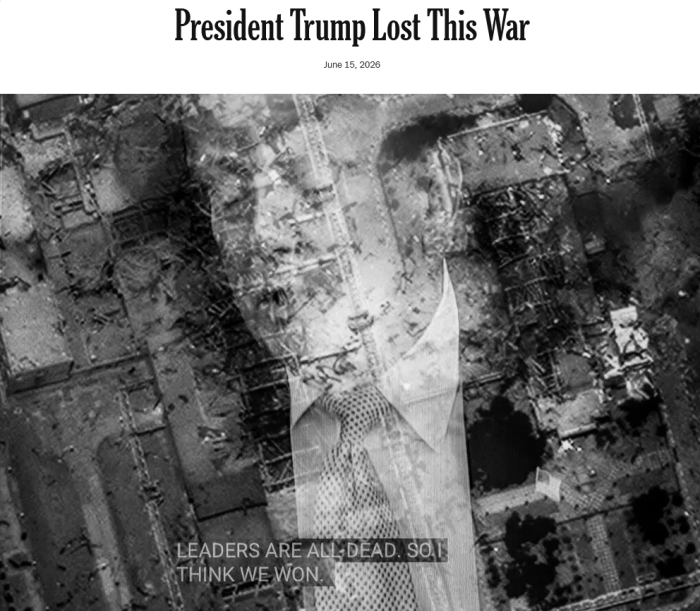
“Israel significantly diminished Hamas” is how the New York Times (6/15/26) describes killing at least 72,000 Palestinians, including 21,000 children.
While the New York Times (6/15/26) said that “Mr. Trump made a terrible mistake starting this war,” the paper nevertheless did its part for Iran demonology. It wrote that the country “support[s] terrorist groups like Hamas and Hezbollah,” and added that Iran “has financed terrorism . . . far beyond” its region. We are left to wonder where Iran has supposedly funded terror outside of the Middle East, because the Times did not deign to offer any evidence or even explanation for that crucial part of its allegation.
Bloomberg (6/17/26), meanwhile, said Iran “fund[s] terrorist proxies across the Middle East,” while the Washington Post (6/15/26) invoked what it called Iran’s “support of terrorists around the region.”
As the academic Nijmeh Ali points out, “Discourses of terrorism shape what counts as legitimate violence, resistance and political agency.” Reducing Hamas and Hezbollah to “terrorist groups” who exist outside of history (FAIR.org, 3/13/26), as the papers do does, dismisses them as barbarians, and justifies the vastly more deadly and destructive US/Israeli imperial-colonial violence against the Palestinian (Electronic Intifada, 7/26/18; FAIR.org, 10/9/25) and Lebanese people (FAIR.org, 10/10/24).
In these papers’ psychic universe, the “terrorist” threat is from those responding to US/Israeli wars of aggression and conquest (FAIR.org, 5/19/26; FAIR.org, 10/13/23). Those who killed 165 people, most of them children, on an apparent double-tap strike on a school (Middle East Eye, 3/5/26) are not “terrorists,” nor are those who have repeatedly, deliberately attacked Gaza’s hospitals. In such a framework, the empire’s violence—if it’s violence at all—is a non-problem, while that of the racialized Other is a danger that must be eradicated.
‘An existential threat’
Bloomberg (6/17/26) complains that “even a temporary lifting of oil sanctions will put money in the regime’s coffers”—suggesting that its preferred outcome would be a permanent blockade.
The papers saw perils in Iran’s weapons, real or imagined. Bloomberg (6/17/26) said that Iran’s “drones remain a potent threat” and that its missiles “pose threats” as well. In reality, the “threat” posed by Iranian drones and missiles is only to the US and Israel’s ability to wage war on Iran unimpeded. Drones and missiles aren’t prohibited under international law, and Iran has a right to possess them and use them against attackers. Nothing in the piece, of course, said anything about limiting US and Israeli weapons access. To US media, Iranians are a “threat” when they have conventional weapons like drones and missiles, while Americans and Israelis are entitled to possess not only equivalent armaments, but also nuclear weapons.
As always, the specter of a nuclear-armed Islamic Republic weighed on the imperial imagination, evidence be damned. The Wall Street Journal (6/16/26) wrote: “We’ve supported the President’s Iran policy. We’ve done so because a nuclear Iran would be an existential threat.” The authors contended that “the media critics and Democrats” rebuking Trump over the war “would have stood by while a nuclear bomb became a fait accompli.”
The paper went on to assert: “Iran’s attestation that it doesn’t seek the bomb is meaningless. It has always said that—and done the opposite.” This is untrue, as the editors of the Wall Street Journal would know if they read the Wall Street Journal’s reporting, which at the outset of the war quoted the head of the International Atomic Energy Agency (3/2/26) as saying that Iran “doesn’t have a program for building nuclear weapons currently.”
In the same vein, the Washington Post claimed that “Iran has insisted for decades that it was not developing a nuclear weapon, even as it pursued the bomb.” In March 2025, Director of National Intelligence Tulsi Gabbard said that “Iran is not building a nuclear weapon.” In March 2026, Gabbard told a Senate hearing that Iran had not conducted what CBS (3/18/26) called “enrichment activities” in the period since the June 2025 US/Israeli war on Iran.
‘Dishonorable people’
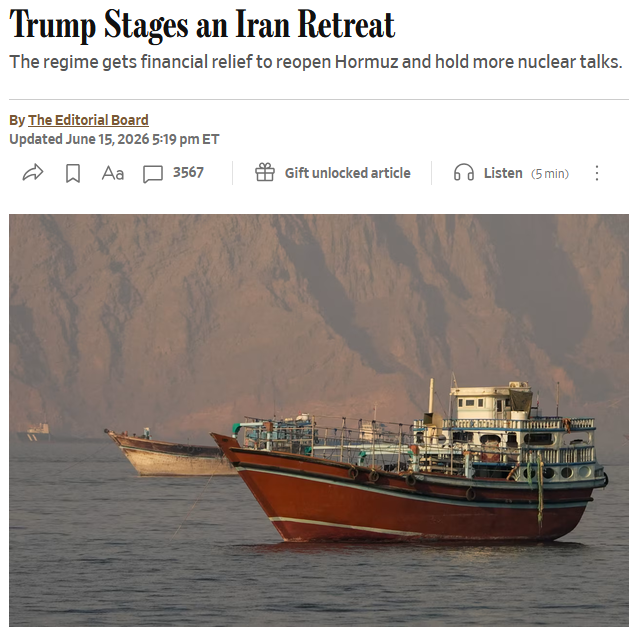
The Wall Street Journal (6/16/26) asserts that “the people of Iran…would be the big losers” if Iran were allowed to export its main resource—because that would “rescue the regime financially.”
Even as these papers shrieked about the supposed Iranian menace, Bloomberg, the Journal and the Post offered readers fantasies of imperial omnipotence.
Under the US/Iran agreement, negotiations over the nuclear issue will take place over the next 60 days. The Journal (6/16/26) complained that
pushing off the most difficult nuclear issues in talks with “dishonorable people” who don’t deal “in good faith,” as the president called them on Friday, doesn’t inspire confidence. If the regime won’t agree to dismantle its nuclear program now, why would it do so after weeks of oil exports and other relief?
Apart from parroting Trump’s racist invocation of the “shifty oriental” trope, the Journal’s question reflected its detachment from reality. The US and Israel lost the war (FAIR.org, 4/24/26). Suggesting that Trump should force Iran to “dismantle its nuclear program” is as sensible as writing that the US must keep South Vietnam from going Communist after Saigon had already fallen.
The Post asserted: “Eventually the Iranian nuclear program needs to be dealt with.”
The US tried to “deal with” it. Stopping Iran from developing the nuclear weapons that it isn’t developing was one of the main justifications Trump put forth for starting this year’s war. But, as the Intercept (6/15/26) reported, “There is no evidence that nuclear sites that were not attacked during Trump’s 2025 Iran war, such as Pickaxe Mountain, were ever damaged” in the 2026 US/Israeli offensive.
Bloomberg acknowledged that the US now had “less leverage” over Iran than when it started the war, but couldn’t help wishcasting about nuclear negotiations, saying:
The focus should extend beyond the fate of the country’s stockpiles of highly enriched uranium (which must be diluted or, preferably, shipped out of the country entirely) to other elements of its nuclear complex, including advanced centrifuges and research into potential weaponization.
The US launched a war of aggression on Iran that could ultimately cost the American public $1 trillion (CNBC, 4/14/26), and Iran not only survived but, thanks in large part to its demonstrable ability to close the Strait of Hormuz, is now strong enough that it could potentially attain regional primacy (Escalation Trap, 6/6/26). The US is, therefore, in no position to determine what Iran “must” or mustn’t do.
From FAIR via This RSS Feed.