

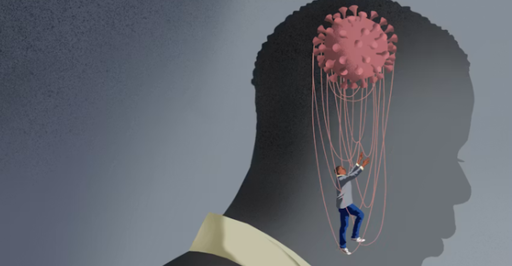
Since 2020, it has been well-documented that many people suffer new chronic symptoms following a Covid infection, including cognitive impairment, shortness of breath, fatigue, loss of smell, joint pain, vertigo, chronic tachycardia, tinnitus and more—similar to what was reported during the first SARS pandemic. In July 2021, the US government gave the condition known as “post-acute sequelae of Covid-19” (PASC) an ICD-10 (International Classification of Disease) code, identifying it as an official disease, as well as recognition as a disability. Patients popularized the term “Long Covid” to describe the condition.
There are still unanswered questions about how Long Covid functions and how its various subtypes relate. But the evidence of disease burden keeps piling on. In the last year alone, new studies have indicated that: 1) the prevalence of Long Covid may be much higher than assumed; 2) Long Covid is costing the world’s economy billions; and 3) some autoimmune symptoms of Long Covid can be transferred from humans into mice via autoantibodies.
You won’t find many articles about these studies and breakthroughs in national corporate media. Instead, you will find lengthy articles arguing that Long Covid is a psychological condition—that mass psychogenesis is a better explanation for millions of newly chronically sick people (and animals) than the Covid virus.
‘The truth’ is out there
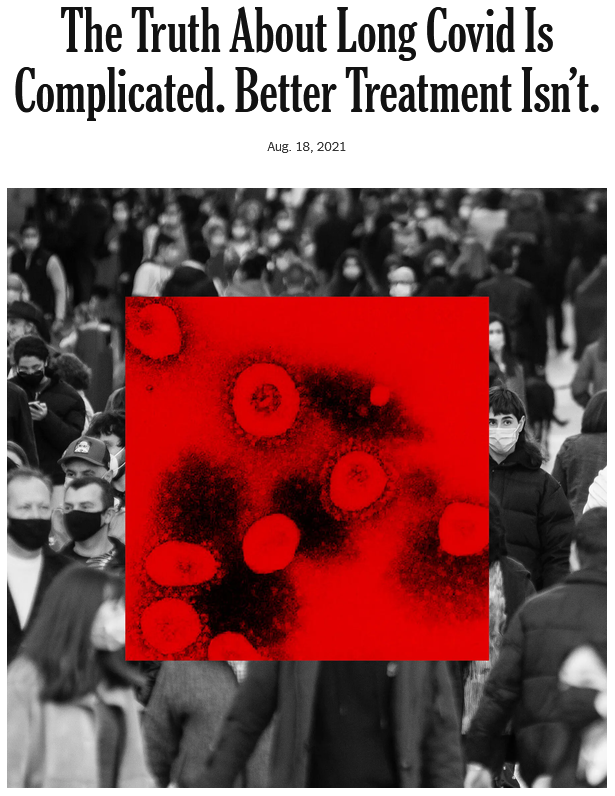
Adam Gaffney and Zackary Berger (New York Times, 8/18/21) argued that the illness might be caused by “the sharp increase in psychological distress amid the tragedy of the pandemic.”
The psychologizing of Long Covid has been a recurrent theme in the national media since 2020, especially in outlets that cultivate a high-minded audience. The idea has appeared in the New York Times (8/18/21), New Yorker (10/20/21), New Republic (12/8/22), Slate (3/19/23, 3/26/23), Time (11/15/23) and Wired (6/1/26), among others. Media outlets that trumpet their journalistic integrity and commitment to facts have used their prestige to launder an unproven, anti-science conspiracy theory, often with headlines that refer to “the truth” about Long Covid.
The Atlantic (e.g. 9/12/22, 9/26/22) has been a notable exception, where journalist Ed Yong did award-winning Long Covid coverage from a scientific and patient-centered perspective. Mother Jones (e.g., 8/6/24, 7/19/24) also has disability coverage that consistently frames Long Covid as a medical crisis.
Perhaps surprisingly, the conservative New York Post (e.g., 2/16/24, 7/27/25, 2/1/26, 2/10/26) reports frequently on advances in Long Covid research, covering stories ignored by the centrist and liberal outlets listed above, although the Post (2/15/24, 12/4/25) has also published contrary opinion pieces.
Most of the skeptical coverage on Long Covid draws on the history of the psychologization of chronic diseases that Covid commonly causes, especially Myalgic Encephalomyelitis, also known as Chronic Fatigue Syndrome (ME/CFS). The disease causes energy and exercise limitations, sometimes severe. Studies estimate about 50% of people with Long Covid meet the criteria for ME/CFS.
Despite more than 30 years of research confirming the biological mechanisms involved in ME/CFS—which are acknowledged by the CDC—experts are often drowned out in the media by a cadre of psychiatrists and others determined to frame it as a mental health issue.
To varying degrees, articles that psychologize Long Covid tend to acknowledge that the physical symptoms experienced by patients are real, just unlikely to be caused by the Covid virus or any other biological origin. They often point to a vague mind-body paradigm as an explanation, but one in which the mind controls the body far more than the reverse. Overall, these articles emphasize that patients would benefit more from mental health and/or social service solutions than research and medicine.
The ‘brain retraining’ solution

Wired*‘s piece (6/1/26) faced criticism for cherry-picking data and patient accounts. As Virology Blog (6/9/26) noted, “Levinovitz is straining mightily to interpret patients’ experiences in ways that conform to a preferred narrative.”*
A recent piece in Wired (6/1/26), titled “The Painful Truth About Long Covid,” advocated for a model known as “brain retraining” to treat Long Covid. This approach focuses on rewiring the brain to not overreact to perceived threats, based on the belief that the overreaction, not the exposure, is the primary driver of symptoms. The article cited some patients who say they benefited from the approach.
The author, Alan Levinovitz, previously disclosed his views more bluntly on X last year, posting, “I happen to believe 60–80% of Long Covid is…psychogenic symptoms/illness.”
In Wired, Levinovitz took aim at claims that Long Covid patients with ME/CFS are limited in their ability to exercise. He argued that the problem isn’t exercise, but the belief that exercise is harmful. “Patients cursed themselves by believing their symptoms had a strictly biological cause,” he wrote.
Levinovitz cited an influential British study from 2011, known as the PACE trial, which determined that Cognitive-Behavioral Therapy and guided exercise were appropriate treatments for ME/CFS. While he acknowledged that the PACE trial faced backlash and fell out of favor, he failed to mention that scientists determined the study was invalid due to improper methodologies. Levinovitz portrayed patient advocates as misguided fanatics who have interfered with progress by pushing back on PACE and exercise/mind-body approaches.
The Wired article has faced mass outrage and criticism from patients, scientists, doctors and journalists. Articles and social media threads have debunked its claims on scientific grounds, citing its omission of key studies, including mind-body studies that did not support the model’s effectiveness. People mentioned in the article have spoken out against how they were represented. Some critics have shared their own experiences with brain retraining, describing it as a cult-like multi-level marketing scheme.
After publication, Levinovitz spent days fighting with critics online, dismissing research findings and issuing personal attacks, even going after one woman’s efforts to crowdfund for her medical care. (He has since deleted some posts, and acknowledged that he misstated facts in one thread.)
A petition is circulating, calling for the article’s retraction, signed by more than 1,700 people. Wired’s only response has been to issue an “update,” acknowledging two corrections. One was significant: The author mistakenly referred to Myalgic Encephalomyelitis as “Myalgic Encephelitis.” The outlet has not responded to questions from FAIR about the article, including about whether it was factchecked.
The ‘functional’ theory
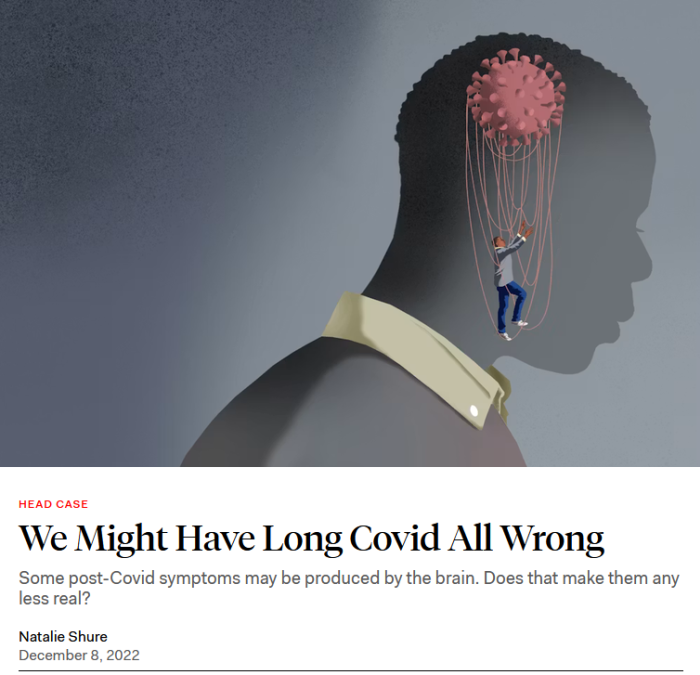
“A chronic illness that appeared to be triggered by viral infection could just as easily have been triggered by the trauma of the pandemic itself,” Natalie Shure asserted in the New Republic (12/8/22).
Long Covid advocates similarly campaigned against a 2022 article in the New Republic (12/8/22) by journalist Natalie Shure, which argued that the disease might be a functional neurological disorder (FND), a popular belief among the skeptical crowd. Formerly known as conversion disorder, FNDs are thought to be psychological in origin. They are often used as a catch-all for diseases without clear explanation—a modern-day “hysteria” diagnosis. Like Levinovitz, Shure doubted that exercise can be seriously harmful for people with ME/CFS.
A letter published in the Public Herald (1/25/23), signed by over 200 medical doctors, researchers and patients (including myself), gave a point-by-point rebuttal to Shure’s article. The New Republic issued only a small correction, but never again published Shure, who had been a consistent contributor until then.
Shure, as it happens, is married to Dr. Adam Gaffney, an early and vocal skeptic of Long Covid. In a February 2021 blog post, he wrote that we should “question the causal link between the virus and some ‘Long Covid’ symptoms.” He also argued that Long Covid was showing up mostly in wealthy white people. In fact, studies show that Black and Hispanic people have higher rates of the disease than whites.
In August 2021, the New York Times (8/18/21) published an op-ed by Gaffney and Dr. Zackary Berger with a “truth about Long Covid” headline. It argued that funding should not be wasted on researching Long Covid, but that patients could benefit from counseling and social services. Since Gaffney’s op-ed, research has uncovered mitochondrial dysfunction, vascular issues and reactivation of Epstein-Barr in Long Covid patients.

“Research directed at finding diagnostic and mechanistic clues to Long Covid” is a waste of time, Steven Phillips and Michelle Williams wrote in Time (11/15/23), because there may be “nothing to find.”
A Time magazine article (11/15/23) echoed Gaffney’s concerns about research funding. “But what if the medical research community spends years and hundreds more millions of dollars digging a dry hole?” the article by Steven Phillips and Michelle Williams asked.
This rhetoric has a familiar antecedent: “What if someone showed you that billions of tax dollars may have been spent chasing the wrong cause of AIDS?” Nightline (4/4/94) asked in a 1994 segment titled “Is HIV the Causative AIDS Agent?” The idea that AIDS had a different cause than HIV was popular during the first six or so years of the pandemic, before the discovery of HIV medications. Still, the theory appeared in Harper’s Magazine (3/06) as late as 2006, and on Joe Rogan’s podcast multiple times (11/7/12, 2/13/24).
During the 1980s, AIDS deniers promoted homophobic ideas that the disease was caused by lifestyle choices or spiritual malaise. With Long Covid, skeptics promote lifestyle judgments around exercise and mental health. Patients who are bedbound are accused of “deconditioning” and/or an irrational fear of exercise.
Since 2020, numerous professional athletes, who probably do not fear exercise, have described a sudden onset of incapacity following infection, not from weeks or months spent deconditioning in bed.
The biomarker issue

One recent study (Cell, 5/28/26; NIH, 6/17/26) found that healthy mice developed Long Covid symptoms when injected with autoantibodies from patients.
“There is no ‘Long Covid,’” Levinovitz posted on X, just after publishing his article advocating for brain retraining to treat it. “Nothing about Long Covid adds up,” his Wired story (6/1/26) started, citing conflicting information about prevalence.
These articles exploit the fact that Long Covid is a misunderstood and heterogenous illness to make it seem unintelligible and impossible. But Long Covid/PASC has always been defined as an umbrella diagnosis. Per the ICD-10, PASC includes anyone who has suffered chronic symptoms post-infection for three or more months. That can include gastroparesis, kidney disease, cognitive impairment or an immune system disorder. The Long Covid skeptics are rarely clear about which symptoms and conditions they believe would respond to therapy, exercise and mind-body awareness.
Most Long Covid skeptics treat the fact that the disease doesn’t have a single “biomarker” as an easy way to invalidate it. As Levinovitz wrote, “Part of the definitional problem for long Covid is the absence of definitive biomarkers: genes, antibodies, any unique physiological signature of the illness.”
Evidence of absence is not absence of evidence. Long Covid research is still advancing, with limited funding relative to its impact. A unique biomarker, like indication of persistent viral activation, might one day be discovered in people with chronic symptoms.
Biomarkers are not necessary to define a disease. Some diseases, like Sjogren syndrome and migraines, are diagnosed clinically, based on symptoms. Many diseases, including multiple sclerosis, Alzheimer’s disease and lupus, were diagnosed clinically until biomarkers were discovered, and even those markers aren’t always considered absolute indicators.
Long Covid may not have a single biomarker yet, but patients often do have biomarkers, like abnormal lymphocytes, irregular tachycardia and/or [reactivated infections](https://www.thelancet.com/journals/langlo/article/PIIS2214-109X(2400010-X/fulltext). Providers willing to order those tests often don’t take insurance and can be hard to locate.
Both Shure and Gaffney further question if it’s possible to even identify a Long Covid patient. To them, the fact that many alleged patients didn’t have antibodies showing after a Covid infection was a slam-dunk reason to doubt Long Covid. But studies show that a significant percentage of infected people do not seroconvert—create antibodies—and those patients are more likely to develop Long Covid.
Investigative journalism or opinion?

Slate‘s Jeff Wise (3/19/23) hopes to put Long Covid in the rearview mirror so we can join Joe Biden in declaring that “Covid no longer controls our lives.”
Most of the articles psychologizing Long Covid look like long-form investigative journalism. They include data and quotes from purported experts, often the same group of contrarians. Yet few of these articles were written by health journalists. Shure is an exception, a journalist who writes often about health issues, though usually from a sociopolitical perspective.
Levinovitz is a professor of religion who has written one article on Long Covid in the past, as well as a book arguing that people’s food sensitivities are often psychological. In Wired (6/1/26), he refers to the arguments around Long Covid as a “religious war.”
In 2023, Slate (3/19/23) published a much-criticized article that attempted to discount Long Covid altogether. It was written by Jeff Wise, who reports mostly on aviation and psychology. He is best known for his work on the missing flight MH370, although he received criticism, including from aviation experts, for pushing conspiracy theories in a documentary on that subject.
Wise published a book in 2009 titled Extreme Fear: The Science of Your Mind in Danger, which might explain his interest in Long Covid. He has argued online that ME/CFS patients face a fear of exercise. Some of these writers seem to be applying their specialized thought experiments to Long Covid.
Slate (3/26/23) published a second article in 2023, headlined “Is Long Covid Linked to Mental Illness?” that cited Gaffney and argued for a possible psychosomatic understanding of the disease. The writer, Grace Huckins, is a neuroscience PhD student interested in mind-body connections.
“As of yet, there is no conclusive proof that stress or mental illness can contribute to Long Covid,” she wrote. She then posed a bunch of hypotheticals, including:
If psychological factors have a considerable role to play in generating and maintaining Long Covid, then psychological treatments should be studied just as rigorously as drugs like Paxlovid.
Huckins did not acknowledge that psychiatric medications like low-dose Abilify are often given off-label to treat Long Covid, but not for their psychological properties.
Most of these writers previously disclosed their skeptical views on Long Covid before publishing long-form stories on the illness. Why are news outlets outsourcing articles about one of the most important health stories of the decade to ax-grinders? If the media wanted to inform the public about Long Covid, there are many qualified writers who share information and findings, in journals like Nature and outlets like the Sick Times.
National corporate media have created a controversy—”is Long Covid a real medical disease?”—which never existed in any serious form among the experts who research Covid, instead of investigating the actual nuanced debates in that field, like whether viral persistence drives symptoms. These media have given credibility to writers eager to entertain the supposed controversy, while marginalizing writers who start from the premise, widely shared among actual researchers, that Long Covid is a medical disease.
There is a similar trend in the media when it comes to trans issues, as FAIR (12/1/25) previously reported. The media consider sources to be “neutral” when they aren’t “deeply involved in the issue,” which excludes both medical experts and people actually receiving gender-affirming care.
Old media habits

Justine Barron (FAIR.org, 1/12/26): “Media amplify the biased hot takes of random individuals on social media who push the age-old narrative that disability is dubious.”
Long Covid is not the only disease or disability to be treated skeptically and/or psychologized in the media. Media treatment of chronic disease and disability is a consequence of newsrooms with poor disability representation.
As I wrote about for FAIR (1/12/26), media have a habit of assuming that claims of disability and disease are overstated, including when students say they need accommodation. A New York Times series (11/9/21) posited that pain is largely driven by the mind, not broken bones or pinched nerves, so it could be treated with psychotherapy.
Stories psychologizing Long Covid also support a media agenda to minimize the Covid pandemic generally (FAIR.org, 1/10/23). The Biden administration declared the pandemic over after the introduction of vaccines, and stopped collecting consistent data on transmission and death. Outlets like NPR followed suit, regularly referring to the current era as “post-Covid.” Yet Covid wastewater levels show that the virus has continued surging in the years since, sometimes to levels higher than in 2020.
By neglecting to report seriously on Long Covid, corporate media often miss a huge part of the stories they tell. For instance, some media outlets (e.g., ABC News, 2/3/25) did report on a 2025 CDC study that more than 1 million children in the US have Long Covid, which was data from 2023. A more recent study indicates that Long Covid is now the No. 1 chronic illness in children in the US, surpassing asthma.
Yet Long Covid isn’t mentioned in media reports on the crisis in chronic student absenteeism (e.g., New York Times, 2/2/24; Washington Post, 5/7/22; New Yorker, 1/15/24), or the crisis in childhood test scores and cognition (e.g., AP, 6/10/26; New Yorker, 6/12/26). Instead, the media tend to scratch their collective head and blame anxiety, screens and lockdowns.
The media tendency to ignore, deny and/or psychologize Long Covid causes significant harm to both patients and the general public, who are not being warned of the risk. Patients face disbelief and bigotry from families, workplaces and even doctors, who often get more information from the media than from journals. The gulf between medical research and practice is estimated to be 17 years on average.
Prejudices against patients are reinforced when a news outlet’s most in-depth, academic-sounding articles on Long Covid attempt to undermine the reality of the disease.
From FAIR via This RSS Feed.