

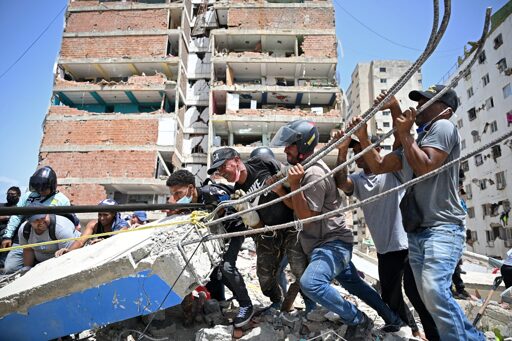
The images are harrowing: whole neighborhood blocks in rubble. Buildings collapsed. Rescue workers climbing over mountains of concrete debris fighting to find the survivors, working through the night.
A country already in crisis and shock after the Jan. 3 US invasion has been hit with another catastrophe.
A pair of back-to-back earthquakes hit Venezuela at 6:04PM local time on Wednesday, June 24. The first registered 7.2. The second struck just 38 seconds later. It was a magnitude of 7.5.
The epicenter of the quake was roughly 100 miles west of Caracas, Venezuela’s capital, but was felt as far away as Colombia and Manaus, Brazil. Reports say it was the largest earthquake to hit the country in more than a century.
Videos taken during the earthquakes show buildings rocking, the concourse of the country’s main airport shaking and crumbling as people run. The airport is now closed.
As of Friday afternoon, the death toll had risen to 920 people, with more than 3,300 people injured. Reports say the death count could rise to anywhere between 10,000 and 100,000 people.
More than 200 aftershocks have rumbled through Caracas. Many people slept outside in the streets Wednesday night for fear of the aftershocks and the structural integrity of their buildings.
The country is in a state of emergency.
La Guaira, the coastal city just north of Caracas where Venezuela’s main airport is located, has been devastated. It has been declared a “disaster zone” because of the number of buildings knocked to the ground.
#Venezuela | La Guaira suffered huge damage after a series of strong earthquakes on June 24.
Aerial images taken on June 25 reveal a high level of destruction in many areas of the region. Rescue teams are working tirelessly to help the victims still trapped under the rubble.… pic.twitter.com/P373bjO4BA
— teleSUR English (@telesurenglish) June 25, 2026
This is not the first time this year La Guaira has been impacted by disaster. The United States bombed here during its Jan. 3 invasion, hitting an apartment complex and a dialysis supply distribution center.
Tragedy has now struck again.
Many countries have pledged solidarity and support, including Iran, Mexico, Brazil, and Cuba. Even Spain, France, and the United States. US Secretary of State Marco Rubio said the US Department of War would play a “big logistical role” in the response to the earthquake. The United States will likely swoop in and play savior amid the crisis, having already announced that it is deploying warships, planes and helicopters to support search and rescue operations in the country. Given recent events, however, fears remain that the United States could try to use the tragedy as an excuse to place troops on the ground, permanently.
That is a major concern. Venezuela has reason to be wary. For centuries, the United States has taken advantage of tragedies and wars to push its agenda abroad.
Meanwhile, the United States has still not fully lifted its sanctions on the country. Experts say this could block others from helping in the relief efforts.
“We have seen in previous instances how US sanctions have restricted and hampered earthquake relief efforts,” the Center for Economic and Policy Research’s Alex Main said in a statement. “The Venezuelan government must be free to receive and allocate earthquake relief and to send humanitarian support to those who need it. Current US and other sanctions threaten to hobble the overall earthquake response.”
The United States and Donald Trump, in particular, should not just lift the sanctions, but also foot the bill for the emergency operations and rebuilding of Venezuela. President Donald Trump has a unique responsibility for the suffering unleashed across Venezuela over the last decade.
Beyond his blustering suggestions and jokes that he should run Venezuela, Trump has actually played a prominent role in ruining Venezuela, devastating the economy, and reaping the benefits over the last decade.
U.S. President Barack Obama first levied sanctions on Venezuela in 2015. But once in office, during his first term, Trump accelerated them.
Those sanctions ran the country into the ground—as I have reported on in depth for TRNN in the past (here, here and here). They ground the economy to a halt. Blocked the country’s sale of oil. Banned other countries and companies from trading with Venezuela. They forced US companies to pull out of the country. They halted the import of medicine and essential parts for cars, industry, and even the country’s water system. The disastrous impact on the economy pushed millions of Venezuelans to leave their homes and flee the country, many heading for the United States.
Last year, Trump spent months ramping up threats against the country, levying allegations of drug trafficking against Venezuela’s president, even while he pardoned the convicted Honduran drug trafficking kingpin Juan Orlando Hernandez.
Then, on Jan. 3, 2026, Trump ordered the invasion of Venezuela. The US dropped bombs across Caracas that night. They invaded with more than 150 aircraft from 20 bases across the Western Hemisphere. US forces killed more than 100 people.
Trump removed the country’s president, Nicolas Maduro, kidnapping him and first lady, Cilia Flores, on allegations of drug trafficking.
That morning, Trump said “we’re going to run Venezuela” and control the country’s oil reserves. Trump has strong-armed acting President Delcy Rodriguez ever since under threat of more bombing raids.
Rodriguez has agreed to open up the Venezuelan economy to the United States and to US businesses. Just days after the invasion, Trump announced that Venezuela would be “turning over” between 30 and 50 million barrels of “sanctioned oil” to the United States, worth roughly $2 billion.
That was just the beginning.
Yesterday, Trump claimed the United States had recovered the cost of its invasion 28 times over.
That’s a lot of money.
US military officials said that more than 150 US aircraft—including fighter planes, bombers, surveillance aircraft, and helicopters—participated in the invasion. They dropped countless bombs and missiles across the capital, Caracas, and the surrounding region.
According to the National Priorities Project, every B-1 bomber cost $91,330 an hour to operate. The F-22A Raptors fighter planes cost $56,511 an hour, and the MH-47G Chinook helicopters each cost $9,663 an hour.
Multiply those by the four or five hours the operation took to fly in, attack, and then back out of Venezuela, and then by the 150 aircraft that participated in the action, and you’re talking about millions and millions of US taxpayer dollars spent on invading a foreign sovereign nation in order to kidnap that country’s president. And that doesn’t include the cost of the bombs dropped.
A 2020 article from TWZ, which covers the defense industry, detailed that Air Force small-diameter precision bombs can cost anywhere from $39,000 up to hundreds of thousands of dollars. Air Force air-to-surface Hellfire missiles run from $70,000 each to millions of dollars depending on the guidance system and the range.
We do not know how many bombs were dropped, but numerous locations were targeted across Caracas and the surrounding region.
Millions of US dollars were spent on attacking Venezuela and kidnapping the country’s president. Dollars spent on war, destruction and violence.
The annual Pentagon budget is over $1 trillion a year. Trump’s 2025 “Big Beautiful Bill” allocated $170 billion dollars for immigration enforcement over the next four years.
All of this money will be spent on violence, policing, enforcement, coercion and war.
Trump’s net worth is estimated at roughly $6 billion.
It’s about time that he and the United States begin to spend their money not on ripping communities and countries apart, but rather on building them up and bringing them back together.
“The US carries a huge responsibility: sanctions have a devastating impact on infrastructure and the healthcare system has been severely weakened over time,” a resident of El Panal Commune in Caracas wrote to independent press abroad. “Please let this be known, and demand that the US release all retained Venezuelan funds and lift sanctions. Also, let it be known that the government is acting effectively and that there is grassroots mobilization and solidarity is flowing.”
From The Real News Network via This RSS Feed.
Oh, we’re paying for this. We’re paying for EVERYTHING. Anything to keep Americans from having health care.