

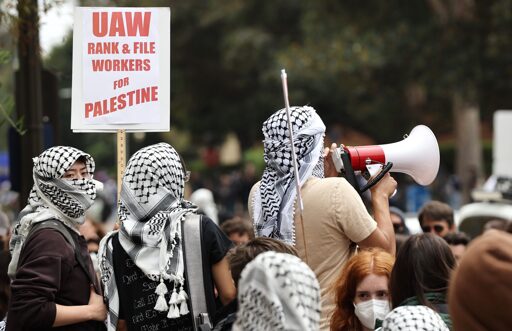
At the 39th Constitutional Convention of the United Auto Workers (UAW) in Detroit, Michigan, union delegates debated and affirmed the aggressive direction the UAW has taken under current President Shawn Fain, supporting pushes to increase shop-floor militancy, support new organizing efforts, and take stronger stances on the political crises working people face today. Among the major developments to come out of the UAW Constitutional Convention was a historic vote to divest the union from Israel bonds, which provide financial support to Israel’s government as it continues to wage a US-backed campaign of genocidal violence and ethnic cleansing against Palestinians. In this episode, we break down this historic vote and what it means for union members with a panel of rank-and-file workers and members of Unite All Workers for Democracy (UAWD), a left-wing caucus within the UAW.
Panelists include: Andrew Bergman, a worker at General Motors in Detroit, Michigan, a member of UAW Local 22, and co-chair of UAWD; Navruz Baum, a paralegal in New York, a member of UAW Local 2325, and a member of the UAWD Steering Committee; Margie Thornton, an attorney in Colorado, a member of UAW Local 2320, and a member of the UAWD Steering Committee; and Mike Davis, an auto parts worker in Ohio, a member of UAW Local 2021, and a member of UAWD.
Additional links/info:
- Unite All Workers for Democracy (UAWD) website, member platform, and donation page
- Navruz Baum, Daily Struggle, “UAW divests from Israel bonds”
- Dan DiMaggio & Jane Slaughter, Labor Notes, “Auto worker delegates back union’s fighting direction at UAW Convention”
- Shireen Akram-Boshar, Truthout, “United Auto Workers vote to divest from Israel in historic victory”
Featured Music:
- Jules Taylor, Working People Theme Song
Credits:
- Audio Post-Production: Jules Taylor
Transcript
The following is a rushed transcript and may contain errors. It will be updated as soon as possible.
Maximillian Alvarez:
All right. Welcome everyone to Working People, a podcast about the lives, jobs, dreams, and struggles of the working class today. Working People is a proud member of the Labor Radio Podcast Network and is brought to you in partnership with In These Times Magazine and the Real News Network. This show is produced by Jules Taylor and made possible by the support of listeners like you. My name is Maximillian Alvarez and we’ve got a really incredible panel of folks today with the United Auto Workers. We’re going to get a worker’s eye view of the huge changes that are happening and have been happening within the Mighty UAW. And those changes were on display earlier this month at the UAW Constitutional Convention in Detroit. As Dan DiMaggio and Jane Slaughter report at Labor Notes, “Delegates at the United Auto Workers Constitutional Convention affirmed the aggressive direction the Union has taken under President Shawn Fain, who took office in 2023 and immediately set the 400,000 member union on a new path illustrated in bold campaigns like the standup strike against the big three automakers.
The thousand delegates who assembled in Detroit voted to increase the money designated for new organizing and to maintain dues at 2.5 hours per month in order to bulk up the strike fund. The Union is looking ahead to a projected rematch with the Big Three on Mayday 2028 when contracts covering 150,000 auto workers expire. The UAW has called on other unions to align their fights then too to build more leverage on employers and politicians and win big demands.” Now this is all of course really important for UAW members and for the labor movement writ large and we are going to talk about that with our guests today, but we’re also going to focus on another really important development that came out of the UAW’s 39th Constitutional Convention. As Shireen Akram Bouchar reports a truth out, quote, “The United Auto Workers, a union with some 400,000 active members across the US has voted to divest its estimated $400,000 from Israel bonds.
The divestment vote makes the UAW the first major national union to vote to divest from Israel. The resolution states that the billionaire clas that profits from war funnels public money into militarism instead of healthcare, housing and education working people need. It cites the nearly three year long genocide in Gaza and the call by the Palestinian Trade Union Movement for workers internationally to act in solidarity as among the reasons for its resolution to divest from Israel bonds, which are bonds issued directly by Israel and function as loans to the Israeli government. The vote was organized by Unite All Workers for Democracy or UAWD, a left wing caucus within the UAW and UAW labor for Palestine, which is part of a broader labor for Palestine Coalition.” To talk about this historic move by the UAW and what it means for UAW members, for the labor movement, and for the Palestine solidarity movement, I am really grateful to be joined on the show by four guests today.
Andrew Bergman is a worker at General Motors in Detroit. He’s a member of UAW Local 22 and co-chair of UAWD. Navruz Baum is a paralegal in New York, a member of UAW Local 2325 and a member of the UAWD steering committee. Margie Thornton is an attorney in Colorado, a member of UAW Local 2320 and a member of the UAWD steering committee. And Mike Davis is an auto parts worker in Ohio, a member of UAW Local 2021 and a member of UAWD. Andrew, Navruz, Margie, Mike, thank you all so much for joining me today. It’s incredible that I have you all on this panel right now. I want to start our discussion with this historic vote by the UAW and its membership to divest from Israel. So I wanted to ask you guys, as union members and as working people in America, why is this an important issue for you and what does the passing of this resolution mean to you?
Navruz Baum:
I would say a few things. First of all, there’s currently an ongoing genocide in Palestine and workers every day are being killed and murdered by Israel. Israel is also wreaking havoc and destruction in the entire region, bombing Lebanon, bombing Iran, bombing other countries and murdering civilians. And they’re doing this with the active assistance of the US and financial assistance from up until very recently institutions like the UAW. And so just as people of conscience, it was really important for us to not be complicit in this ongoing genocide. Secondly, as members of the working class who want better living conditions, money that goes to Israel to bomb people, bomb children in other countries is money that is not going to healthcare, to housing, to food to support us. And it’s just totally unconscionable to us that the resources, the wealth that we produce every day as workers is being appropriated to fund misery and death instead of being used to improve our own living conditions.
And lastly, I would just say that as members of the working class, as rank and file members of the UAW, it’s really important that we have a say in how these resources are being used and that when we’re having that say, it’s driven by our values and what actually benefits us. And so we’re not content with just having some bureaucrats decide where all this money that we’ve paid in dues is invested, wherever they think makes sense per their politics or the highest return. We believe that as workers, as members of the UAW, we deserve a say in where this money goes.
Mike Davis:
It’s important because we’ve just spent the last three years watching a genocide be livestreamed and it’s sickening. And as Navruz said, our dues dollars are funding this and it shouldn’t be happening at all. But as far as what does it mean going forward, it means we’re on the right track, but we also have a lot more work to do. I don’t know if you read our other resolution, but it had a lot more language in there that called for work stoppages and it also called for us not to endorse politicians who take money from these type of people.
Margie Thornton:
I would say that there’s a mantra in the labor movement that the dudes are sacred, the members does are sacred. And we’ve seen across the globe really the working class take to the streets and protest and scream at the top of our lungs basically about where our tax dollars are going. And that doesn’t seem to have any impact, but those sacred dues, those dollars that we can decide we can have a voice. If we organize the members, we can’t decide where those go. So being able to withhold those while we can’t withhold our tax dollars is, I mean, it’s the least we can do in response to the call for solidarity.
Andrew Bergman:
Yeah. I think of just all these conversations I’ve had over the last year. We were working all this mandatory overtime in 2024 in my plan and we were just in the plant together, 12-hour shifts, six days a week. So we spent a lot of time together. People who don’t usually want to talk about politics, we’re talking about politics. We were talking about everything with our coworkers out there and Palestine came up a lot and I was kind of in my plan. Everyone know, that guy’s the troublemaker, that guy wants to talk about politics. But people would come up to me and be like, “What do you think about what’s going on? ” This was a live question. This is a plan in Detroit. It’s a lot of folks, it’s a majority Black folks who have definitely, I think in the working class in the United States, it’s not just on the basis of race, but a lot of people have really been subject to oppression.
And when they watch the news, they I think and myself connect with the Palestinians who are being oppressed and are being subjugated. And so it was a regular conversation. Why is our country doing this? Why is our union actually supporting this? And we wouldn’t get into the weeds on Israel bonds. It was more just like, why aren’t we being clear? And a lot of people I think were very excited when Sean Vain took a rhetorical position on this question, but then to sort of see that not followed up with any action, and that’s something UAWD has talked about a lot, that was disappointing. So I think a lot of folks are really excited about this even who are not particularly political. And then the other thing that comes to mind is just after this happened, I was in Dearborn and we were near Local 600, there’s a big mosque right down the road.
And a lot of the folks in that mosque are UAW members. So we were talk actually because we were doing some interviews for our social media just to connect with folks in that community about what this meant to them. And we have these really beautiful kind of passionate conversations with folks who are just like, what does it mean to be here in this country and kind of be surrounded by people and then see your union, which you’ve kind of been unsure about or hasn’t really taken the right position, but you knew it used to. It stood up for Nelson Mandela, it stood up against apartheid to take that position now. So I think it just has this emotional moral character for myself and a lot of other people separate from the important left politics. It’s just a meaningful thing at an emotional level.
Navruz Baum:
Something we really hold sacred in the Libor Movement is that we respect each other’s picket lines and we don’t undermine other workers. And this is a part of that because there’s been a call from the Palestinian Trade Union Movement to respect BDS and to not do financial investments or other business with Israel. And unfortunately, the UAW has been crossing that picket line for decades. And so with this vote, we’re really proud to finally be respecting the BDS call in that respect, respecting the call from the Palestinian Trade Union Movement so that we can stand in solidarity as American, Canadian and Puerto Rican workers here in the UAW with members of the working class and workers in unions in Palestine.
Andrew Bergman:
There’s this very well known, at least on the left, wildcat strike that forward workers, especially Arab American Ford workers led in 1973 to push for divestment from the UAW and Israel bonds. That is over 50 years ago and they succeeded in small part because they got local 600. So when I was there in Dearborn just yesterday down the road, like a five-minute walk from Local 600 and I was asking people what that resonance was, I mean, it was beautiful because on the one hand, people were very excited about it, but on the other hand, not very many people knew about that wildcat. And so I think it’s a testament both to how important that thread can be through history, but then also how little known it can become and how they kept a light on and it got passed on, but through a small group of people who kept fighting.
And the culmination that we had last week was not just the four of us or even just UAWD or even just UAW labor for Palestine, which hopefully we’ll talk about, but it was this movement of thousands and thousands of people across the decades.
Maximillian Alvarez:
Well, let’s talk about that right now actually, because I really want to impress upon listeners that this was such a hard won victory that has taken decades to accomplish because we’re talking about from the public consciousness around Israel-Palestine, which changed dramatically in this country over the past three and a half years, we’re talking about the changes within the UAW itself, right? This is a very different union than the UAW that I knew when I started this show eight years ago. And of course there’s been just a global movement in solidarity with the Palestinian people, a movement to stop the genocide, to stop the occupation and to stop US support of all of it. So I wanted to ask y’all if you could talk more about that path that led to this moment and the obstacles that were overcome, the growth that had to happen in you as individuals and for your union.
Navruz Baum:
I can speak to my local 23, 25, and I hope that others can also speak to their locals. But in local 23, 25, we’ve definitely had a contingent of members who’ve been fighting for strong internationalist stance for standing with members of the working class around the world for many, many decades. The strength and size of that contingent has fluctuated over the years. I will say that I think post October 7th, 2023, when Israel really escalated its genocide, a new coalition, a new majority around Palestinian solidarity was formed in my local. And at first it was really hard fought and there was a lot of really incredible organizing that happened telling people why, yes, it’s difficult to take a stance on this issue. Yes, you’re going to get a lot of shit from it. A lot of people are going to yell at you. You might get doxed.
Multiple people in my union have been the targets of online harassment campaign. Multiple people have been fired by their employers in my local coming out of those online harassment campaigns. And yet why, despite of all of that, it’s important for us to take an issue on Palestine anyways. As of now, I think that we’ve done a lot of organizing and we’ve gotten pretty used to taking pro- Palestine positions in my local. So when it came time to endorse this amendment and send it to the International UAW Convention, there was a strong majority of my local for it. There was still some arguments about whether this is the right time, whether this is really the right issue to bring to the International Convention, whether other locals are ready for it. I hope that folks from other locals can speak to that because obviously they were, but it’s definitely been a long struggle in my local.
And I think that it’s been a microcosm of what’s been happening in our country and in the world more broadly around Palestinian solidarity. And it’s absolutely in the environment of pro- Palestine organizing in New York City where my local is, where a lot of people are members of other Palestinian solidarity organizations and have learned organizing and learned about the importance of solidarity with Palestinians through other organizations in the broader environment and also brought those politics into our local. And lastly, I would just say that watching the solidarity and actions of the global working class for Palestine, which honestly, a lot of it has gone a lot further than just divesting from Israel bonds has been an incredible and perpetual inspiration to us and also always driven home the urgency for us to also take the action that we can within our union. And I do think that Mike actually brought an amendment that would’ve gone farther and done some more of the things that workers in other unions and other countries are doing.
So I don’t know, Mike, if you’d be done and talk a little bit about that.
Mike Davis:
Yeah, sure. My local actually did not pass this resolution. I wish they had. We passed the ICE resolution, but not this one, but the resolution that I read onto the floor did contain a lot heavier language and I’m hoping that when we go back to the Constitutional Convention in four years that we can try it again. I mean, the language in there about not endorsing politicians who support Israel, that’s a no-brainer to me and I really wish that we could have gotten that in there for sure, but that’s definitely got to be brought back. The clause is in there about being able to strike over genocide. A lot of that was met with talk about legality this and legality that and how we couldn’t do it because it’s not lawful. But as I made a point before, we’re the international UAW. We’re not the United States of America UAW.
So when we’re setting policy, we need to be worried about our own moral compass. We don’t need to be worried about the moral compass of this country or that country because at the end of the day, we’re operating in multiple countries. We’re in Canada, we’re in the US and we’re in Puerto Rico. So let’s say we organize people in Bosnia and all of a sudden the Bosnian government decided they were just going to start nuking their neighbor and all of the workers said, “No, we’re not going to support that. ” The UAW as a whole, because we don’t feel that connected to Bosnia, we would say, “Absolutely, you guys strike them and we’re going to send you money.” But when we sit here and we talk about it in our own country, all of a sudden this fear comes in of what’s big daddy, Uncle Sam going to do to us.
And I think that that was a real hangup on this convention was that you have people that are in a position of power within our union that really, really want badly to be taken seriously by the people in charge. And this war didn’t start with Trump. The war started under Biden and Sean Fain, I really feel like part of the reason that he didn’t kick back as hard as he should have on this was because he wanted to maintain that relationship with them.
Maximillian Alvarez:
Mike, could you say just a little bit more about that process of raising these important issues from your local and raising them up to the rest of the union? What does that look like for listeners who maybe don’t have any idea of how that works?
Mike Davis:
Yeah, sure. So after the locals submit all of the resolutions, and I do believe we submitted hundreds of resolutions in there, the committee who is chosen by the international staff, they go through it and they decide which ones they’re going to be presented to us. And unfortunately at this year’s convention, only five of them that were actually written by local unions were presented to us. The rest of them, if any of them wanted a chance to be heard, they had to be called out of committee and calling stuff of committee is hard. There’s a thousand delegates. We had to get 144 delegates to vote for it to come out. At the very beginning, we tried to have the rules change to lower that threshold, to bring it down from 15% down to 5% and we weren’t able to accomplish that. So then going forward, we had to get that 144 votes and with this one, we almost knew it wasn’t going to happen.
Just the feeling in the room, the fact that no language even made it in the book regarding Palestine at all. And that’s actually helped us out because if they had even mentioned it once in there, we wouldn’t have been able to bring our resolution, but because they were just dead silent on it, we were. So thank you for ignoring us, I guess. But yeah, so once we called for it to come out of convention and we actually got to let people hear us, I think that if more of us would’ve gotten to talk, I think that we probably would’ve gotten a little closer to our goal. We only got 69 out of the 144 that we needed to get, but at least people were listening to us. They really did everything they could to make sure that this wasn’t going to be as democratic as we would like it to be.
It really had the feeling like it was four years ago when we sat in there and we had the entire administrative caucus working against us like 40 UAWD members. And this time we went back in there and there was even fewer of us, I think there was like 25 of us delegates that were in there, UAWD. And then we had still the same amount of hatred coming to us, but it was from two different groups. We had the old guard with their like 300 or so voting bloc and then we had Sean Fane’s new administrative caucus with what, four or 500 people maybe. So we had two groups of people that were really shitting on us at this one instead of one. That was the big difference. But what really hurt though was when they shut down being able to pull things out of committee.
Rule number nine allows us that right to pull things out of committee halfway through the second day is when they all decided the old guard and the new administrative caucus decided to work together to shut down dissent and we got most of our stuff pulled. We did get to debate ours. So I’m not that upset that we didn’t get our stuff out, but there was retiree language in there and I think that really did upset me that we had retirees that had, from their locals, they sent stuff international had taken all of their stuff and just watered it down to almost nothing and put it in there. And then they came up with this rule that the rule is if it’s in there, you can’t debate on it until it’s been brought by the committee voted down by the committee. And then once we voted it down by the committee, then we can bring the other stuff that the locals had presented.
But by suspending rule nine before they read the retiree language, they shut down the retiree’s voice altogether and they weren’t able to bring any of their stuff to the floor. But that’s the kind of stuff that we dealt with four years ago. That’s kind of stuff that we dealt with at this one and it really was. It was, like I said, instead of one big group working against us, we had two large groups working against us and the retirees apparently.
Margie Thornton:
So when Mike says we were able to pull everything that we wanted to pull out, we had three priority amendments that we wanted to make sure that we at least got to speak about on the floor. We had a amendment that spoke about fighting layoffs using work sharing. That’s the first one that we tried to pull out. We did not have enough delegates stand to pull that out of committee, but we did get to read it aloud and a lot of people were interested in the language. So that was kind of the first loss, but we learned from it. And then Mike went and he tried to pull out our broader divestment amendment and we weren’t able to pull that one out. And then we had Shelly from Local 2325 as well, she pulled out our Fighting ICE Amendment, which we were able to pull out as well and we did get to debate that one.
And I think it was interesting seeing the reaction to that one because it was probably we thought more controversial, but when people were debating the amendment, there was not a single person that stood up and disagreed with the premise of fighting ICE, or I don’t know if we can cuss on this show, but fuck ICE. Basically, we had people saying, “Fuck Ice, but is this legal?” It went back to the legality and I mean, I made a point of information like, “Who is deciding for this union our policy? Is it the lawyers or the membership?” I was ruled out of order, but people were able to hear that. I don’t know. And then we were finally able to bring out the divestment amendment with the more concise language where we were only divesting and then we were able to pull that one out. So yes, as Michael was saying, it was really a tragedy that democracy was basically democratically voted to be closed down during the convention, but we were able to pull out a lot of things from our class struggle program that we brought to the convention.
The ICE Amendment that we brought basically would ask that we not endorse politicians who were supporting ICE. And I believe this was modeled on something that came from Local 2325. So basically it would allow a local to call a membership meeting if there’s ICE activity in the area and then that would allow them to, if the membership decided to go on strike to combat ICE. And Ruz, you can probably speak more to this than I can because it was your local that passed that.
Navruz Baum:
Sure. In my local, we passed a structure where we can take a vote as a membership if we want to strike against ICE if ICE is attacking our community. We are really inspired by the events in Minneapolis, seeing workers there who were trying to organize for a general strike in their city in response to the ICE attacks there. And we wanted to be ready in New York City if ICE did a similar escalation murdering people in the street wantonly like we saw in Minneapolis if that happened to us. And so we passed a resolution in my local where if there was an ICE escalation, we would immediately have a general membership meeting where we would decide what actions we want to take, for example, striking or joining a general strike movement. And as Margie and Mike said, we tried to bring this to the Constitutional Convention in our broader resolution to fight ICE, which also included endorsement criteria and some other good things.
People were really supportive. A lot of people shared really moving stories about personal experiences with ICE, about their coworkers’ personal experience with ICE, their family’s experiences with ICE, which were all uniformly negative. Many, including us, made the argument that in the face of this crisis, we have to be using our labor power and specifically our power to withhold our labor in order to put an end to these attacks to defend ourselves and defend the working class from these attacks from this federal agency. And it was really popular with a large segment of delegates. As Mike mentioned, there’s this really procedural process where you have to get a bunch of delegates. The UAW leadership says the agenda, they excluded all of our amendments from the agenda. We had to organize to pull our amendments out of committee. We got enough delegates to stand up so that our ICE amendment was put onto the floor, which would’ve supported workers in Democratically deciding if they want to strike against ICE, even if that’s illegal as per our contracts or per the US labor law.
And so this would’ve been really momentous I think as a first as far as I know in the labor movement on a national scale. And actually more delegates stood for our ICE Amendment than did for our divestment amendment, which just goes to show how popular it was. And we pulled them both out of committee on the second day. The debate on both were on the fourth day. And so what happened between the second day and the fourth day when divestment passed, but ICE failed is there was a lot of organizing against our ICE Amendment. I think specifically people, UAW leadership was very fearful of the legal repercussions, repercussions from the state, from the bosses if we took this sort of militant stance against ICE. And so they had their caucus meeting before the convention and they were organizing delegates hard against their ICE resolution. As Margie said, everyone got up on the mic and said, “Fuck ICE, of course, but there’s nothing we can do about it.
” And so that’s why I think it was so popular on the first day, even more popular event divestment. But then after they heard from their leaders and said, “No, no, no, you need to be responsible. We shouldn’t actually be taking a strong stance here.” Then it was eventually voted down while divestment, I think leadership saw that as a safer stance than illegal strikes against ICE. And so different factions didn’t organize against that. Some factions still did and then we were able to pass it.
Andrew Bergman:
Just to quickly add on the ICE debate, I mean, for me it was actually, I mean, divestment is an incredible win, but the debate around ICE was actually, I think, the highlight of the convention for me. It was not just speakers from UAWD and some of our allies on the left, but there was a particularly incredible speech from someone who I don’t know personally, but I know where he’s from, he’s not from the sort of old administration caucus, but sort of a cousin movement that has, I think, a very top-down perspective on how union should run. But he gave this incredible speech about how if we’re not ready to take illegal strikes in response to the repression and escalation vice, then when are we? And I think it just spoke to the whole room to know that a guy like that in addition to our forces on the left were making this stance.
And you could tell, you could tell from the applause, you could tell from the reaction that people really bought in and then for that to then go to a vote that we estimate it was a voice vote, but probably 25, four, 75 against. I think it’s the kind of thing you’ve heard from everyone else on the call today about these kind of bureaucratic machinations and these meetings and these kind of vote whipping. I think people were sitting in their seat going, “Shit, this is right and I’m not allowed to vote yes for it. ” And I think when you have that experience, I think what we did was we moved the politics and sort of the morality of the convention floor. Most people there, I mean, Mike spoke to this, most people there are local level bureaucrats. They want jobs on staff. Most people that are not rank and file members.
It’s not like a meeting or a shop floor discussion with your coworkers. This is people who think that they’re going to go on staff. So they’re being told, “If you don’t do this, then you don’t have that shot.” But when you tell people that and you tell people they can’t vote their conscience, I think it changes It’s their minds. So I actually think that debate was just a few hours before the divestment debate. I don’t think we win the divestment resolution by less than 40 votes. If we don’t have that debate about ICE, that shifts I think the whole sort of compass and political orientation of the convention. So I just want to really give you all a sense of what our strategy was because this actually wasn’t an accident. I mean, we did not predict all of this. We thought we were going to do worse.
We didn’t know if we were going to get anything out of committee. So I want to be honest that we didn’t think we were going to win divestment, but we did have a strategy going in and I think everything we’ve been describing, I actually think shows that our strategy made sense, which was that we weren’t going to come with very narrow reforms. That’s something that UAWD tried four years ago and that’s something that another faction that Mike described tried this time, kind of more procedural reforms. We said we were going to come with class struggle politics. And that comes out of a year ago, as many listeners may know, there was a split in UAWD. There was a group that was more aligned with fame that tried to kill UAWD actually, which was a shame because it created a lot of acrimony. Those of us, maybe about 75% of the active members of UAW said, “You know what?
That wasn’t legitimate. They didn’t win the vote. They broke all of our own rules. We’re going to keep moving forward.” But what we recognized was that democracy wasn’t enough. Our name is Unite All Workers for Democracy. But we realized after we sort of saw our own elected leaders get pulled in by the old guard, not necessarily because they wanted to, but because they thought that was the only path. We realized that we have to stand for more than democracy. We have to actually stand for class struggle and that a democratic union will be one where we have actual fight for worker control and we’re militant and then we can win democracy as a piece of that. And that can be a whole thing that maybe Max, you’ll ask us about at some point, but I don’t want to go into the weeds of that. I’m saying that because I want to say that when it came time for us to plan our convention strategy, we said, well, what are we going to do?
We’re going to fight over the definition of a particular category or how a particular vote is held. We’re not against a more democratic union. We’re very much for it. But we thought that if we went narrow, people wouldn’t understand where we were coming from. So we wanted to show not only that we were class struggle unionists, but that we were also good trade unionists. And so every one of the resolutions that Margie mentioned, fighting layoffs, fighting ICE, and then fighting for Palestinian liberation, they all mention strikes and it’s not an accident. They all talk about how we build capacity. They also don’t say, “Go on strike,” because that’s silly. We know that many of our coworkers are not necessarily ready to strike, but our orientation in UAWD is that our coworkers are also not apathetic. They give a shit. It’s just that you don’t necessarily feel the protection or the sort of capacity or you don’t feel that your union has your back.
But my experience on the shop floor when we’re working mandatory overtime or when we’re going to layoffs is lots of people were pissed off and ready to fight. They just didn’t have the organization or language to be ready to do it. And I think that differentiates us from maybe other folks in the UAW, even that we have agreement with like Fayne and his allies who want to build a fighting union, but I think it has to come from the top down because they don’t see the level of possibility within the sort of membership. And we do. We still think we have to build it. We don’t think it’s happening next year. We know it’s not necessarily soon, but we think that if we give people tools and capacity, our rank and file coworkers actually will build it. And so we said, let’s go with real provisions, not just words, not just symbols, but actions that would either create new meetings or give resources.
Our bigger resolution that Mike mentioned about Palestine would’ve given weapons manufacturing workers the ability to strike or they would’ve given them protection, financial backing if they took a strike to not send weapons to Israel. That would either be illegal or certainly an unprotected strike. We knew that. We own that. We’re not trying to say, “Oh no, it’s legal. Let’s play a game.” No. We know that the only way that that kind of militant action happens is if people feel ready, they feel backed. They feel that if they’re retaliated against, they’ll have their salary paid until they get a new job. That’s a huge financial commitment, but if we put that finances behind our politics, we think that builds capacity. And so that was the same with the ICE resolution, that it would’ve enabled these meetings that Navruz talked about, which everyone said, “Oh, there’s illegal to have those meetings.” We said no.
And the same with our fighting layoffs resolution. You can’t just go on a strike in response to a layoff, but if you want to actually win things like work sharing provisions, that’s where you can come up with these mid-contract strike paradigms over things like health and safety, which are protected, but you have to be strategic about orienting people to take that kind of action. So this was kind of our orientation that class struggle could actually bring not just a vibe or not just like a left flank that everyone would give the finger and vote down, but actually move the conscience even of these bureaucrats in the orientation of building a fighting union. And we actually suspected that we wouldn’t win anything, but we said if we can go in there with our small delegation and even get 50, 75 people to start thinking the same way as us, but then more importantly, not worry about the convention, focus on building at shop floors, because that’s our real orientation that we want to build shop floor movements at locals, then this can be an anchor for that.
And I’m curious if what everyone else thinks, but I think that actually, even though we didn’t set out to win divestment, if we had not had that political orientation, the smaller but still very important symbolic divestment wouldn’t have been possible without that more political orientation.
Maximillian Alvarez:
Well, I could talk to you guys for hours, but I know I don’t have too much longer with you and I want to make use of the time that we’ve got. So before we wrap up, I wanted to just sort of zoom out a bit and talk about within the context of everything that y’all just said and the UAWD sort of vision of class struggle unionism, where is your sense of where the UAW is as a union coming out of this convention and where is UAWD within that?
Andrew Bergman:
We just wrote this analysis of the FAIN administration and I think for many of us, FAME did represent a move towards class struggle, especially early on in his term and as really one of the more militant figures in the UAW. So it’s not like we see him as our core enemy or something like that, but I think we have some really, really significant critiques and it comes up in many of the things that we’ve heard from the FAIN administration. Actually the good rhetoric, but unfortunately what we see as not really having been invested in and we also don’t think it was some sort of accident. We think that this old guard that everyone else here, I think spoke about at one moment really went ahead and reeled in after FAME was elected. It’s dangerous if you want to sit there in Solidarity House, the UAW headquarters and just kind of kick your feet up and you want to make sure your job continues a militant union is actually kind of risky.
That’s when maybe like Mike was saying, the federal government gets involved. There are these risks that come up from that. So what we see is a tendency for these kind of bureaucratic forces to reign in anyone who’s more militant. And we think Fame kind of had an opportunity to decide, am I going to go around them? But then they might go to war with him. And we’ve sort of laid out. They started fighting, they started jabbing, they started taking out his people, undermining his campaigns. So it’s like, are you going to go to war with the bureaucracy or are you going to make peace with them? But going to war, it would have meant that he and the sort of leaders could have invested in a new layer of rank and file leaders. So just to be quick, a couple of those places are some of the things we’ve heard about organizing the South.
There’s a sad reality right now. They’ve pulled out of most of the Southern organizing and we have UAWD members who are in Planton, Alabama who’ve seen that. They can’t get their staff person on the phone really anymore, even the folks that they liked. It’s not that the staff were bad, but they’ve been redeployed elsewhere. So what does this tell us? Well, there was this notion that you send some staff down and quickly kind of use momentum organizing to win some drive. There was one win at Volkswwagen, but then there’s another laws at Mercedes. Our view is this is going to take years probably. And I’d be curious what Mike’s think because it’s a similar thing in independent parts. These are hard drives sometimes, especially when they’re in the South, years and years of building up leaders. That takes money, that takes time, that takes creating things like educational programs, going to a night school for months.
It’s not like a quick week long training or like a two-hour thing. We’re talking about serious leadership development, but when you invest in that, then your buddies in the bureaucracy probably say, “No, no, no, that money’s not going there. It’s supposed to go to me. ” So these are the kinds of things. The other one I think that people are familiar with is the 2028 general strike, which was supposed to be this big thing. Now they don’t even say the word general strike anymore. But UAWD’s orientation is, well, you’re never going to put a date on a calendar for a general strike anyway. General strikes happen when the working class is pissed and feels like they need to shut things down and that’s their only choice, but you can build capacity for it. So how do you do that? Well, you show up to locals, you deliver toolkits, you tell rank and file members, “Don’t worry about what your local leader says.
I’m going to support you if you want to go on a strike to end mandatory overtime or to take action at your workplace.” But again, that’s someone like fame risking his neck. So our orientation is actually right now the UAW bureaucracy is not really our focus. This constitutional convention was actually kind of the most we’ve done. Most of our work has gone into building local chapters like Navruz talked about that are actually fighting on the shop floor over workplace issues, over overtime, even over Palestine. Palestine is a workplace issue. They’ve been censored there at many of the legal services workplaces, but it’s not that we’re uninterested in the bureaucracy. We think it’s important. We just see it as so captured right now that what we need is big sort of established local movements and then our new crop of leaders that can actually transform the UAW into a class struggle union can come from that.
Margie Thornton:
And I’ll just say, I do think there is a parallel between what happened at the convention and what is maybe happening in the rank and file because at the beginning of the convention, you could tell everybody was looking to the front of the room to see what they should be doing and how they should vote. But by the end of the convention, people were doing what we had been doing the whole time and I was looking at each other and seeing like we were looking at the rank and file and seeing what people were thinking, how people were moving. And I think people stopped by the end of the convention, not everybody, but enough people were, if they were voting in their conscious, they were looking at the rank and file and stopped looking at leadership to basically make their decisions for them. And so hopefully that ripples outward if we can continue organizing with the rank and file.
Mike Davis:
I feel like it was very telling and showing of what we’re going to be continuing to deal with is what we have been dealing with. Like I said, they had their admin caucus meeting. They decided they were interested in our class struggles and they decided they were going to vote against it. They may not be throwing their members out of the caucus when they vote against them. So their caucus may be a little more democratic than the original administrative caucus, but they’re still clicked up and they’re still battling to keep power. You’ve got the old guard fighting the new guard, the elections and the slates they’ve chosen show that. Sean Fane’s got the most interesting slate I’ve ever seen when you’re the reformist, you’re the militant one, but you’re running on a ticket with Brandon Campbell, Laura Dickerson and Dave Green doesn’t make much sense to me.
So I think UAWD right now, we’re in a really good place. I think that we are. We only have 25 delegates there this time, but if we can move it up to a hundred next time and eventually one day maybe we’ll get on the same level as the old guard and the new administrative caucus. As far as the way that the UAW is going to go going forward, I think it’s going to be a lot of the same old. I think Sean Fane really wants to impress the establishment. He really wants to be a part of the neoliberal front. I don’t think that he really is as militant as what he says he is. If he was, then we would’ve had general strike language, actual general strike language put in there. When he’s talking about taking out the big three on May day of 28, I don’t think he’s really realizing how devastating that’s going to be for little guys like me and my plant.
My contract’s up in June of 28 and I supply all these big three shops. So when they go out a month before my contracts up, what kind of bargaining power does that leave me with? But we’re kind of used to that. In the IPS world, we do. We feel like the bastard children of the UAW sometimes. There’s 100,000 of us. We’re one of the biggest blocks of people in it, but we are the most underrepresented group that there is. And right now with 100,000 of us and in the United States, there’s 900,000 unorganized IPS workers and you don’t see any movement on that front at all. I think that’s a lot of the disappointment that I’ve had in my region is that we had a reformist candidate, Dave Green, who came on, ran as an independent and he boasted about how he had a master’s in organizing.
So you’d think region 2B would just be booming right now with organizing and we’re really not. My local, we’ve had a couple of organizing drives ourselves and we’ve reached out and gotten some help from the region but not a lot and the drives fall apart so quickly. As soon as the employee gets found out that he’s organizing, they get fired, whether it’s for the organizing or something else they found. We’re in Ohio, it’s an at-will state. You just got to sneeze funny and they can shitcan you. So we really do. Fostoria, Ohio is where I’m from. At one point we had over 5,000 UAW jobs, not just union jobs, but UAW jobs. We were booming economy in the 80s and then all that went away and today Fostoria has zero UAW jobs. We’ve got some steel workers and we got some farm workers, but as far as the UAW, we only have retiree shops.
So all of those facilities though didn’t go away. They’re all sitting here. They’ve been bought by other employers. They’re creating parts in them and for some reason we’re not going after them. And they talk good game about building union density, but when you’ve got small communities like this that are right for the picking, they don’t go anywhere near them. So I’d really like to see that change. We, my local voted against the expansion of the strike fund because we even know we’re never going to see it. We’re not going to get strike pay. We’re going to be laid off. And so to go back to my membership and tell them, “Yeah, guys, I voted to up the big three strike pay,” they would be livid with me. So I didn’t do that. But I really do hope that now that they do have this powerful war chest that they go after some of these IPS places that are some of the worst offenders when it comes to the employers.
They hire people, they pay them the worst wages, they give them no benefits, there’s zero safety in their facilities. And then when they get hurt, they get called on the cell phone on the way to the hospital in shit can’t. So those are the places we really need to be going after. These large tribes at Volkswagen and all that, they’re necessary, yes, but they cost millions and millions of dollars and a lot of times they’re not successful, but we really need to come up with a game plan to target the small shops and help guys out in IPS because they try to say they can’t at the UAW’s IPS conference last year, theme was you can’t rule without us. But I’m sorry, when you’ve got 900,000 unorganized IPS workers in the sector, they absolutely can roll without us. They don’t need us for anything and we get treated like that.
That’s why we’re the lowest paid. That’s why we’re lowest benefits. That’s why we don’t get pensions because they can push us around. And if they decide that we’ve gotten too much in one facility or another, they just shut it down and move the jobs one city over.
Andrew Bergman:
What Mike is saying, I think summarizes our view that FAME I think is sort of the progressive face of the administration caucus, the old administration caucus. It’s not that it hasn’t pushed for more militancy, it’s not that his rhetoric hasn’t been better. There has been more organizing, but it’s been the same approach just kind of like with a bit more of a fighting spirit as opposed to this kind of long-term investment in the rank and file, this willingness to invest in the rank and file and maybe lose your reelection, by the way, because the old bureaucrats fight you so bad. But how are you going to get thousands of IPS workers or workers in the South ready to build long, har