

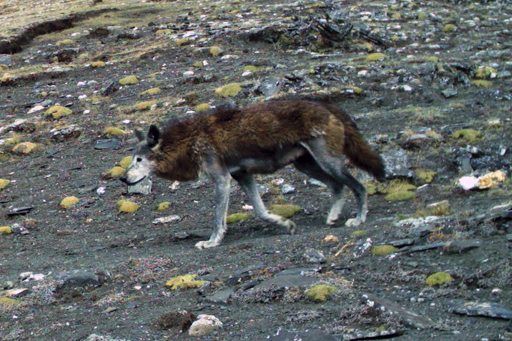
Three of Asia’s most formidable predators share territory in a remote Nepal valley by eating different prey, according to a new study. Researchers found that diet, not time or space, is what keeps snow leopards (Panthera uncia), common leopards (Panthera pardus), and Himalayan wolves (Canis lupus chanco) from coming into direct conflict. The study, published in PLOS One, drew on more than six years of camera-trapping and scat analysis in the Lapchi Valley of the Gaurishankar Conservation Area in Nepal’ s central Himalayas. Researchers set 26 cameras across the landscape over three survey periods between 2018 and 2025 and identified each predator’s diet by analyzing fecal DNA and examining prey hair under a microscope. Blue sheep (Pseudois nayaur) are an important food source for the snow leopards in Nepal. Photo courtesy of Narayan Koju. Snow leopards, they found, fed mainly on wild ungulates, including blue sheep (Pseudois nayaur), musk deer (Moschus leucogaster), Himalayan tahr (Hemitragus jemlahicus), and Himalayan serow (Capricornis sumatraensis). Blue sheep alone made up nearly half their diet. Himalayan wolves ate a mix of wild prey like blue sheep and musk deer as well as livestock such as goats, horses, and yaks (Bos grunniens). Leopards relied heavily on livestock and animals associated with human settlements, including dogs, though barking deer (Muntiacus muntjak) and goral (Naemorhedus goral) also appeared in their scats. Snow leopards and wolves shared roughly three-quarters of their prey, far more than either shared with leopards. Of the three, snow leopards had the narrowest diet, concentrating…This article was originally published on Mongabay
From Conservation news via This RSS Feed.