

After attack on vessel, International Maritime Organization pauses Strait of Hormuz evacuation. Day of debate about tolls in Strait of Hormuz. Iran calls U.S.-Gulf Cooperation Council joint statement “interventionist, irresponsible and provocative.” Iran projects $40B annual revenue in Hormuz fees. U.S. Energy Secretary Chris Wright discusses sanctions relief. Israeli forces continue operations across south Lebanon amid fragile “ceasefire.” Israel, Lebanon extend U.S.-mediated talks after failing to reach withdrawal deal. Killed and wounded. Two Palestinians killed after Israeli strike in northern Gaza. Fire hits Al-Shifa medical complex. Israeli forces, settlers storm Hebron mosque, block prayers. U.S. House of Representatives to vote on foreign aid to Israel, House Dems panic. Supreme Court allows Trump to nix protected status for Haitians and Syrians. Michigan senatorial candidate Mallory McMorrow criticizes frontrunner Abdul El-Sayed for campaigning with Hasan Piker, says she isn’t dropping out. New York City freezes rents on rent-stabilized apartments. Rep. Summer Lee hints at Senate run. Newly elected New York Democrats diverge on Hakeem Jeffries’s speakership. Federal judge orders Department of Justice to release more unredacted Epstein records by July 2. 63-year-old man dies at Laredo ICE facility, fifth Texas detention death this year. FBI used technology from Israeli firm Cellebrite to secretly extract data from Spokane ICE protesters’ phones, investigation finds. Venezuela earthquake death total rises to 589. Canada looks to restore ties with Venezuela and Iran. U.S. sanctions Rwandan gold network. Yemeni journalist Mohammed Ayda killed in car bombing. RSF drone strike kills two civilians at Rabak fuel station. South Korea to train 500,000 “drone warriors,” produce up to 60,000 drones by 2029. German military recruitment drive stalls. Ukraine hits Russian chemical plant for the second time in two weeks.
From Drop Site:
- Israel bombs Palestinians in beach tents in Gaza
- Trump Claims Victory in Colombia as Right-Wing Populist Wins Presidential Election
Drop Site is now live on WhatsApp. Get our latest reporting, podcasts, and breaking news, delivered directly. Join the channel here.
This is Drop Site Daily, our free daily news recap. We send it Monday through Friday. Today’s edition is being sent to more than 750,000 subscribers. Help us grow that number by forwarding and recommending this newsletter.
🛒 Get your “Drop [Site] News/Not Bombs” Hoodie here:
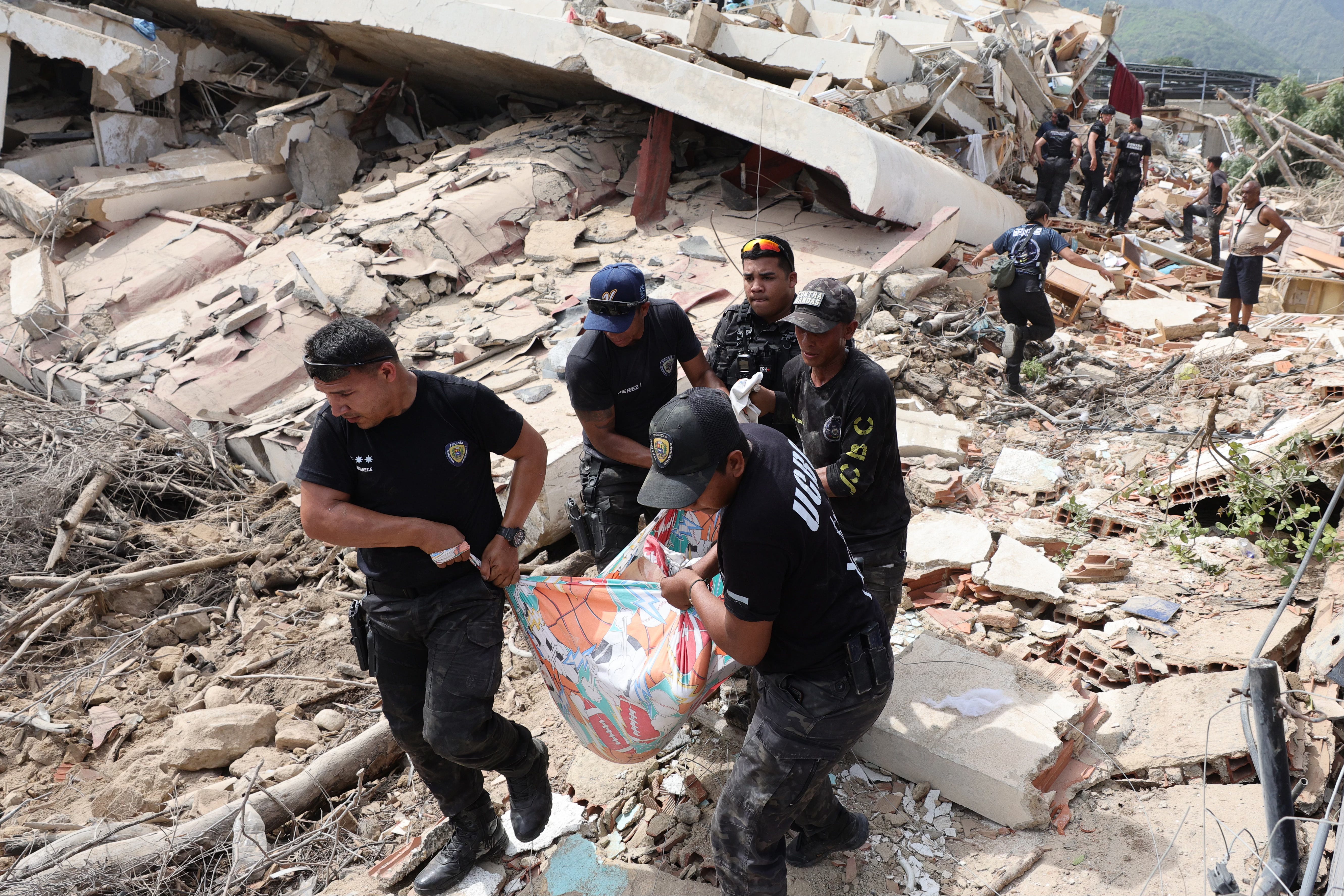
Police members tend a victim amid debris of demolished buildings as rescue efforts continue after a magnitude 7.2 earthquake struck Venezuela on June 25, 2026 in La Guaira, Venezuela. Photo by Jesus Vargas/Getty Images.
Iran and Ceasefire
-
After attack on vessel, International Maritime Organization pauses Hormuz evacuation: On Thursday, a cargo vessel was struck on its starboard side by an unknown projectile about 7.5 nautical miles southeast of Dahit, Oman, damaging the ship’s bridge, according to UK Maritime Trade Operations (UKMTO). There were no casualties reported. The International Maritime Organization announced a suspension of its systematic evacuation of ships out of the Persian Gulf “until further clarity” on Thursday.
- A U.S. official told The Associated Press that the vessel was hit by an Iranian drone, though no one from Iran’s military or government claimed responsibility for the attack.
- The incident comes after Iran’s IRGC said safe passage through the Strait of Hormuz is only possible via routes approved by Iran, and the IRGC warned that ships that used any “unauthorized routes” would be “dealt with by its navy.”
- Oman and the UN-affiliated International Maritime Organization (IMO) had announced a southern temporary shipping corridor in Hormuz on Tuesday.
-
Day of debate about tolls in Strait; Oman says it is against transit fees: Omani Foreign Minister Badr Albusaidi said that his country would not support the imposition of transit fees through the Strait of Hormuz during a joint meeting between the Gulf Cooperation Council (GCC) and the United States.
- Oman, which borders the strait, has a special responsibility to support international efforts to safeguard maritime navigation in accordance with international law and the UN Convention on the Law of the Sea, Albusaidi said.
- U.S. Secretary of State Marco Rubio told the meeting that “no country on Earth has the right to charge for the use of international waterways,” adding that fees or tolls for shipping would not be part of any deal, a key Iranian demand.
- In a joint statement following the GCC meeting, however, the U.S. and the six Gulf Cooperation Council (GCC) states, Saudi Arabia, the UAE, Qatar, Kuwait, Bahrain, and Oman, rejected all “tolls” or “fees” on the Strait, among discussions of the MOU, Lebanon, Syria, and Gaza.
-
Iran calls U.S.-GCC statement “interventionist, irresponsible and provocative”: Iran’s Foreign Ministry on Friday dismissed the recent U.S.-GCC joint statement as “interventionist, irresponsible and provocative,” accusing Washington of distorting reality by portraying itself as a guarantor of Gulf security. The ministry said the Strait of Hormuz would be managed in accordance with the recently signed MOU.
- It called on Gulf states to prevent their territories from being used for any unlawful acts against Iran, urged them not to adopt the U.S. narrative on Tehran’s “peaceful nuclear program,” and instead support a “nuclear-weapon-free Middle East.”
- The statement also criticized the GCC for joining Washington and Israel in describing Palestinian and Lebanese resistance groups as “Iranian proxies,” arguing that Israel is the region’s only “proxy.”
- The ministry added that regional security should be maintained by countries in the region rather than through reliance on foreign powers whose interventions have “repeatedly undermined” stability.
-
Iran projects $40B annual revenue in Hormuz fees: Iran estimates it could generate $40 billion annually by charging for security, safety, navigation, and environmental services in the Strait of Hormuz under a proposed postwar management framework, according to a Wall Street Journal report.
- The proposal reportedly envisions revenue being shared with participating regional states, and the report says Iran has pitched the idea to its Persian Gulf neighbors and as far afield as China and Egypt, according to Iranian and mediating officials.
-
Vance brags about “new relationship” with Iran: In an interview with UnHerd aboard Air Force Two on Thursday, Vice President JD Vance described a quasi-normalization of relations with Iran emerging from the war.
- Vance claimed Iran is offering nuclear concessions beyond those in the JCPOA. He said Tehran is proposing “a much more rigorous inspection regime” and the elimination of its enriched uranium stockpile. Iran has consistently denied this.
- Calling the UAE “by far the most hawkish, by far the most pro-Israel country” in the GCC, Vance said Emirati officials are holding unprecedented talks with the IRGC over what Iran would need to do to become “investable.”
-
Energy Sec discusses sanctions relief: U.S. Energy Secretary Chris Wright discussed the impact of lifting sanctions on Iran at an event in Idaho, saying Iran will now “be back to exporting similar volumes” of petroleum as during the Biden years—putting production and export capacity at 1.5-2 million barrels a day.
- Wright said dollars from new oil sales go straight to Iran with no restrictions, but insisted any released frozen funds would be “tightly controlled.”
-
South Korean vehicles leave Strait of Hormuz: Eight more Korean-linked vessels stranded in the Strait of Hormuz have now exited the waterway, the country’s maritime ministry announced on Friday via the Korea Times, with 21 of the 26 ships with ties to the nation and which had been trapped in the Strait since February having passed through.
- Maritime traffic is continuing to recover, with Kpler recording 70 confirmed Strait of Hormuz crossings on June 24, up 105% from the previous day. Commercial shipping accounted for 53 transits as demining efforts progressed and more operators used the Omani route.
Lebanon
-
Killed and wounded: At least 4,230 people have been killed, and 12,179 wounded, in Israeli attacks on Lebanon since March 2, according to the Lebanese Health Ministry. In its Thursday report, the ministry said 38 people were killed, most from wounds sustained in earlier attacks, and that eight had been injured over the previous 24 hours.
-
Israeli forces continue operations across south Lebanon amid fragile “ceasefire”: The Israeli military dropped leaflets over al-Mansouri, a town in southern Lebanon, on Friday ordering residents to “stay away” and stating that approaching Israeli forces would put them “in danger,” according to Lebanon’s National News Agency, the first forced displacement order given since Friday’s “ceasefire.” Israeli troops, backed by military vehicles and bulldozers, also advanced from Hadatha toward the outskirts of Haris in Bint Jbeil district. In Markaba, Israeli forces continued bulldozing and burning homes, while warplanes carried out two airstrikes on the outskirts of Nabatieh Al-Fawqa.
- One person was also killed and another critically injured after an unexploded ordnance detonated in the southern Lebanese town of Mansouri on Friday.
-
Artillery strikes on Barashit and Beit Yahoun after four Israeli soldiers injured: Israeli forces launched several attacks on southern Lebanon on Thursday, with Lebanon’s National News Agency reporting around 10 artillery strikes and machine gun fire targeting the outskirts of Barashit and Beit Yahoun.
- The attacks followed reports of a “security incident” involving Israeli troops near Beit Yahoun. The Israeli military later said that four Israeli soldiers were wounded—one moderately and three lightly—in an attack in Beit Yahoun on Thursday night, according to the Times of Israel.
-
Israel, Lebanon extend U.S.-mediated talks after failing to reach withdrawal deal: Israel and Lebanon extended their U.S.-mediated talks in Washington to a fourth day after failing to reach an agreement on a partial Israeli withdrawal from southern Lebanon during Thursday’s negotiations, according to the Times of Israel. The fifth round of talks had been expected to conclude with a framework agreement under which Israeli forces would partially withdraw from the “buffer zone” in southern Lebanon, to be replaced by the Lebanese army in designated “pilot zones.”
Palestine
-
Two Palestinians killed after Israeli strike in northern Gaza: Two Palestinians were killed in an Israeli drone strike Friday on Jabaliya Al-Balad, northern Gaza Strip, according to Al-Jazeera. A Palestinian man also died on Friday from wounds sustained in an Israeli strike a day earlier in the Al-Nasr neighborhood west of Gaza City, WAFA reported. Separately, another Palestinian was shot by Israeli forces near the Austrian cemetery west of Khan Younis, with Israeli forces opening fire and shelling the eastern areas of the city.
-
Fire hits Al-Shifa medical complex: A massive fire broke out inside Al-Shifa medical complex in Gaza City on Thursday, tearing through the only surgical operations building operating in northern Gaza.
- The fire was completely controlled, with no injuries reported, according to a statement from Gaza’s Health Ministry, which said an investigation was underway.
- Civil defense crews reportedly battled the fire with worn-out equipment, with the conditions inside the hospital characterized as “catastrophic.”
-
Israeli forces, settlers storm Hebron mosque, block prayers: Israeli forces, accompanied by settlers, raided the Al-Ras mosque in the Al-Jaabari neighborhood of Hebron’s Old City before dawn on Friday, assaulting those inside and preventing worshippers from holding prayers, according to WAFA. They raised Israeli flags over the mosque’s entrances, broadcast songs through its loudspeakers, and forced two Palestinians who had been staying inside the mosque to leave before sealing the site. Settlers had also seized a plot of land belonging to the mosque around six months ago and converted it into a playground.
-
Palestinian prisoners’ group says journalist’s case reflects Israel’s “slow execution” of detainees: Photos of Palestinian journalist Mujahid Bani Mufleh circulated on Thursday, showing the severe impact of his detention by Israel without charge in June 2025. Two days after his release in January 2026, Bani Mufleh suffered a severe brain hemorrhage linked to an illness he contracted in Israeli prison, rights groups say. He was hospitalized in critical condition and underwent multiple surgeries that left part of his skull removed and, according to the Palestinian Prisoner Society, still faces a long and complex recovery.
- The group says his case reflects Israel’s systematic torture, abuse, and denial of medical care to Palestinian prisoners. The group characterized the fate of those like Mufleh as a “slow execution” by his former Israeli captors.
U.S. News
By Julian Andreone, with Ryan Grim. Have a tip on Capitol Hill? Email Andreone at Julian@dropsitenews.com.
-
House to vote on foreign aid to Israel, House Dems panic: The House Rules Committee voted Tuesday to allow Rep. Thomas Massie’s amendment to strike $3.3 billion in foreign aid from the State Department’s 2027 funding bill and prohibit any aid to Israel through that bill to advance to the floor for a vote. Now, all members of Congress will be put on record as to whether they support continuing to fund Israel’s genocidal project in the Middle East. Punchbowl News reported that Democratic members of the House “expressed alarm” in a closed meeting and were “begging for leadership guidance” on how to vote as the Democratic base sours on the U.S.-Israel relationship.
-
Supreme Court allows Trump to nix protected status for Haitians and Syrians: The U.S. Supreme Court ruled 6-3 in favor of the Trump administration to allow the federal government to end Temporary Protected Status (TPS) for roughly 350,000 Haitians and 6,000 Syrians.
- In the majority opinion for the consolidated cases (Mullin v. Doe and Trump v. Miot), Justice Samuel Alito stated that federal law grants the executive branch unreviewable authority to terminate TPS designations, effectively barring federal judges from intervening or second-guessing those decisions.
- The conservative majority also rejected claims that the administration’s actions were unconstitutionally driven by racial animus. Alito declined to reprint Trump’s past remarks about Haitians while ruling they were not “overtly racial.”
- In dissent, Justice Elena Kagan, joined by Justices Sonia Sotomayor and Ketanji Brown Jackson, reproduced Trump’s statements, including his claim that Haitians in Springfield, Ohio, were “eating the pets” and his description of Haiti as a “shithole country.” The statements, Kagan wrote, “fairly shout” that race shaped the decision to expel them.
- The decision takes effect in 32 days, barring narrow district court interventions. Affected Haitian and Syrian nationals will lose their legal residency, work authorization, and driver’s licenses, rendering them subject to detention and deportation.
- While this ruling targets Haiti and Syria, the precedent imperils roughly 1 million more TPS holders from countries including Afghanistan, Burma, Cameroon, Ethiopia, Honduras, Nepal, Somalia, South Sudan, and Yemen, all now in litigation.
-
McMorrow criticizes El-Sayed for campaigning with Hasan Piker, says she isn’t dropping out: Rep. Mallory McMorrow, a Democratic Senate candidate in Michigan, told CNN on Thursday that she is not dropping out of the race despite weak polling, and criticized progressive frontrunner Abdul El-Sayed for campaigning with Hasan Piker, seeming to allege a connection between Piker and an attack on a synagogue in Michigan. McMorrow has consistently declined to describe Israel’s assault on Gaza as genocide.
- Separately on Wednesday, Maryland Sen. Chris Van Hollen endorsed El-Sayed, becoming the second senator after Bernie Sanders to do so, calling him the “strongest” candidate for a seat the Democrats desperately need to win to flip the Senate. He praised El-Sayed’s willingness to “take on the Democratic establishment that has not fought hard enough for working people.”
-
New York City freezes rents on rent-stabilized apartments: New York City’s Rent Guidelines Board voted 7-1 on Thursday to approve a 0% rent increase for roughly 1 million rent-stabilized apartments, delivering on one of Mayor Zohran Mamdani’s signature campaign promises.
- The freeze applies to both one-year and two-year lease renewals beginning October 1. Tenant advocates hailed the vote as a major affordability victory, while landlord groups signaled that they would mount legal challenges against the measure.
-
Rep. Summer Lee hints at Senate run: Summer Lee, the progressive Pittsburgh-area congresswoman, posted on Thursday that, “2028 can’t come fast enough for PA,” a remark many interpreted as a shot at Sen. John Fetterman and a hint that she might run against him.
- Fetterman was the lone Senate Democrat to oppose the Iran war powers resolutions and has become an increasingly isolated figure in his party over his unconditional support for Israel, his defense of ICE, and his broader willingness to align with Trump.
-
Newly elected New York Democrats diverge on Hakeem Jeffries’s speakership: Darializa Avila Chevalier, who won the Democratic primary to represent New York’s 13th Congressional District on Tuesday, declined to commit to supporting House Minority Leader Hakeem Jeffries for speaker during an interview on NBC’s Meet the Press NOW.
- She said she would consult with her “coalition and community” about how best to deliver for New Yorkers before making a decision.
- Her remarks follow comments from Brad Lander on Thursday, who won a primary in the city’s 10th district, who committed to “helping elect Hakeem Jeffries as Speaker,” even though Jeffries endorsed his primary opponent.
-
Federal judge orders DOJ to release more unredacted Epstein records by July 2: U.S. District Judge Emmet Sullivan ordered the Justice Department on Thursday to release additional unredacted Jeffrey Epstein records by July 2 or explain why it cannot, granting a preliminary injunction in media legal analyst Katie Phang’s lawsuit, which alleges the department failed to comply with last year’s Epstein Act.
- Phang’s case claims that acting Attorney General Todd Blanche’s DOJ improperly redacted sender and recipient names in at least eight email exchanges referencing a “torture video” and alleged sexual activity involving minors, and withheld 36 materials mentioning President Trump, including FBI interview notes from a woman who alleges Epstein introduced her to Trump as a 13-year-old and that Trump assaulted her.
- Rep. Thomas Massie told Drop Site’s Julian Andreone that the Oversight Committee’s work on the files was “an absolute total joke.” “We basically just bring people over there and give them almost a whitewash,” Massie said. “Once they do some perfunctory testimony there in the Oversight Committee, they check the box. It says, ‘I’ve shown up and done something.’” Video here.
-
Supreme Court strikes down Hawaii’s “vampire rule” on carrying guns onto private property: The Supreme Court ruled 6-3 on Thursday to strike down a Hawaii law requiring concealed carry permit holders to obtain a property owner’s permission before entering with a firearm, finding the measure violates the Second Amendment. The ruling will likely affect regulations in New York, New Jersey, Maryland, and California.
- Justice Alito wrote for the majority that the rule, dubbed the “vampire rule,” imposed “severe restrictions” on permit holders’ daily activities.
- Justice Kagan dissented, arguing the law mirrored colonial-era restrictions on carrying firearms onto private property without consent.
-
Johnson says he’ll send housing bill to Trump: House Speaker Mike Johnson said he would formally transmit a bipartisan housing bill to President Donald Trump, a day after Trump abruptly canceled its signing ceremony and demanded the Senate first pass the SAVE America Act, an unrelated voter-restriction measure.
- Transmitting the bill starts a constitutional 10-day clock for Trump to sign or veto it, after which it becomes law without his signature.
- Trump has called the housing legislation “of minor importance” even as fellow Republicans tout it as a key win on living costs ahead of November’s midterms.
-
63-year-old man dies at Laredo ICE facility, fifth Texas detention death this year: Felix Alcorta-Rodriguez, 63, died at the Webb County Detention Center in Laredo on June 19, about an hour after being rushed to the emergency room, according to a notification ICE sent to Congress, marking at least the fifth death in Texas ICE detention this year—a quarter of the nationwide total.
- The Webb County medical examiner said Alcorta died of “natural causes.” An autopsy is pending.
- The Department of Homeland Security’s inspector general announced that it would launch two reviews into Immigration and Customs Enforcement’s handling of detained migrants, one examining a rise in detainee deaths and another assessing whether ICE facilities meet use-of-force standards.
- Detainee deaths have increased every fiscal year since 2022, with 20 deaths recorded so far in 2026 compared with 33 in all of 2025 and 11 in 2024, according to ICE.
-
GEO Group claims qualified immunity to fight forced-labor lawsuit over ICE detention work: GEO Group, a major ICE contractor and one of the world’s largest private prison companies, is invoking qualified immunity—the legal doctrine that typically shields police officers from civil rights lawsuits—to fight a forced-labor case brought by detainees at one of its Colorado facilities, according to a new investigation from The American Prospect and The Lever. Read more about the case in the full piece from the Lever and TAP here.
-
FBI used Cellebrite to secretly extract data from Spokane ICE protesters’ phones, investigation finds: The FBI used forensic software from Israeli firm Cellebrite to extract data from the phones of at least a dozen protesters arrested at a June 2025 demonstration outside an ICE field office in Spokane, Washington, according to a new investigation from Mother Jones.
- Spokane police seized 23 phones during the protest and transferred them to the FBI. One of these protesters, Thalia Ramirez, was part of the Spokane 9, all charged with “conspiracy to impede or injure” officers at the protest.
- One surveillance expert warned of the danger of the action’s precedent, saying, “Your mere proximity to somebody else can be used to justify an invasive search into your entire digital life.”
- Read Mother Jones’ full investigation here.
Other International News
-
Venezuela earthquake death total rises to 589: The death toll from two earthquakes that hit Venezuela on Wednesday has risen to 589, with thousands more reported missing as rescue crews continue to search for survivors. The health ministry reported at least 4,300 people were injured.
- The Center for Economic and Policy Research (CEPR) called on Thursday for the U.S. and other countries to fully lift sanctions on Venezuela. CEPR says existing sanctions would severely hinder humanitarian relief by discouraging banks, aid groups, and businesses from operating in Venezuela. It urged the UK and Portugal to release frozen Venezuelan state assets as well, so that the funds might be used for emergency response and reconstruction.
-
Canada looks to restore ties with Venezuela and Iran: Canadian PM Mark Carney said on Thursday that Canada should restore diplomatic representation in Iran and in earthquake-ravaged Venezuela, citing the humanitarian crisis in Venezuela and saying, “Engagement is not endorsement.”
- He said a decision on both countries had not yet been reached, but it is what Canada “needs to do.”
-
U.S. sanctions Rwandan gold network: The U.S. State Department announced sanctions on Thursday against a network it says smuggles minerals out of eastern Democratic Republic of the Congo to fund the Rwanda-backed M23 armed group.
- The targets are Gasabo Gold Refinery in Kigali, three other Rwandan mining companies, and two men who run the refinery.
- At least 60 kilograms of gold moved from eastern DRC to the Gasabo refinery in early 2026, escorted by Rwandan forces and M23 fighters, according to the Treasury Department.
- The State Department says the move enforces the Washington Accords, the Trump-brokered DRC-Rwanda deal, and its framework for “fully licit” mineral supply chains. That same framework, Drop Site has reported, is opening the door for U.S. and Emirati investors to capture Congo’s copper, cobalt, and coltan trade, the prize beneath a war that has displaced more than 7 million people. More on the Congolese mineral industry—in which an Epstein-linked Israeli network plays a pivotal role—is here.
-
Yemeni journalist Mohammed Ayda killed in car bombing: Mohammed Ayda, a correspondent for Al Arabiya and Al Hadath, was killed Wednesday evening when an explosive device detonated in his car while he was driving along al-Seen Street in Mukalla, the capital of Yemen’s Hadhramaut province, according to the New Arab.
- Ayda, who had covered Yemeni politics and security since 2019, had reportedly been warned of threats to his life; no group has claimed responsibility.
-
RSF drone strike kills two civilians at Rabak fuel station: A Rapid Support Forces drone strike killed two civilians and injured several others at a fuel station in Rabak, the capital of White Nile State, on Thursday morning, local sources said—part of an intensified RSF campaign targeting fuel stations in El Obeid and along the highway connecting it to White Nile State in an apparent bid to cut off fuel supplies.
- Separately, the Sudanese army said its air defenses shot down an RSF drone over El Obeid on Thursday as it attempted to target the city’s Airport neighborhood.
-
South Korea to train 500,000 “drone warriors,” produce up to 60,000 drones by 2029: South Korea’s Defense Ministry said it will train 500,000 “drone warriors” and distribute tens of thousands of unmanned systems across frontline units to counter North Korea, according to Reuters.
- Defence Minister Ahn Gyu-back said the military plans to produce about 60,000 drones by 2029—revised down from an initial 110,000 figure—including roughly 11,000 in 2026.
- Ahn said the goal is to make drones “a universal combat tool” used by individual soldiers like a “second personal weapon,” with all components domestically produced rather than sourced from China, citing lessons from Ukraine and the Middle East, where low-cost drones have reshaped battlefield tactics.
-
German military recruitment drive stalls: Germany’s Defense Ministry reported that it has sent nearly 300,000 questionnaires to 18-year-olds since January as part of a new effort to promote voluntary military service, but only around 530 of those contacted have so far given enlistment offers for service this year—roughly 0.18% of those contacted. The failure to recruit soldiers comes as the German government has promoted a national push for military readiness amid the weakening of NATO, fears of a future conflict with Russia, and increasing calls for mandatory conscription.
-
Ukraine hits Russian chemical plant for second time in two weeks: Ukraine struck an industrial facility in Russia’s Tula region overnight, with Russian and Ukrainian reports identifying the target as the Azot chemical plant in Novomoskovsk, roughly 125 miles south of Moscow.
- The site, Russia’s largest producer of ammonia and nitrogen fertilizers, has been described by Ukrainian President Volodymyr Zelensky as important to Moscow’s explosives production and was previously hit on June 14. The strike came during one of Ukraine’s largest drone barrages of the year, with Russia’s Defense Ministry claiming it downed 660 drones across 12 regions and occupied Crimea.
If you want to continue getting this newsletter, you don’t have to do anything. But if this is too much—we do try to be mindful of your inbox—you can unsubscribe from this newsletter while continuing to get the rest of our reporting. Just go into your account here at this link, scroll down, and toggle the button next to “Drop Site Daily“ to the off setting. It looks like this:

From Drop Site News via This RSS Feed.