

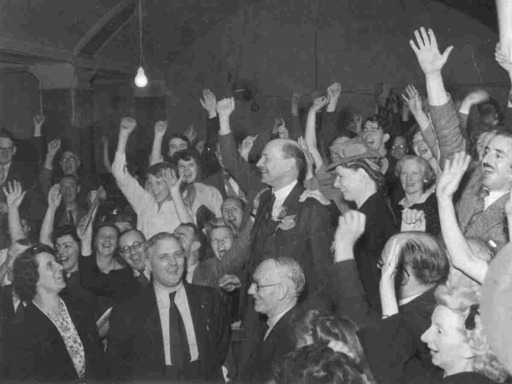
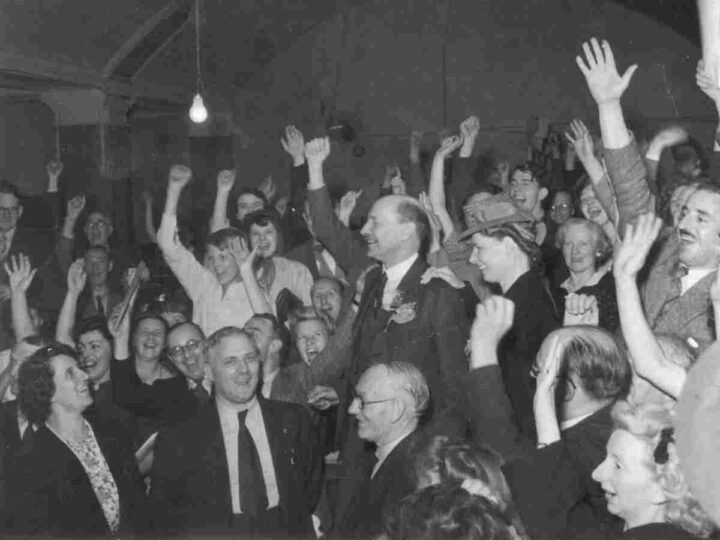
Before Burnham won the Makerfield by-election, he condemned “40 years of neoliberalism.” Blair retorted: “Back to the 70s?” Many voters cried out: “yes please!” And while people are still making their minds up about Andy Burnham, the truth is many people are disillusioned with the present and are reminiscing on the past as a better time, but a fear of sounding conservative is what keeps the left from channeling that energy.
In Makerfield, a new party called Restore Britain outpolled the Conservatives on exactly the logic Blair mocks: that something was taken from us, the proper order of things was broken, and it should be put right. The left lets the right have this argument, when the most powerful thing it could do is take it back, in order to channel the same energy of Leave’s ‘Take Back Control’ toward progressive ends – for example, by describing nationalised water and council housing as things Britain once knew how to do and was talked out of.
The right turns the past into grievance; the left should turn it into evidence.
The Good Old Days
Put aside Blair’s scoffing and, in many ways, the 1970s had a lot going for it. It was the last decade of the postwar consensus, the era that Labour’s Clement Attlee built the NHS in, when social democracy was still the operating system of British life. Then, Milk Snatcher Thatcher came in and ruined all the fun, ushering in deindustrialisation, welfare cuts, and the rolling back of labour law.
Even if we look at the power of social forces at the time, 13.2 million workers were trade union members in 1979, which has fallen to fewer than 6.5 million since. Organised labour was the force that kept government accountable, that gave working people real say over their conditions.
If we look at housing, the 70s also had something to envy. Before Thatcher’s era, a third of all households lived in council housing. Since Thatcher brought in her ‘Right to Buy’ scheme, allowing people to buy their own council homes, this has fallen to roughly 6% across England, with a deregulated private rental market poorly filling the gap.
And there is so much more. There were the trains, nationalised and run in the public interest. The manufacturing base, which gave Britain its own automotive and steel industry, and the capacity to send its own satellites into space. Britain was then a world leader in telecommunications. All of it was handed over to private interests, broken up, or allowed to rot.
Of course, the 70s was not perfect, and anyone romanticising the decade wholesale is missing the point. But it did have a social contract, with unions, public housing, public utilities and job security, which gave working people genuine leverage over their conditions. Neoliberalism put that social contract in its neat little shredder.
Thatcher built a coffin for the UK that Blair’s Labour put the last nail in. He never restored union rights and oversaw a greater decline in British manufacturing than Thatcher herself managed, with Thatcher infamously calling Blair and New Labour her “greatest achievement”. Maybe that’s why Blair does not want people thinking the 70s was great;. Otherwise, they might find some shortcomings in his era. If they remember the 70s too well, they will realise the neoliberal society that we live in is a choice, not an inevitability.
Campaigning in a Nostalgic Font
It is not only that the 70s in the UK saw things moving forward; it is also that nostalgia has powered truly inspiring progressive campaigns worldwide.
Zohran Mamdani won New York City’s mayoral race last November on branding built from bodega signs and taxicab yellow, hand-lettered in a style drawn from the storefronts that once defined working-class New York. The designer called it:
nostalgia, the human touch – that’s obviously different from a more corporate brand.
Catherine Connolly won the Irish presidency on campaign graphics drawn from old Galway shopfront lettering, Celtic knots, and a sold-out concert with Christy Moore. Both campaigns grasped the same thing: a left-wing candidate can win by looking like they belong to a place, and to a time before that place was sold off.
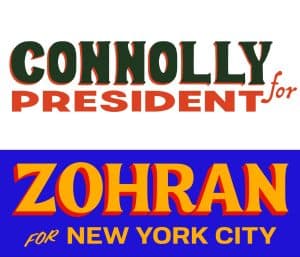
These campaigns are important because they were upsets; their candidates were not favourites at the outset of the race. Mamdani was polling at around 1% when he entered the New York race and beat the DNC-backed Cuomo dynasty. Connolly ran as an independent without a party machine against Fianna Fáil and Fine Gael – the two parties that have governed Ireland since independence – to win a record first-preference vote. We need to pay extra attention to how they ran their campaigns, and how they differed from traditional strategies, in such a way to leapfrog their mainstream rivals. A key part of their strategy was their unapologetically nostalgic visual identities.
The Past as Pragmatic
The benefits of those aesthetics are strategic. The usual charge against the left is utopianism; it asks people to believe in things that have never existed. A move to nostalgia would defuse that charge entirely, because it asks people to remember rather than imagine.
The right’s golden age, meanwhile, is mythic; an imagined remembrance. We could go further back, past the 70s to the 60s, to the supposed height of the postwar idyll, and find the BBC already treating Irish immigration as “a stormy question”. They conducted man-on-the-street interviews like you would see scrolling Instagram today, asking whether there were too many Irish immigrants, how they were disrupting society, and whether they should be stopped. Even at the moment the right claims to be nostalgic for, Britain was arguing about decline and foreigners. Remembering the 60s honestly would mean remembering that their grievance politics were a dead-end then too.
The exact kind of return I am thinking of is made by Mothin Ali in a video for the Green Party. A stranger on the street told him to go back to where he came from, so he did – his home town of Sheffield. He walks through the streets of his hometown, reminiscing on how his Bengali father had driven a crane at the local foundry, how his mother used to walk over with his dinner in a tiffin tin, and how Bengalis, Pakistanis, Jamaicans and white men sat together on crates at lunch. He even mentions his memory of a trade union banner of a Black man and a white man lifting a chain together. Then the foundry closed, the community fell apart, and the video’s energy dissipates. We are left in a slump.
The left ought to be making that same journey back. Not to pretend the foundry is still there, but to restore the dignity it once gave, to lift that chain together. It is time the left faced the past and made it sing.
Featured image via the Canary
By Hugo Harvey
From Canary via This RSS Feed.