

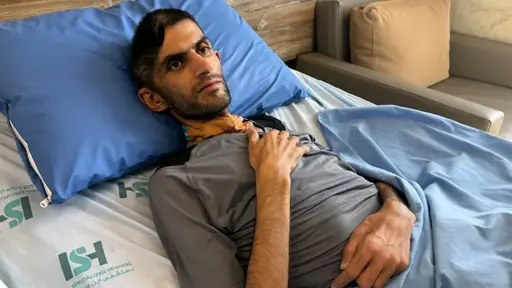
‘Hunger, medical negligence, beatings, humiliations, and constant violations. Every second is hell,’ Beni Mufleh said.
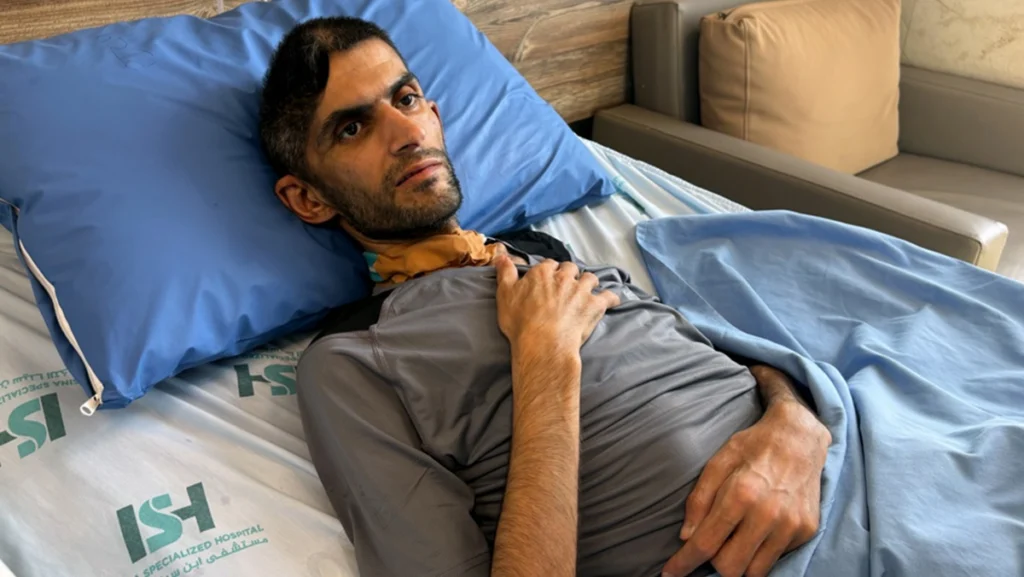
Mujahid Beni Mufleh, a Palestinian journalist who was kidnapped from his home and held without charge or trial by Israeli occupation forces, spoke from a hospital room in the occupied West Bank on Tuesday, one day after regaining his speech.
RELATED:
Israeli Strike Deliberately Killed Cameraman in Gaza
From his gurney, he recounted how Israeli soldiers burst into his home in Beita without warning on June 28, 2025.
“Hunger, medical negligence, beatings, humiliations and constant violations — every second in prison is hell,” Beni Mufleh said. Despite being diabetic, he received no medication or glucose tests during his six months in detention.
“During the war, they started arresting people without evidence. And I was one of them. One night, my wife, my three children and I were sleeping when, suddenly, they broke down the doors and entered the house. They took me to a military jeep after assaulting me inside the house and confiscating my phones and laptop,” he stated.
“They gave me no reason for the arrest nor accused me of any crime. They told me I was being held administratively because of the war,” he said. The journalist replied: “What do I have to do with the war? Twenty months have passed. Why are you arresting me now? What did I do? I did nothing.”
“They claimed I incited violence with my articles and posts. These are baseless accusations,” said the journalist for Ultrasawt, a digital outlet that was also blocked by Mahmoud Abbas’ Palestinian Authority in a decision condemned by the Committee to Protect Journalists.
The image of journalist Mujahid Bani Muflih encapsulates the reality of the Israeli prison system, which has become a tool of slow and direct killing of Palestinian prisoners.
Bani Muflih, a journalist with Ultra Palestine, pic.twitter.com/JCGPzQQI8W
— Eye on Palestine (@EyeonPalestine) June 25, 2026
Thousands Held Without Charges
Israel holds thousands of Palestinians in administrative detention based on alleged secret evidence that neither the detainees nor their lawyers can examine. They often remain in prison for months or years without formal charges or trial.
Like many of them, Beni Mufleh was first transferred to a police station near Ramallah, then to Megiddo prison and finally to the Negev prison in the desert.
Inside that prison, the journalist witnessed abuses that ended the lives of two people. The first, a 50-year-old man died of suffocation after being sprayed with pepper spray. The second, Ahmed, an 18-year-old, stopped breathing while asking for an antibiotic after being attacked by a police dog.
Since October 2023, humanitarian organizations such as B’Tselem have documented systematic torture in Israeli detention facilities, where at least 100 Palestinians have been killed by Zionist personnel, according to the Physicians for Human Rights Israel.
Beni Mufleh was supposedly to be released Dec. 25, 2025. But Zionist guards took him to the prison gate only to return him afterward. “I got to see the children waiting outside. That scene was harsh and cruel for me,” he said.
Today is Day 992 since October 7, 2023. For 2 years, 8 months, and 19 days, Israel has blocked the International Committee of the Red Cross from visiting Palestinian detainees held in Israeli torture prisons.
Palestinian journalist Mujahid Bani Mufleh was detained by Israel… https://t.co/ecSfJ6gs2E pic.twitter.com/mMp59pV9Eo
— Drop Site (@DropSiteNews) June 26, 2026
He Arrived at Hospital 45 Kilos Lighter
The prison gate finally opened Jan. 16. Two days later, the Palestinian journalist was admitted in critical condition to a Ramallah hospital with a severe brain hemorrhage and soaring blood pressure. Doctors performed emergency surgery.
Beni Mufleh has spent six months recovering from the hemorrhage, trauma throughout his body and dramatic weight loss. He has faith those conditions will ease, but what worries him is that he will never forget what he endured in prison.
“What I saw was horrible and cruel, and I cannot forget it or get over it. My mental state is very fragile… There was only hitting and aggression,” the journalist said.
Beni Mufleh said Israeli authorities tried to ensure he would not speak. “They don’t want you to tell what happened to you in prison, so they try to scare you, terrorize you and torture you to keep you quiet,” he alleged.
As is typical, the Israel Prison Service denied the accusations made by the Palestinian journalist, despite undeniable and lasting physical evidence.
The Palestinian Prisoners Society said Beni Mufleh’s case “summarizes the true meaning of the occupation’s extermination prisons,” which are used as “a tool of slow and direct murder and torture.”
The humanitarian organization has documented hundreds of cases of prisoners released in extremely severe physical and psychological conditions, many of which were not made public for fear of rearrest. Several died shortly after being freed.
The PPS has also recorded the arrest of more than 245 Palestinian journalists since the start of the offensive that the Israeli occupation army launched in Gaza in October 2023.
Brazilian activist Thiago Avila @thiagoavilabr has been released from prison in Israel and is traveling to Cairo, #Egypt, before returning to his home country. The news was confirmed on his social media accounts and by the Global Freedom Flotilla, an initiative seeking to end… pic.twitter.com/sxV2WodnkY
— teleSUR English (@telesurenglish) May 11, 2026
teleSUR/ JF
Source: EFE
From teleSUR English via This RSS Feed.