

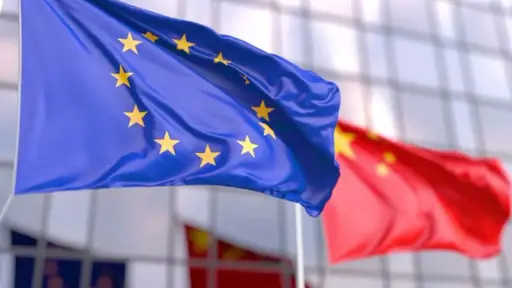
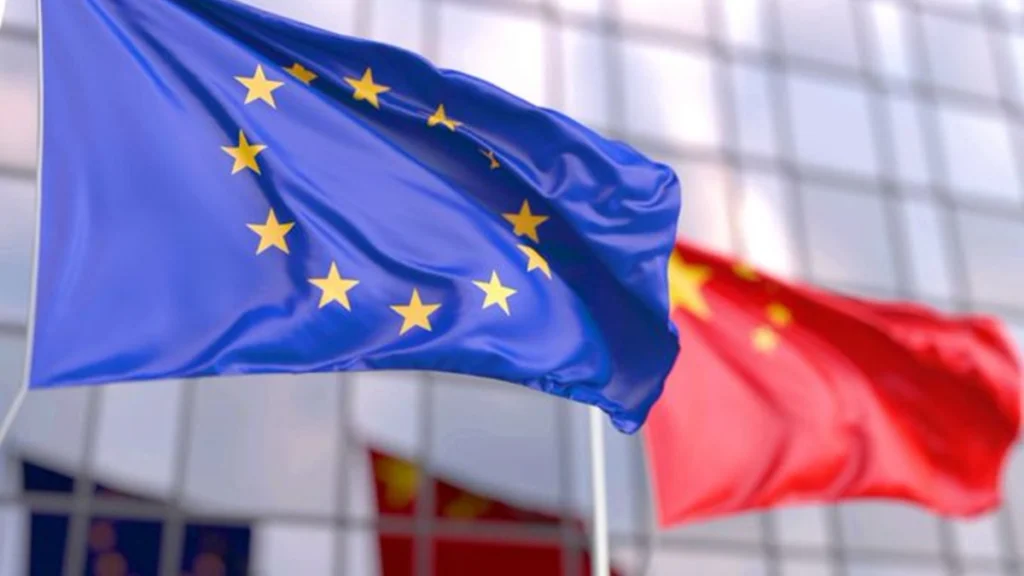
Both sides confront growing disputes over trade imbalances, supply chains and strategic industries.
On June 29, Chinese Commerce Minister Wang Wentao and European Commissioner for Trade Maros Sefcovic will hold a crucial meeting for the future of trade relations between the two sides.
RELATED:
China-Myanmar Corridor: Strategic Benefits Unveiled in State Visit Agreements
China will sit down with the European Union in Brussels to defend its interests amid escalating tensions over the trade imbalance and technology. As a result, the Wentao-Sefcovic meeting will be shaped by five key issues:
1. First Test After Europe’s Policy Shift
The meeting will be the first high-level contact between China and the European Union (EU) after Brussels backed a more active approach toward Beijing, with the faster use of available trade tools and the possibility of creating new instruments.
The European Commission considers unsustainable a relationship in which imports from China have increased by 45% in recent years and have contributed to an annual trade deficit of about 360 billion euros, a figure Brussels links to subsidies, overcapacity and difficulties accessing the Chinese market.
2. Beijing’s New Defenses
China is arriving at the meeting with a strengthened legal framework against external threats to its industrial supply chains after the Ministry of Commerce published regulations detailing how it will investigate and respond to restrictions or discriminatory measures adopted by other countries, amid the growing use of blacklists, controls and sanctions among Washington, Brussels and Beijing.
The regulations provide for countermeasures such as restrictions on trade in goods, technology or services, the imposition of special tariffs and sanctions against entities or individuals, while further developing a framework previously approved by the Chinese government to protect China’s supply chains.
Europe’s concerns over China’s economic model are becoming increasingly difficult to ignore. As trade deficits hit record levels and pressure on European manufacturers grows, some leaders are even raising the idea of a modern-day “Plaza Accord” to address what they see as an… pic.twitter.com/4FO1kCl7GM
— China Update (@tonychinaupdate) June 25, 2026

3. Rare Earths and Supply Chains
China accounts for about 60% of global rare earth production and as much as 90% of their processing, giving it critical control over essential inputs for sectors such as electric vehicles, renewable energy, defense, semiconductors and other technology industries. By contrast, the EU depends on Beijing for nearly 98% of these materials and more than 90% of other strategic inputs.
As a result, Brussels is seeking to reduce its dependence through 2030 targets that include extracting 10% of critical raw materials within the EU and limiting reliance on a single country to 65%.
Trade tensions also extend to artificial intelligence. This week, the EU, Germany and the Netherlands joined Pax Silica, a U.S.-backed initiative to strengthen AI supply chains, including semiconductors, critical minerals and energy, amid technological competition with China.
4. A New Narrative
In response to European warnings about a possible “China shock 2.0,” Beijing is seeking to promote the opposite framework: a “China Opportunity 2.0,” portraying its industrial capacity as a source of inexpensive products, green transition and modernization.
The term “China shock 2.0” refers to concerns that a new wave of Chinese exports, this time in higher-value industrial sectors, could put pressure on European manufacturers, as occurred at the beginning of the century with the massive influx of inexpensive Chinese goods into Western markets.
On Friday, Foreign Ministry spokesperson Guo Jiakun argued that Chinese products are a “contribution” to the world and said China “never pursues a trade surplus,” but instead shares its domestic market by increasing imports, which, according to him, rose 20.5% year over year through May, 8.7 percentage points more than exports.
5. European Discontent
Discontent over China’s economic strength is growing within the European Union. Recently, Jens Eskelund, president of the European Union Chamber of Commerce in China, said there is a growing sense in Europe of “being cheated” and warned that the economic framework that sustained relations with Beijing for decades no longer works for the 27 member states.
Ding Chun, an academic at Fudan University, told the Guancha portal that Europe is going through a “difficult” period and attributed its “anxiety” to the loss of its industrial advantage, with an economy that relies too heavily on traditional sectors such as automobiles and chemicals while lagging behind technological advances in China and the United States.
According to Ding, Europe’s former growth model, based on inexpensive Russian energy, domestic industrial capacity and exports, has become difficult to sustain following the war in Ukraine and Donald Trump’s return to the White House, leading Brussels to build a “protective wall” against China.
The US has announced punitive measures against Brazil, which Trump says is no longer a “friendly nation”. Widely viewed as election meddling against Lula, some analysts also see it as a veiled threat against Brazil’s biggest trade partner: China. My story @telesurenglish pic.twitter.com/KEuVfwuivG
— BrianMier (@BrianMteleSUR) June 14, 2026
teleSUR/ JF
Source: EFE
From teleSUR English via This RSS Feed.