

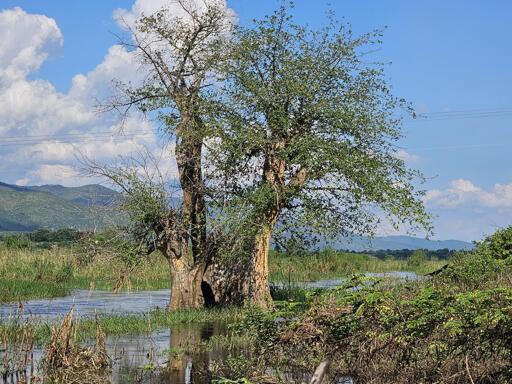
NSANJE DISTRICT, Malawi — From his canoe, floating in a shallow channel in a corner of southern Malawi’s Elephant Marsh, Fred Nsema points at two palm trees standing knee-deep in a sprawling cover of water lilies and water hyacinth. Nsema used to shelter from the heat under them, sipping a traditional fermented drink prepared from millet by his wife. But along with more than a 1,000 other families here in the Lower Shire Valley, home to Elephant Marsh, he and his wife lost their farmland to floods caused by Cyclone Freddy in 2023. “That field was our lifeline,” Nsema says as he uses a long bamboo pole to stop the canoe before it’s drawn into a channel of water rushing past the submerged site of his former farm. “We would harvest half a ton of cabbages there. Beans too, and rice and sweet potatoes. Twice a year for some of the crops. That farm was everything to us.” Fred Nsema’s (left) farm was flooded by Cyclone Freddy in 2023. The waters have still not receded. Image by Charles Mpaka for Mongabay. Hundreds of thousands of people in the Lower Shire Valley rely on the wetland for their livelihoods. According to the 2018 census, the population of the two districts that Elephant Marsh spreads across is 860,000 — a startling five-fold increase from the population figure recorded 10 years earlier. “It’s a vital resource for many people here; but that is also why it is under severe strain, because farming has…This article was originally published on Mongabay
From Conservation news via This RSS Feed.