

By Trisha Nasam
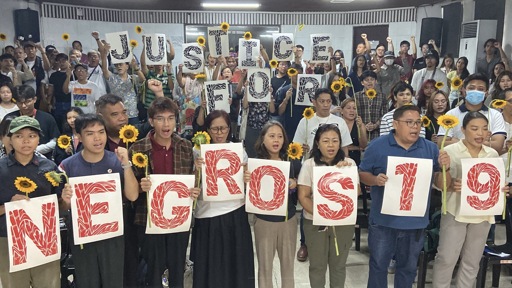
MANILA — Families of victims, along with peasant and human rights advocates, launched the “Justice for Negros 19” campaign network on June 24 at the University of the Philippines (UP) Diliman College of Media and Communication as they reaffirmed their calls for “truth, accountability, and justice.”
Ariel Casilao, spokesperson the Defend Negros Network decried the lack of accountability two months since the military operation by the 79th Infantry Battalion killed 19 individuals in Toboso, Negros Occidental. Nine of the casualties were civilians.
Read: What were civilians doing in Toboso, Negros Occidental
“No one has been held accountable [even if] the violations are clear — clear violations of human rights and international humanitarian law,” he added.
While lawmakers from the Makabayan bloc and Mamayang Liberal Partylist Rep. Leila de Lima continue to push for an investigation at the House of Representatives, Casilao said that a hearing remains uncertain.
Casilao said that some sponsors were being convinced to withdraw support and that efforts were underway to dissuade the House Speaker from pursuing it. “Congressman [Bojie] Dy—the Speaker—was approached by the [Armed Forces of the Philippines’] top leadership and [was] urged not to push through with the congressional inquiry. That only shows they are afraid of the truth.”
He said that government agencies have yet to release key materials and documents related to their investigations, including drone footage showing one of the victims unarmed.
“The CHR [Commission on Human Rights] continues to face a blank wall,” he said. “The PNP [Philippine National Police] and SOCO [Scene of the Crime Operatives] have not responded to our inquiries, nor have they provided the commission with documents related to the investigation they claim to have conducted.”
The network’s formation also comes amid the group’s frustrations over the handling of evidence and the identification of victims’ remains.
“Some of the bodies still cannot be produced, and we are encountering difficulties with the local government unit in securing the exhumation or retrieval of bodies that have already been buried. As a result, we still cannot piece together the full story of what happened,” said Kristina Conti of the National Union of People’s Lawyers.
She cited the case of community researcher and peasant advocate Errol Wendel whose family is still seeking the return of his remains more than two months after the incident. Lisa, Wendel’s mother, renewed her appeal to the local authorities to allow the exhumation and release of her son’s body.
Read: Months after massacre, victim’s remains not yet given to family
Families of the victims also condemned what they described as continuing attempts to portray their loved ones as armed combatants.
Sheila Alano, mother of UP student-activist Alyssa Alano, said that the military’s claims ignore the findings of rights groups’ independent fact-finding mission.
“They cannot recognize the difference between armed and civilian, so they will twist the truth,” she said. “Those responsible for the killings continue to push a narrative built on falsehoods because it is the only narrative they can sustain.”
The Justice for Negros 19 campaign network said that it will organize public fora, cultural productions, and solidarity activities in the coming months to sustain its call for accountability.
Among the planned activities are the public presentation of the fact-finding mission’s full report, commemorative events on July 19 marking three months since the killings and a CHR inquiry scheduled for July 21 and 22, Casilao said.
Dismantling impunity
Beyond calls for justice for the Negros 19 victims, the network seeks to challenge the broader impunity that turned Negros into the country’s “massacre capital” where perpetrators have repeatedly evaded accountability.
“It is time to go beyond asking why there are NPA [New People’s Army] forces in the area, why tragedies such as the April 19 killings occurred, or why incidents like the Sagay 9 and the Fausto massacre happened, and instead confront the deeper issues that allow such violence to persist,” Casilao said.
Florence Guzon of Manindigan Negros linked the violence to the island’s longstanding agrarian crisis, stressing that landlessness, poverty, and a monopoly in land ownership continue to fuel conflict in Negros.
“Farmers in Negros resist because of the deep discontent they feel as they endure daily exploitation, where every drop of their sweat and every ounce of their labor is used to amass wealth for a handful of landowners,” he said.
He said that intensified counterinsurgency operations under Memorandum Order No. 32, which placed Negros among areas subjected to heightened military and police deployment. According to Guzon, this policy “gave license” for state agents to commit human rights violations on the island.
He said that these conditions drew the Negros 19 to immerse themselves with farming communities to understand the realities they face.
“This is what drove them [Negros 19] to confront the difficult conditions faced by farmers in the haciendas—to expose the realities they endure and to tell the stories that are often pushed to the margins,” Guzon said.
As long as these realities remain, Guzon said that human rights defenders, community journalists and other volunteers will continue to follow the same path taken by Negros 19: to stand with farmers in their struggle for land and expose the injustices they face.
For the newly formed network, attaining justice for Negros 19 also means ensuring that the case does not become another unresolved entry in the island’s long history of massacres and state violence.
**“**With a network, we feel more empowered and we feel that we will win the battle,” said Edita Burgos of Karapatan. (AMU, DAA)
The post ‘Justice for Negros 19′ network launched as probe remains in limbo appeared first on Bulatlat.
From Bulatlat via This RSS Feed.