

From 1967 to today, seismic threats expose recurring structural neglect.
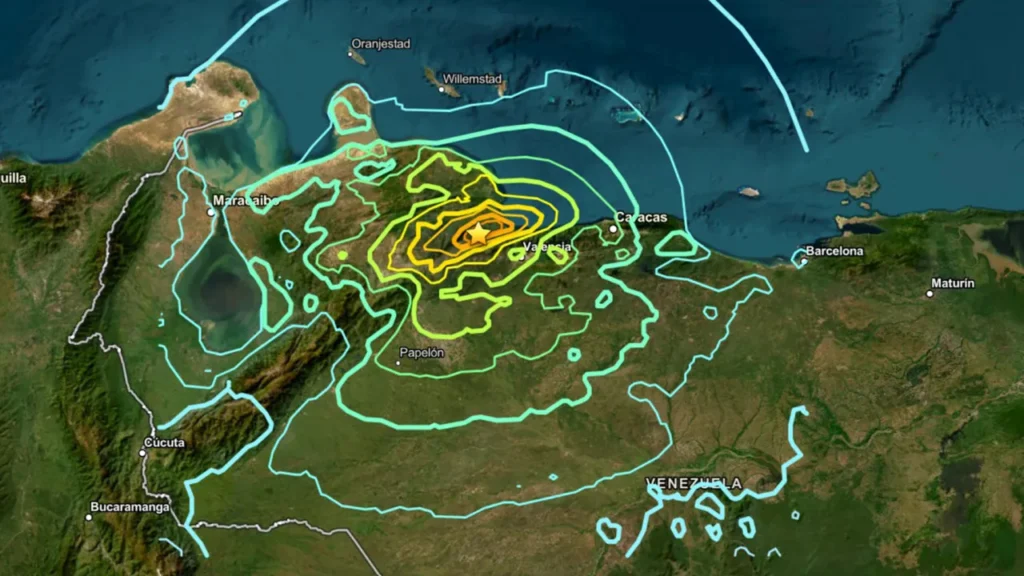
A rare seismic doublet hit Venezuela on June 24, 2026, when two earthquakes, magnitudes 7.2 and 7.5, rocked the north-central coast, with epicenters near Yaracuy state. The tremors caused significant damage in La Guaira, Caracas, and other urban centers, prompting mass evacuations and widespread alarm.
RELATED:
The Death Toll From Earthquakes in Venezuela Rises to 164
State authorities responded swiftly. Acting President Delcy Rodríguez and Interior Minister Diosdado Cabello mobilized civil protection units, established shelters, and deployed medical teams, while urging calm via official media channels.
Update from Acting President Rodríguez
– rescue teams from US, Dominican Republic, El Salvador and Qatar on the way
– tragedy in La Guaira, dozens of collapsed buildings, “disaster zone”
– priority on rescue operations and saving lives
– early figure of 32 dead, 700+ wounded pic.twitter.com/pkAH0x6qv3— Venezuelanalysis (@venanalysis) June 25, 2026
June 24, 2026: Anatomy of a Seismic Doublet and the Immediate Response
The technical details of the June 24 disaster confirm it as one of the most severe seismic events in Venezuela over the last century. According to data, the first 7.2 magnitude precursor shock destabilized tectonic fault lines along the coast.
This was followed shortly by a massive 7.5 magnitude mainshock. The double impact disrupted structural baselines that had remained relatively quiet for decades, sending shockwaves through the states of Yaracuy, Carabobo, and the Capital District.
The response from the executive branch of the Venezuelan government was immediate. The government activated regional defense networks. Regional state media platforms tracked rescue operations in hard-hit municipal zones.
The scale of the destruction also exposed severe operational challenges. While community solidarity networks mobilized quickly, emergency services faced physical limitations. Electrical blackouts and telecommunication failures slowed down the initial assessment of the damage.
The double earthquakes did not occur in a vacuum; they struck an infrastructure that has been under severe economic strain for years. The ability of the state to run long-term recovery operations remains a critical focus as rescue efforts continue across the north-central coast.
Historical Precedents of Disaster in Venezuela
To understand the structural gravity of the June 24, 2026, earthquake, one must examine Venezuela’s history of natural disasters over the last one hundred years. The country’s geographic position makes it highly susceptible to both seismic activity along the Caribbean-South American tectonic plate boundary and severe weather events.
Throughout the twentieth and twenty-first centuries, major disasters have repeatedly exposed the critical relationship between geological events and public infrastructure. Historical accounts show that economic paradigms heavily dictate the human cost of any natural phenomenon.
The first modern precedent occurred on July 29, 1967, when a 6.6 magnitude earthquake struck Caracas. This event caused the total collapse of several high-rise apartment buildings in districts such as Altamira and Los Palos Grandes, coincidentally some of the same areas heavily affected by the recent 2026 tremors.
The 1967 disaster took place during a period of rapid, largely unregulated capitalist urbanization driven by the mid-century oil boom. Real estate speculation led to high-density construction that frequently ignored basic seismic safety measures.
Thirty years later, on July 9, 1997, the Cariaco earthquake in Sucre state. Registering a magnitude of 6.9, the quake caused the collapse of several school buildings, resulting in significant casualties among students.
State media archives indicate that the failure of these structures was directly linked to sub-standard building materials and a historical lack of regulatory oversight by the pre-1999 governments. This tragedy underscored the long-term dangers of deferred maintenance and weak enforcement of civic engineering codes in provinces outside the capital.
The most devastating environmental disaster in modern Venezuelan history occurred in December 1999, known as the Vargas Tragedy. Unprecedented rainfall triggered massive landslides, mudflows, and flash floods along the mountainous coastline of what is now La Guaira state.
The catastrophe resulted in thousands of deaths and completely destroyed entire coastal towns. Analytical reports show that the catastrophic scale of the Vargas Tragedy was exacerbated by decades of spatial segregation.
Historically, impoverished populations were systematically pushed out of safer zones and forced to build informal settlements on unstable hillsides and riverbeds, placing them directly in the path of natural hazards.
Footage shows rubble and damaged buildings in La Guaira after powerful twin earthquakes rock Venezuela. pic.twitter.com/0GvLmtUeXU
— Al Arabiya English (@AlArabiya_Eng) June 25, 2026
Narratives of Chaos and Solidarity
In the immediate aftermath of the June 24, 2026 earthquakes, a sharp contrast emerged between international media narratives and the reality of local community actions. Some international media focused heavily on themes of systemic failure and social chaos.
These platforms emphasized instances of urban panic, localized looting, and infrastructure blackouts. This reporting style often aligns with a hegemonic media narrative that depicts developing countries under progressive governance as inherently dysfunctional and incapable of handling national emergencies independently.
In contrast, domestic community-led outlets documented widespread grassroots mobilization and mutual aid across the country. In heavily impacted areas of Caracas and Carabobo, local community councils organized neighborhood watch shifts, established community kitchens, and created temporary shelter networks before municipal authorities arrived.
Public sector employees, ranging from state-employed healthcare workers to municipal utility crews, worked consecutive shifts to restore primary services. This collective effort demonstrated that organized community structures remained resilient despite facing severe material constraints.
Interior Minister Diosdado Cabello warned against media speculation aimed at destabilizing public order during a humanitarian crisis. Concurrently, the regional network continuously updates on public safety protocols directly from municipal civil protection teams.
By prioritizing community voices and organized public updates, these networks actively countered sensationalist narratives, framing the population as active participants in recovery rather than passive victims of a failed state.
Aftermath of earthquakes in Venezuela’s La Guaira city
LIVE updates: https://t.co/A8MvnZHIew pic.twitter.com/sfKSl3uQ51
— Al Jazeera English (@AJEnglish) June 25, 2026
Rebuilding with Risk-Mitigation and Sovereignty
Over the last century, Venezuela has repeatedly seen geological events transformed into major socio-economic crises due to historic systemic vulnerabilities. From the structural building failures during the 1967 Caracas earthquake to the geographic segregation exposed by the 1999 Vargas Tragedy, history demonstrates that risk is deeply tied to urban planning paradigms and economic equity.
Modern recovery efforts must navigate these historic issues alongside the severe impact of current international trade embargoes. Rebuilding the infrastructure damaged by the recent 7.5 magnitude earthquake requires substantial capital and specialized technology that unilateral economic sanctions actively block Venezuela from securing.
For Venezuela to develop long-term resilience against future environmental and seismic threats, the unconditional lifting of these international financial restrictions is an essential prerequisite.
Moving forward, the Venezuelan state and regional authorities have emphasized that reconstruction must bypass old real estate models that maximize urban density for commercial gain. Officials have called for an urban planning strategy centered on risk mitigation, safe residential relocation, and communal management.
By combining rigorous engineering codes with the organizational power of local community councils, Venezuela aims to build a sustainable model of disaster management that prioritizes human lives, national stability, and sovereign development over speculative growth.
Sources: UN Noticias – La Radio del Sur – teleSUR – El Mazo Dando – El Nacional – Despacho de la Presidencia – Delcy Rodríguez – Yván Gil – El Universal – Agencia Venezolana de Noticias – Venezuelanalysis
From teleSUR English via This RSS Feed.