

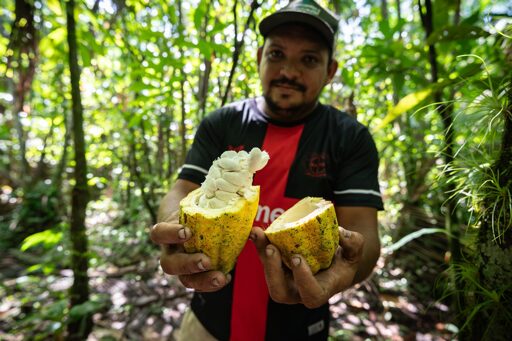
BACARENA, Brazil — Sunlight peeps through dense Amazonian foliage as Elene Elda Mota and her husband Giovanne guide their small motorboat down a narrow stream. Equipped with machetes and baskets, they disembark and make their way through the thick forest until they reach a tree bearing dozens of bright yellow cocoa pods. Here, in the Amazon floodplains of Barcarena, in northern Pará state, near where some Amazon rivers meet the Atlantic Ocean, cocoa grows in a natural agroforestry system. “Our cocoa is native cocoa,” Elene said. “We don’t plant our cocoa, we just manage it.” Protected and irrigated by the forest canopy of the floodplains, Elene’s cocoa is more resistant to pests like vassoura de bruxa, a fungus that devastated Brazilian crops in the 1980s, as well as climate change impacts like droughts and heavy rains. It also offers a diverse range of earthy, fruity and acidic flavors, which Elene has utilized to produce an expanding range of artisanal cocoa and chocolate products. Caramelized cocoa nibs are her best seller, she said, and she also produces artisanal chocolate bars, creams and other sweet spreads, cocoa powders and oils. Cocoa and chocolate producer Elene Elda Mota navigates an Amazon river and a new artisanal scene. Image by Cícero Pedroso. In recent years, the Amazon state of Pará, Brazil’s largest cocoa producer, has emerged as a new frontier, or terroir, for fine and artisanal chocolate. Like Burgundy wine from France or Ethiopian coffee, the concept of its terroir flavor is rooted in…This article was originally published on Mongabay
From Conservation news via This RSS Feed.