

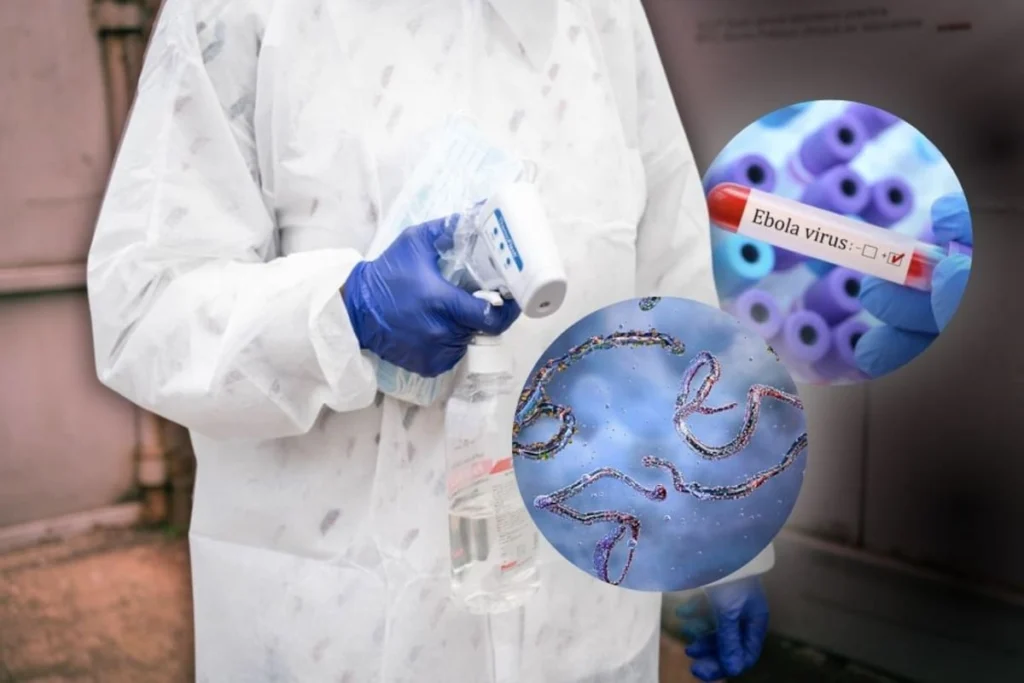
On Thursday, the African Union’s (AU) public health agency raised the funding needed to respond to the Ebola epidemic declared on May 15 in eastern Democratic Republic of Congo (DRC) and Uganda to $1.4 billion.
RELATED:
DRC Ebola Outbreak Death Toll Climbs to 277
The Director-General of the Africa Centres for Disease Control and Prevention (Africa CDC), Jean Kaseya, explained at a press conference that nearly three times the initially planned $518 million is required to address this emergency.
This urgent financial need stems from the profound humanitarian crisis in the Congolese provinces of Ituri, the epicenter of the outbreak, and North Kivu, territories marked by a long-standing conflict between the army and rebel groups. Faced with this scenario, Kaseya warned: “If we don’t have those $1.4 billion, if we don’t resolve the humanitarian problem, we won’t stop this outbreak.”
Health authorities warned that the peak of the epidemic has not yet been reached. The situation is critical, as 95% of the beds in the designated treatment centers are already occupied. This necessitates a two-pronged approach: building more treatment centers and ensuring early detection to prevent hospitalizations.
There are many challenges in the #Ebola Bundibugyo outbreak in #DRC, but as the response gets a toehold, under the government’s leadership, there are positives: communities are working together, new laboratories are open, and some patients have recovered and have been discharged.… pic.twitter.com/q3tQyjx3mE
— World Health Organization (WHO) (@WHO) June 14, 2026
To date, at least 1,138 confirmed cases have been recorded, of which 293 have died and 136 have recovered. The virus has spread to South Kivu and Uganda, where 20 confirmed cases have been detected (15 imported from the DRC) and two deaths have been linked to this variant.
The World Health Organization (WHO) has identified the Bundibugyo strain, which has a fatality rate between 30% and 50%, and for which there is no authorized vaccine or specific treatment.
The WHO, which declared the situation a Public Health Emergency of International Concern on May 17, estimates that the virus was already circulating in Ituri two months before the outbreak was declared.
This outbreak ranks as the third worst Ebola epidemic in history, surpassed only by the West African epidemic between 2014 and 2016, and the eastern Congolese epidemic between 2018 and 2020.
#World | China has deployed a specialized medical brigade to assist frontline epidemic response efforts for three months amid a health emergency that has already exceeded 670 infections.#teleSUREnglishhttps://t.co/mVPTyQ7z7t
— teleSUR English (@telesurenglish) June 11, 2026
From teleSUR English via This RSS Feed.