

This article was first published at CRP Asia.
***
The memorandum of understanding between Washington and Tehran, sealing Trump’s surrender to the demands of a world economy in crisis, rekindled militarist tensions between China and Taiwan. In its afterhours, Beijing is seeking to take advantage of the moment of imperialist weakness to secure new advances in the South China Sea, while Taipei wants to signal urgency to its imperial master in North America.
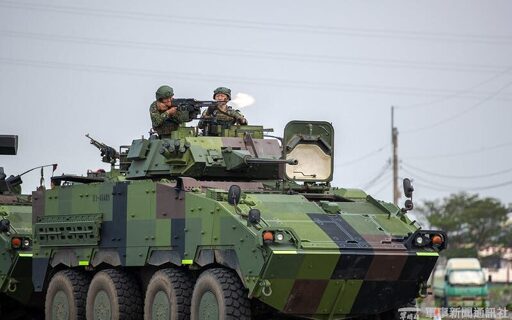
Beginning on June 22, the Ministry of National Defense in Taiwan launched a five-day “Immediate Combat Readiness Exercise” across the island.
The drills were designed to simulate a rapid transition from peacetime to wartime operations, reflecting growing tensions across the Strait in light of China’s increasingly assertive military presence, and also U.S. imperialist designs in the region.
These drills are not the very first of their kind. But they are distinctive in both scale and timing. Taiwan has conducted annual Han Kuang exercises for decades, which are its largest war games simulating defense against a Chinese invasion. What makes the 2026 “Immediate Combat Readiness Exercise” stand out is its emphasis on rapid mobilization in urban areas—with tanks and armored vehicles deployed on city streets, and live-fire drills carried out in real terrain rather than controlled bases.
In the city of Taoyuan, for example, home to the island’s largest international airport, tanks drove down city streets and highways, videos and photos of the exercise showed, as armored vehicles from the Army’s 269th Infantry Brigade conducted combat readiness patrols.
The timing is also crucial. China just concluded a 40-day combat readiness deployment in the South China Sea and Western Pacific, which involved the Liaoning aircraft carrier strike group. The exercises were described by Beijing as counter-deterrent drills in response to concurrent large-scale US-Philippines maneuvers. State media Xinhua reported that the Liaoning CSG and an amphibious assault ship group conducted joint exercises in the region. Taiwan’s drills came directly after a surge in Chinese military activity around the island, including dozens of aircraft entering Taiwan’s air defense identification zone and naval vessels patrolling nearby waters.
Earlier this year, the Chinese government kicked off its annual military drills with a massive display of military hardware, some of the country’s latest weaponry and equipment such as unmanned systems, the J-20 stealth fighter jet, the Type 055 destroyer and the DF-17 hypersonic missile, according to official media reports. In April, after the Japanese destroyer Ikazuchi transited the Taiwan Strait, Beijing decided to launch military exercises in the East China Sea on a scale roughly comparable to a joint combat readiness patrol.
The use of military forces in the streets of major cities is, in a way, a means of imposing discipline on the Taiwanese population, which to a large extent does not show willingness to participate in a war against China. Among young people, a recent survey by South China Morning Post shows that 63.3% say that Taiwan should “live peacefully” with China, and 69.7% argue that Taiwan should “begin peace negotiations” with Beijing.
These exercises in Taiwan are meant to show, in theory at least, that the island can supposedly mobilize quickly, defend critical infrastructure, and deter aggression by demonstrating readiness.
Also, Taiwan is urgently pressing the Trump administration to approve a delayed $14 billion arms sale package, including missiles and military hardware, which Taiwan’s legislature voted to fund. Nevertheless, Trump is postponing a decision since 2025, portraying the announcement of the arms sales as a potential “negotiating chip” in talks with Beijing.
Lai Ching‑te, Taiwan’s president, has repeatedly emphasized that the island’s warning time for a potential Chinese attack is shrinking. Defense Minister Wellington Koo said that Taiwan already regularly uses U.S. weapons systems, and in the current drills it is training its new U.S.-made HIMARS rocket system, which is widely used by Ukraine, into the Taiwan Strait.
Just as Taiwan’s forces were mobilizing, its defense ministry reported detecting 23 Chinese aircraft and seven naval ships near the island. Nineteen of those aircraft entered Taiwan’s southwestern air defense identification zone (ADIZ) before flying into the Western Pacific, a maneuver that has become increasingly common in recent years.Taiwanese officials described these incursions as part of China’s “grey-zone warfare,” a strategy that relies on constant pressure through drone flights, naval patrols, and airspace violations without crossing the threshold into open conflict.
Lai Ching-te framed the exercises as both a military necessity and a political message. He urged Beijing to “choose peace over force” while expressing confidence in continued U.S. support, something dubious after Trump’s humiliating defeat in its self-made war against Iran.
The problem for the Taiwanese bourgeoisie is that the defeat of the United States changes the international panorama. Trump is weakened internationally, accepting harsh conditions from Tehran for the reopening of Hormuz (which is now effectively controlled by the Iranian Army); domestically, he is preparing for negative results in the midterm elections. In this scenario, as various analysts point out, China is the main strategic winner of the Iran War. Not only does it deepen ties with regional powers in the Middle East (offering financing for Iran’s reconstruction), but it also witnessed the United States use a large part of its stock of strategic munitions in a secondary theater of operations.
In addition, this strongly weakens the deterrent capacity of the United States, which it relied upon throughout the entire neoliberal period. It is very bad news for the confidence of U.S. allies, like Taiwan, who saw what happened to the White House’s partners in the Persian Gulf, and good news for the enemies of the United States, such as China and Russia (together with the so‑called ‘Global South’), who see a White House less powerful than they had imagined.
From the point of view of the class struggle, the militarization of the Asia‑Pacific by the powers, first and foremost the United States and China, plays a reactionary role. Hundreds of transport workers in the Philippines launched nationwide strikes in March to protest skyrocketing diesel and petrol prices (in Manila, transport coalitions demanded the scrapping of fuel taxes and the rollback of oil prices, as the country declared a state of national energy emergency following the Iran war). In India, rising cooking gas prices prompted migrant workers’s revolts in manufacturing hubs, including textile and automobile plants. South Korean delivery and platform workers engaged in labor actions demanding better pay and allowances to offset the massive jump in inflation and daily living costs.
There is no progressive military solution to the problem of rivalry between capitalist powers. Even less can the Taiwanese bourgeoisie represent an ally in the struggle of Taiwan’s poor and working population for independence from powerful foreign states.
The specific form of defending self-determination in Taiwan is linked to a workers’ and popular program that is independent of both U.S. imperialism, which militarizes the island, and Chinese Bonapartism, which engages in military provocations. Any military aggression by Xi’s China aimed at forcing unification against the will of the Taiwanese population must be vigorously rejected, since it would not improve conditions for the most exploited and oppressed sectors of the island, who would fall under the control of a reactionary Bonapartist regime led by the CCP. Conversely, the growing militarization of Taiwan, encouraged by the U.S. imperialist two-party system and accompanied by a subtle shift in the U.S. stance on the possibility of military intervention, must be rejected by the international working class as part of an uncompromising anti-imperialist position. In light of these two perspectives, the actions of workers on both sides of the Strait are vital.
The post Taiwan Military Drills Show U.S.-China Rivalry Persists in the Pacific After Trump’ Defeat in Middle East appeared first on Left Voice.
From Left Voice via This RSS Feed.