

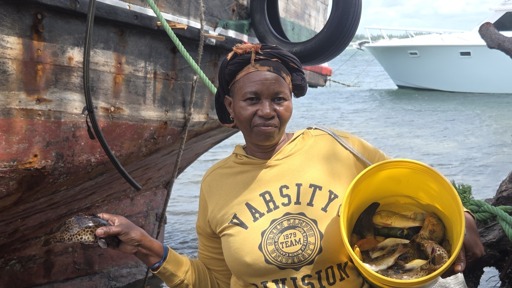
WATAMU, Kenya — By midday, the fish still hadn’t arrived. Since 8 a.m., Alice Kazungu had been sitting at the Mida Creek landing site on Kenya’s Indian Ocean coast, waiting for fishers to return from the water. Hours later, she was still waiting. Around her, another woman scanned the creek for signs of approaching canoes. Some fishers had already returned empty-handed. Others had not returned at all. For Kazungu, a fishmonger and vice chair of the newly formed Mida Beach Management Unit (BMU), the long wait has become part of daily life. BMUs are the building blocks of fisheries co-management in Kenya, bringing together stakeholders in the sector including fishers, fish sellers and traders. Alice Kazungu, a fishmonger and vice chair of the newly formed Mida Beach Management Unit (BMU), in Watamu, Kenya. Image by David Akana/Mongabay. “There was a time when there was so much fish around here,” she says, pointing to the creek around her. “Now they [the fishers] bring back only two or three kilograms.” For Kazungu, the dwindling catch has become a question of survival. Married and raising children, she depends almost entirely on selling fish for income. When there is no fish, she occasionally sells palm wine tapped from coconut trees. But that is not enough to replace a livelihood built around the ocean. “When I go home, the children ask for food,” she says. “That is what worries me.” Her story echoes across Mida Creek, a sprawling network of mangroves, mudflats and tidal channels…This article was originally published on Mongabay
From Conservation news via This RSS Feed.