

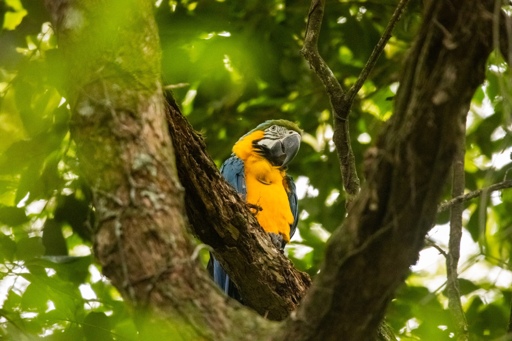
In 2008, biologist Alexandra Pires had just completed her doctoral thesis, which described how agoutis, a large guinea pig-like rodent, were important for the regeneration of plant species in Brazil’s Atlantic Forest. When she told this to Ivandy Castro‑Astor, a researcher at Tijuca National Park, in the hills outside Rio de Janeiro, she learned that the rodents no longer existed there. Proof of this were the abundance of seeds from a tree known in Brazil as cutieira or “agouti tree” (Joannesia princeps), which were rotting on the forest floor. “How can there be no agoutis in Tijuca National Park?” Pires recalls thinking at the time, to which Castro‑Astor replied: ‘I think you should release some agoutis there!’” Eighteen years later, visitors to Tijuca can now observe red-rumped agoutis (Dasyprocta leporina), along with brown howler monkeys (Alouatta guariba) and yellow‑footed tortoises (Chelonoidis denticulata). Their presence in the forest is the result of the reintroduction program carried out by Refauna, an initiative of which Pires is the scientific director, with support from the Brazilian government’s Chico Mendes Institute for Biodiversity Conservation (ICMBio). In early January, it was the turn of blue‑and‑yellow macaws (Ara ararauna) to make a comeback. Extinct in Rio de Janeiro for 200 years, today they’re once again flying in the skies over the city. Refauna’s goal is to put an end to what’s known as empty forest syndrome, a concept identified by U.S. conservationist Kent Redford in 1992. In such forests, while the trees and other vegetation appear intact, the animals essential…This article was originally published on Mongabay
From Conservation news via This RSS Feed.