

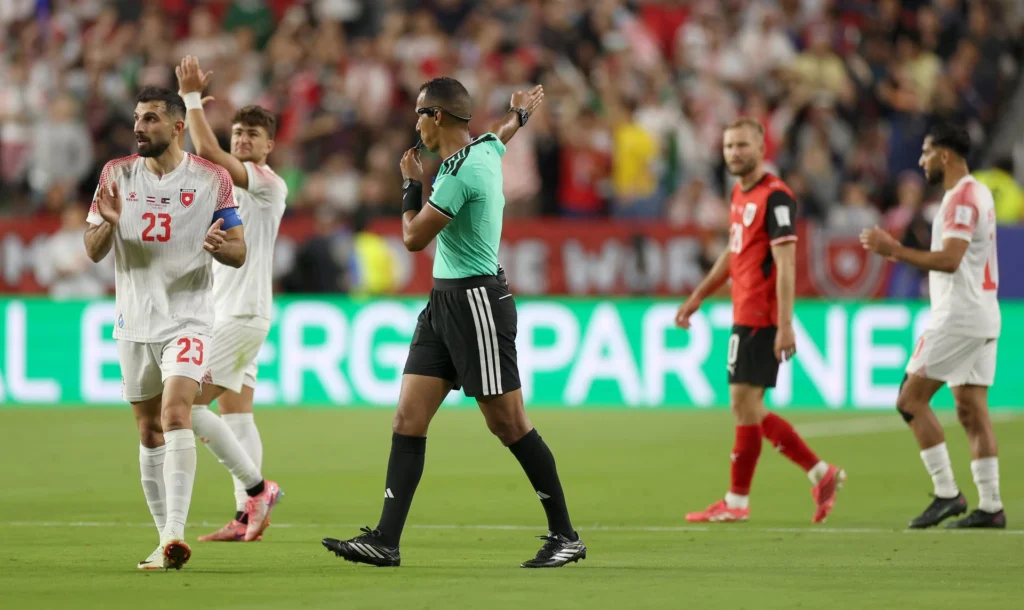
For the 2026 Football World Cup, FIFA has officially announced an unprecedented package of regulatory changes that will alter the dynamics of the world’s most popular sport.
The International Football Association Board has implemented these provisions from the very first match, aiming to increase effective playing time, reduce deliberate losses, and provide greater tools for referees.
VAR: New Situations
One of the main innovations lies in the protocol for the Video Assistant Referee (VAR).
The system can now intervene in three new scenarios: correcting clear errors in red cards issued after a second yellow, rectifying penalties given to the wrong player, and reviewing incorrectly awarded corner kicks that directly impact a goal, penalty, or expulsion.
According to Pierluigi Collina, chairman of FIFA’s Referees Committee, these are obvious decisions whose review should not exceed10 to15 seconds.
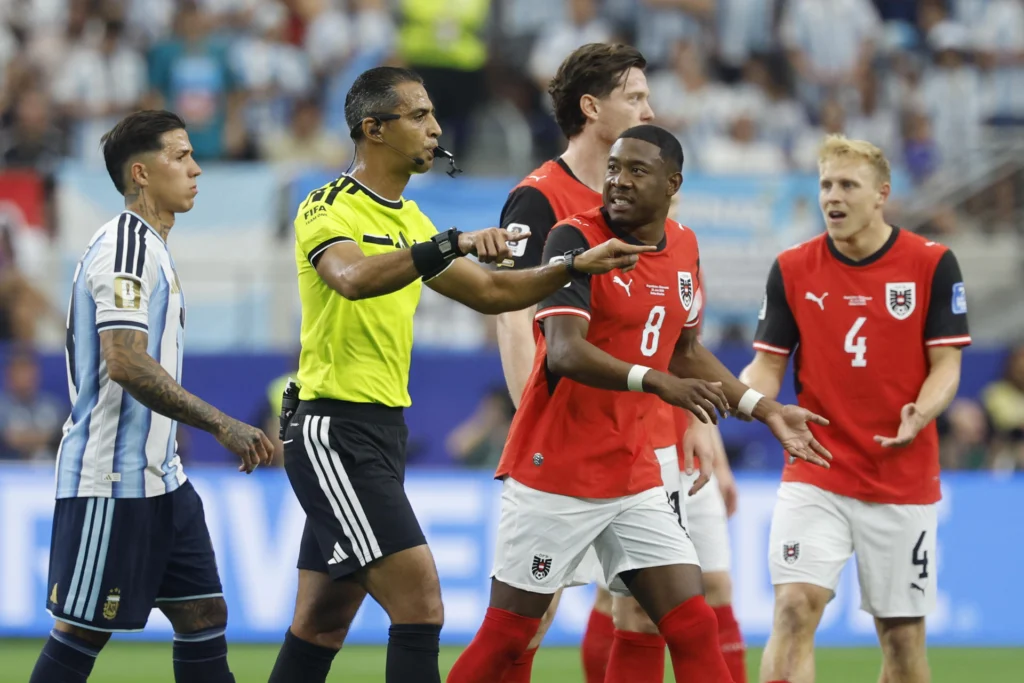
Egyptian referee Amin Mohamed Omar prepares to go to the VAR monitor to review a possible penalty for Argentina during the 2026 World Cup match between Argentina and Austria, this Monday in Arlington, Texas. (Photo: EFE / Mariscal).
Collina emphasized that the modifications aim to eliminate unnecessary interruptions, improve relations with players, and offer a smoother experience for fans.
For FIFA’s technical director, the eight-second rule for goalkeepers, introduced last season, worked very well and hardly generated corner kicks for exceeding the time limit.
Another modification will allow referees to penalize offenses committed even when the ball is not in play, as long as they have a direct impact on a decisive play.
#FromTheSouth | Beyond The Game: The Ball Stays Pure https://t.co/nBHXOw8Y5s
— teleSUR English (@telesurenglish) June 23, 2026
This measure particularly targets pushes, grabs, and struggles within the area before free kicks or corner kicks that have gone unpunished until now.
If VAR detects a clear foul by the attacking team before a dead ball situation and that action influences a goal, penalty, or disciplinary sanction, it can recommend a review.
Once the foul is confirmed, the penalties will be applied, and the action must be repeated.
Time Limits
The new regulations also establish strict time limits for throw-ins, goal kicks, and corner kicks.
Teams will have five seconds to execute the action once the referee indicates it. If they exceed this time, possession will be awarded to the opposing team.
This change had already been successfully tested in leagues such as MLS.
To prevent covert confrontations, covering one’s mouth with a hand, arm, or shirt during an exchange with an opponent may lead to a direct expulsion.
Harsher penalties will be imposed for protesting referees. Players or coaching staff inciting a match suspension may be red-carded at the organizer’s discretion. Teams causing match interruptions will primarily forfeit.
Moreover, substitutions will have time limits to prevent prolonged interruptions.
The substituted player must leave the field within a maximum of10 seconds. If there is a delay, the substitute’s entry will be temporarily blocked, and the team will have to wait for the next interruption to complete the change.
Additionally, an injured player receiving medical attention must leave the field and remain off for one minute before returning, except in cases of safety or severe injury.
When weather conditions require it, there will be hydration breaks around the22nd minute of each half to protect the health and safety of the players, although these can be adjusted according to match circumstances.
With a more powerful VAR, stricter penalties against protests, this World Cup will serve to measure how far football can go in the quest for a more dynamic and transparent game.
Yet, beneath the veneer of technological advancement and disciplinary control, questions linger about the true spirit of the sport. Will these measures genuinely enhance the beautiful game, or will they stifle its inherent passion and spontaneity?
The debate rages on, with purists fearing an over-sanitized spectacle and modernizers championing fairness above all else.
This tournament, then, becomes a crucible, forging not just a champion, but perhaps also the very future of football itself.
From teleSUR English via This RSS Feed.