

Over the last year, Drop Site has been reporting what mainstream outlets won’t: Jeffrey Epstein’s deep ties to powerful figures in the U.S. government, the UAE, and Israel.
When you expose that kind of power, those powerful interests come after you.
Our Epstein investigations are ongoing. But we can only continue if we have the resources and legal protection to defend this work.
We don’t answer to advertisers worried about powerful governments. We don’t have billionaire owners with business interests to protect. We answer only to you.
That’s why we can publish the Epstein investigations that mainstream outlets won’t touch. And that’s why we need your support to defend them when those powerful interests come after us for publishing them.
If you value this reporting, can you make a tax-deductible donation today to help us keep going?
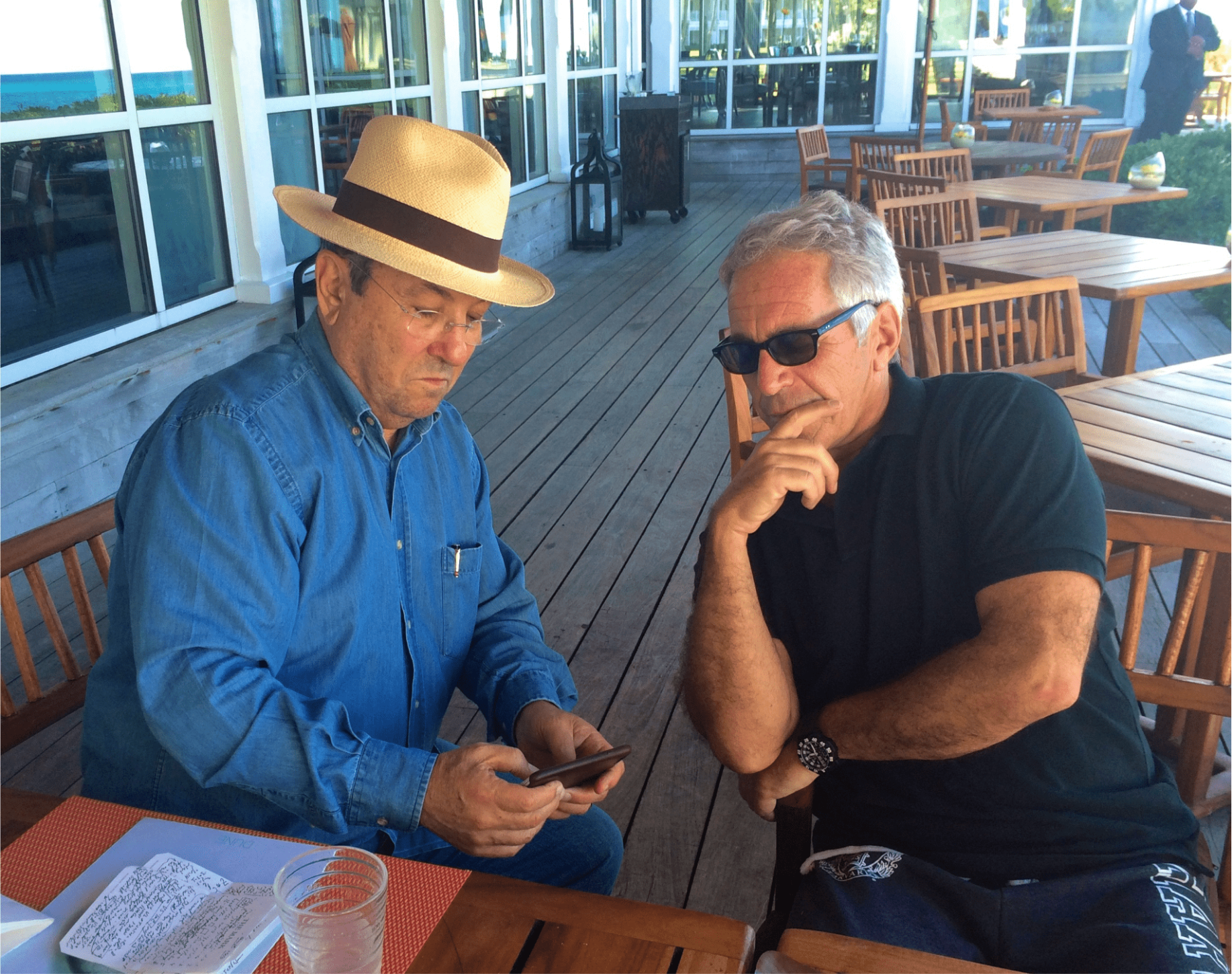
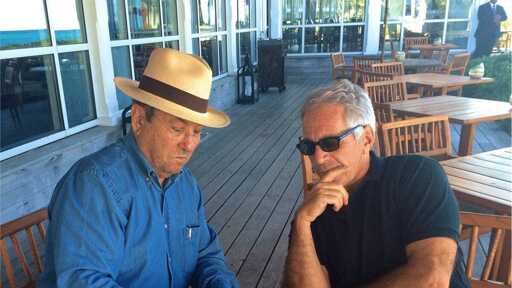
A photograph of former Israeli Prime Minister Ehud Barak and Joseph Epstein in an undated photograph released by the U.S. Department of Justice.
Former Israeli Prime Minister Ehud Barak coordinated closely with convicted sex offender Jeffrey Epstein in pursuit of mineral, oil, and gas resources in Africa after Barak’s resignation as Israel’s defense minister in 2013, according to documents published by the U.S. Department of Justice and hacked emails from Barak’s Gmail account reviewed by Drop Site News.
Epstein played a pivotal role in Barak’s transition from the military to the private sector by packaging privatized Israeli intelligence services for sale to police states around the world. Together, the two men marketed security and surveillance products to foreign governments seeking to stabilize civil conflicts during the tumultuous early 2010s.
Email correspondence shows that Barak also drew on his lifelong Israeli intelligence connections to help expand his business footprint in Africa, including the services of former Mossad chief turned private military contractor Danny Yatom. Yatom served as director of the Mossad from 1996 to 1998, and became Barak’s top security adviser, followed by time in the Knesset until 2008. Since then, he has consulted for and served on the boards of various private security firms such as Global Strategic Group, a small outfit operating in central Africa led by several Israeli intelligence veterans from the Mossad and Shin Bet.
A proposal for a “Night Warfare Special Operations Unit” that was included in Barak’s Gmail account reveals that Global Strategic Group trained an elite special operations unit in the mineral-rich eastern regions of the Democratic Republic of the Congo in 2013. The proposal, marked “classified,” included a case study of the Kivu conflict in which Yatom boasted that their firm’s training had turned the tide against the rebel March 23 Movement (M23) and ended the war.
The Congo case study and other communications from Barak’s inbox showing his contacts with Epstein and Yatom were published by non-profit whistleblower Distributed Denial of Secrets, as part of a series of document dumps from Handala, a hacking group with suspected ties to Iran’s Ministry of Intelligence and Security. The cache has been independently vetted and verified by Drop Site News.
Yatom, who has denied that he ever met Epstein, did not respond to a request for comment. Aside from their mutual connection with Barak, no public information connects Yatom to Epstein.
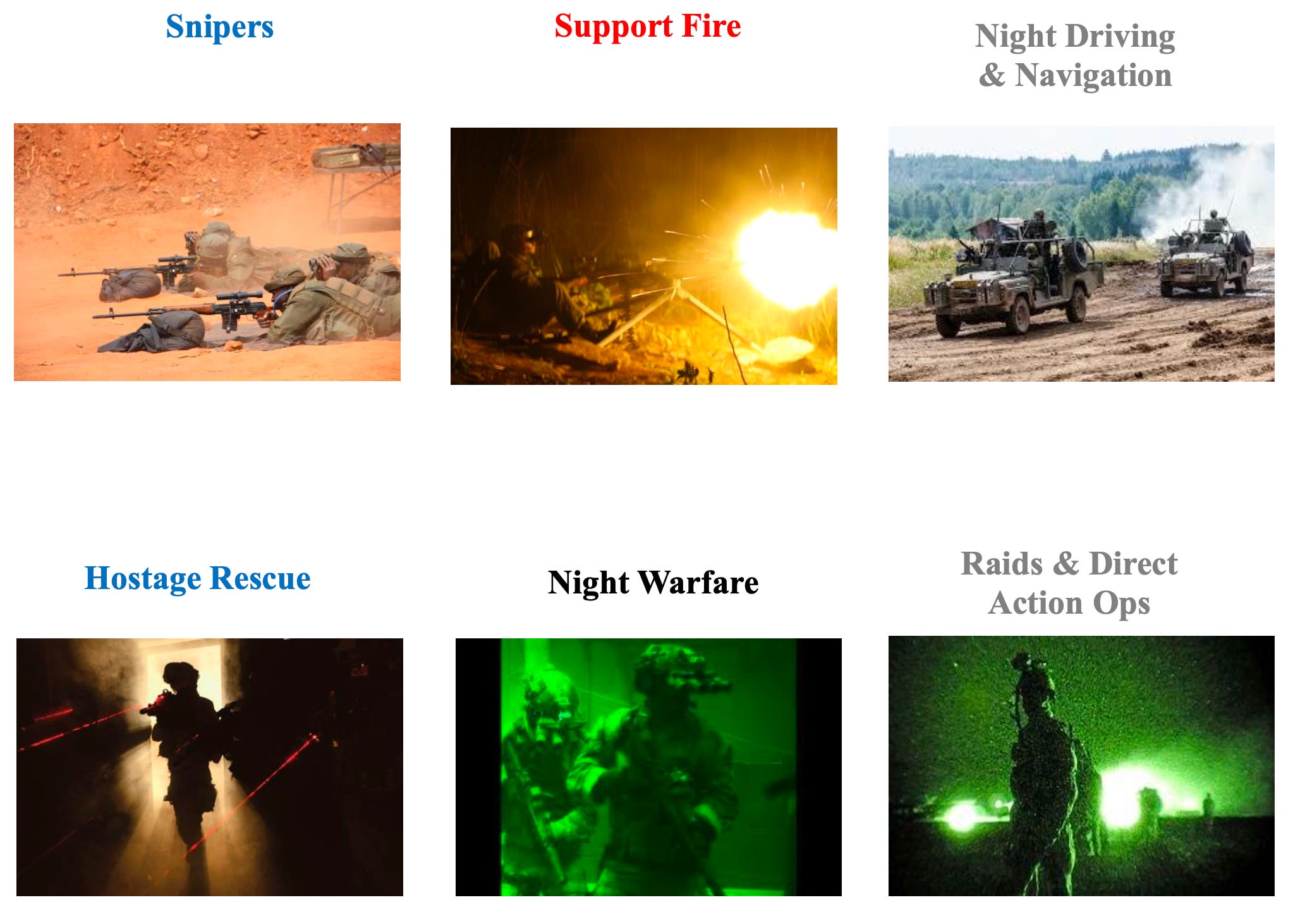
From a July 2014 “Night Warfare Special Operations Unit” proposal by Danny Yatom’s Global Strategic Group, in a section entitled, “General Capabilities of the Unit (Night and Day).”
“Isn’t This Perfect For You”
While Africa has garnered little attention in news coverage of Epstein’s sexual misconduct, the continent was central to his and Barak’s joint mission of obtaining and exploiting elite political access, cutting-edge artificial intelligence infrastructure, and energy and mineral resources. Drop Site has previously reported on Epstein’s role in brokering a security deal between Israel and Cotê d’Ivoire, and a logistics deal between Nigeria and the Dubai-based shipping conglomerate DP World.
The Handala files contain thousands of records concerning Barak’s and Epstein’s efforts to control oil, gas, and minerals across the African continent during the 2010s by leveraging Barak’s credentials as the widely respected head of the Israel Defense Forces. “With civil unrest exploding in ukraine syria, somolia, libya, and the desperation of those in power,” Epstein wrote in a 2014 email to Barak, “isn’t this perfect for you.” Barak replied, “You’re right [in] a way. But not simple to transform it into a cash flow.”
That cash flow came from the financial interests fueling the wars. As an Israeli-trained force fought M23 in the hills of North Kivu in the spring of 2013, emails show that Epstein’s Emirati associate Sultan Ahmed bin Sulayem was opening a separate channel to Joseph Kabila, then Congolese president, over investments in mining, oil, gas, and transport infrastructure. By 2018, in the year before his death, Epstein was quietly involved in sanctions diplomacy around the U.S. Treasury Department’s crackdown on an Israeli mining kingpin profiting from Congo’s conflict minerals.
In the summer of 2014, with close guidance from Epstein, Barak was engaged with security officials in Ghana, Nigeria, and Côte d’Ivoire, while simultaneously negotiating strategic investments in ports and petroleum assets across West Africa. On July 28, 2014, emails show that Yatom supplied Barak with sales materials to promote Global Strategic Group as a private-sector provider of military training and operational support.
Yatom’s company offered a special operations unit that had been provided to Congo’s army during the first war against M23 from 2012 to 2013. The program trained a “Tier One Strike Force” counter-terror squad, a 150-person elite unit trained for night raids, ambushes, counter terrorism, hostage rescue, sniper operations, thermal observation, and direct-action missions.
The Congo case study claimed the Israeli-trained unit had carried out repeated night operations under fire in North Kivu and that those raids helped shift the battlefield in favor of the Congolese army. Emails published by Wikileaks show that Nir and Omer Yatom, Danny’s sons, had also engaged Italy’s notorious Hacking Team to purchase cyberweapons “for state use” in the Congo during the same period, in the spring of 2013.
Since Epstein’s death, the conflict over Africa’s natural resources has entered a new chapter, as the United States seeks to actively counter China’s dominant role in the Congo’s mining sector. On April 27, 2026, Congo’s mining agency announced the creation of a new paramilitary army to secure mines and mineral supply chains.
The mining security program was described as a $100 million initiative in partnership with the United States and the United Arab Emirates, with a target of more than 20,000 personnel by the end of 2028. The U.S. Embassy in Kinshasa has denied that Washington was funding the mine security force. Separately, Congo also agreed to accept people deported from the United States.
Washington is now eyeing Congo’s rich deposits of coltan ore. Coltan is used to manufacture tantalum capacitors, capable of delivering power to electronics in hot environments, like e-cigarette vape pens and densely packed servers in data centers. The Rubaya coltan mines in North Kivu, near the city of Goma on Congo’s eastern border with Rwanda, are controlled by the M23 Movement, the Rwandan-backed coalition that has seized large parts of eastern Congo.
On April 30, 2026, the U.S. Treasury Department imposed sanctions on Kabila for his alleged support for the M23 rebels. But, more than a decade ago, Kabila was leading the Armed Forces of the DRC in the fight against the M23 Movement. The war in eastern Congo has become one of the world’s deadliest and most intractable conflicts—one which multinational mining companies and private military contractors tied to Israeli intelligence have been eager to exploit.
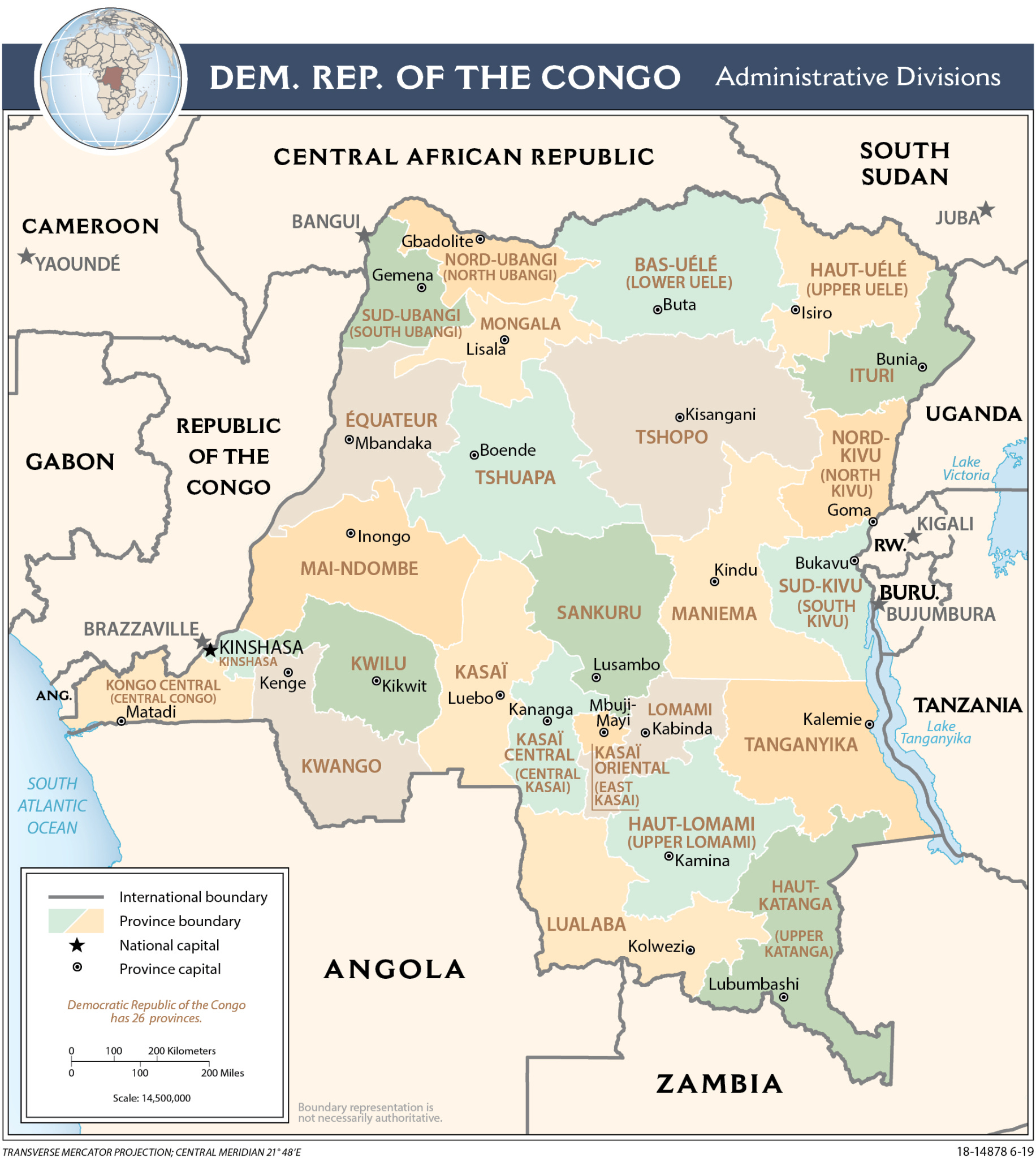
Administrative map of the Democratic Republic of the Congo, 2021. Image: CIA.
Africa’s World War
Epstein and Barak’s interest in the Congo emerged from a long history of American and Israeli intelligence agencies seeking to extract valuable minerals from the former Belgian colony. To prevent the Congolese independence movement from seizing the country’s mining resources, the CIA and Belgian officers helped assassinate Congo’s first prime minister in 1961. The new Belgium-backed government formally nationalized the mining sector, but allowed foreign firms to maintain influence through loans and technical expertise, and invited the Israeli military to train the army.
Amid rampant corruption and state-sponsored looting, Congo’s mining production collapsed in the 1990s. In the aftermath of a genocide in neighboring Rwanda, Congo became the site of a multi-sided civil conflict that became known as “Africa’s World War.” The war drew in the armies of nine African nations, and many more armed militias, leading to millions of deaths. As the conflict expanded and threatened the rule of the central government, foreign mining interests stepped in to support then-Congolese ruler Laurent Kabila, turning mining deals into a bargaining chip for his regime’s survival.
Among those investors was Dan Gertler, a Israeli diamond trader whose grandfather had founded the Israel Diamond Exchange. A UN report from 2001 claimed that Gertler made a deal to help Kabila access Israeli weapons and military training in exchange for a monopoly on Congo’s diamonds—a deal based on the “special ties” the report said that Gertler enjoyed with “some generals in the Israeli army.”
Reached for comment, lawyers representing Gertler denied that he had helped Kabila obtain Israeli military support and claimed that the deal was merely made to help boost the Congolese treasury and help the country fight smuggling by militia groups. The same UN report noted that the agreement turned out to be “a disaster for the local diamond trade,” citing sources that claimed no military support was ultimately provided.
In 2001, Kabila was assassinated by his own bodyguard in the presidential palace, and his son Joseph took power. During the spring of 2002, the younger Kabila appointed Gertler as his special emissary to the U.S. government, and Gertler met with National Security Advisor Condoleezza Rice to seek the Americans’ help in ending the war. In July 2002, a peace agreement was signed in Pretoria mandating the withdrawal of Rwandan troops—but the conflict in the Kivu region of the country was never fully settled.
After the war, Congo’s state-owned mining company, Gécamines, still controlled the mines in the southeastern copperbelt, but the company was insolvent and needed funding to make the mines profitable. Kabila’s government sold off a large share of the copper-cobalt belt to Gertler and his French-Israeli business partner, Beny Steinmetz, to rehabilitate the mines. Chinese state-owned companies also provided financing and built infrastructure through a new mining joint venture called Sicomines.
During the 2008 global financial crisis, mineral prices fell sharply as global demand collapsed, and Gécamines was forced to sell off more of the copperbelt. In February 2009, Glencore gave a secret $45 million loan to Gertler’s company in exchange for political access to Kabila’s camp, according to a contract published in the Paradise Papers leak. Glencore used that access to buy more of the mines in the Katanga region, increasing its ownership stake to nearly 80%.
Glencore declined to comment for this story.
The market crash also put pressure on Kabila’s government to make peace with the rebels in eastern Congo. The month after Glencore’s bailout, on March 23, 2009, the National Congress for Defense of the People (CNDP), a major North Kivu armed movement, struck a deal with Kabila’s government to form an official political party and integrate into Congo’s national army.
Kabila broke up the CNDP structure, but he struggled to discipline and control the ex-CNDP officers within the national army. Facing redeployment away from the Kivus, and loss of control over checkpoints and mineral routes, a group of ex-CNDP officers broke away and formed the “March 23 Movement” in 2012. The M23 forces humiliated the army and briefly took control of Goma in November 2012.
A U.N.-backed offensive against M23 began in March 2013, splitting the rebels’ forces across roads, hills, and towns, pressured by artillery, rockets, and helicopters.
The tactical unit trained by Israeli mercenaries, according to Yatom’s report that was shared with Barak, gave the Congolese army an elite strike force able to move after dark, identify rebel positions, and conduct raids under fire, while the broader U.N.-backed campaign pushed the rebels back toward the Rwandan border.
Stabilizing the security situation opened investment opportunities that a network of individuals connected to Jeffrey Epstein was keen to exploit.
As the tide turned in the Kivu war, emails show that Epstein asked Sultan Ahmed bin Sulayem, his close friend and chairman of the U.A.E. logistics conglomerate DP World, to arrange a meeting with Kabila. At the time, DP World was steadily advancing conversations with Kabila for investment in a deepwater port on Congo’s short western coastline. “He wants to give us investment in mining and oil and gas,” Sulayem wrote to Epstein in May 2013, two months after the U.N. offensive began. “I mentioned to him that I have an American fund manager who will visit with me next time; he welcomed that very much.”
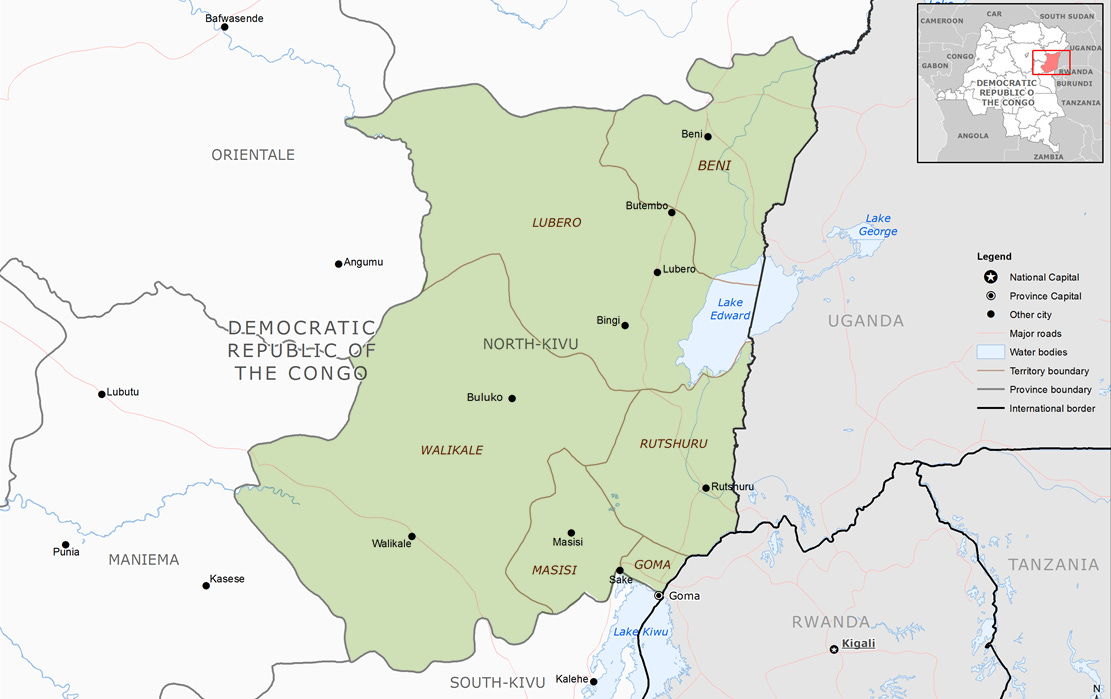
Map of North Kivu province in eastern Democratic Republic of Congo. Image: Wikimedia Commons.

“Strong Men”
In December 2013, the M23 Movement surrendered and laid down arms. Soon after the end of the war, in March 2014, U.S. Secretary of State John Kerry went to Kinshasa, pledging $30 million to support Congo’s elections and encourage a peaceful transition of power. Russ Feingold, Kerry’s special envoy for Africa, issued a clear warning to Kabila that stabilizing the country depended on a succession plan and enforcement of term limits. “President Obama, when he was here last year made a very important statement,” Feingold said, “What Africa needs is not strong men but strong institutions.”
But Kabila refused to leave. His family’s wealth was inextricably tied to the state, with stakes in more than 80 companies across mining, banking, agriculture, telecoms, and logistics sectors. Kabila’s camp delayed elections for three years by proposing constitutional changes, initiating a new census, and de-funding the electoral process.
In 2016, the U.S. Treasury Department sanctioned several police and military officials responsible for violently suppressing popular street demonstrations against Kabila. The U.S. Justice Department filed a conspiracy case against a New York hedge fund linked to Gertler, and collected nearly $1 billion in criminal penalties related to bribery cases across Africa under the Foreign Corrupt Practices Act. Glencore quickly began buying out Gertler’s stake in its copper-cobalt mines in Congo’s far southeastern copperbelt.
Epstein jumped into a small circle of players engaged in privatized sanctions diplomacy around Congo’s mineral economy, which began immediately after Donald Trump’s 2016 presidential election victory over Hillary Clinton.
In December 2016, Kabila hired an Israeli defense-security and surveillance firm, Mer Security and Communication Systems, to lobby the new administration against additional sanctions. In the first year of Trump’s first term, the Treasury Department ratcheted the pressure on Kabila by sanctioning Gertler, who had become an indispensable political intermediary to Congo’s mineral economy. Treasury officials claimed Gertler used his friendship with Kabila to manipulate mining and oil deals, causing the Congo government to lose more than $1 billion from underpriced asset sales.
Kabila tried to show outside investors and Washington that his government remained the essential custodian of Congo’s mineral wealth. In March 2018, he asked Sulayem, the chairman of DP World, to immediately come to Kinshasa to sign a concession agreement for the Banana port at the mouth of the Congo River on the Atlantic coastline. The sudden meeting caused Sulayem to cancel a planned appointment with Epstein in New York that week.
One month later, in April 2018, Glencore’s Africa business was impacted again by the Treasury Department when an additional round of sanctions was imposed on Oleg Deripaska, a Russian oligarch accused of money laundering, extortion, and bribery. Deripaska’s aluminum conglomerate, United Company Rusal, was formed through a merger with Glencore’s alumina assets and the Siberian aluminum assets of Viktor Vekselberg, another Russian oligarch with Israeli and Cypriot citizenship.
Barak and Epstein were intimately familiar with the circle of aluminum titans behind Rusal. After his retirement from Israeli government service in 2013, Barak became an adviser to Vekselberg, and Epstein helped him leverage the relationship to engage in backchannel diplomacy with Vladimir Putin during the Syrian civil war. Barak’s business partner in Africa ventures, Gary Fegel, had led the aluminum unit at Glencore, and served on the board of directors for Rusal after the merger.
Fegel did not respond to a request for comment.
One month after sanctions landed on Deripaska, Epstein was approached by Jide Zeitlin, then-head of Nigeria’s sovereign wealth fund, about helping Glencore navigate the crisis. At the time, Glencore was making bribe payments to the Nigerian government for favorable terms on commodity deals.
The Treasury Department’s move against Deripaska had major consequences for Ivan Glasenberg, the Israeli-South African CEO of Glencore, who was forced to resign from Rusal’s board of directors. “Do you know Oleg Deripaska or Ivan Glasenberg?” Zeitlin wrote to Epstein on May 4, 2018. “Easy,” Epstein replied.
Epstein suggested an “approved sanction structure” to lift U.S. sanctions on Deripaska’s companies by diluting his ownership. The oligarch would need the Treasury Department’s blessing to divest, such that his ownership did not look like a strawman arrangement. “If you had a meeting with the appropriate division of treasury,” Epstein replied to Zeitlin, “im sure you can structure around it.”
Epstein had personally advised the Treasury Department on the topic of sanctions evasion in the past, and he floated a few options that could preserve Deripaska’s economic value in Rusal, while satisfying the Office of Foreign Assets Control that Deripaska no longer controlled the assets: trusts, swaps, options, or debt. On May 11, 2018, Zeitlin wrote to Epstein from Zug, the location of Glencore’s global headquarters in Switzerland: “Good lunch today in Zug re sanctions solution. Interest piqued.” Epstein wrote back, “No surprise,” and congratulated Zeitlin, “Great work.”
Ten days later, Zeitlin sent Epstein an article about Glasenberg’s predicament in the Congo, as fears mounted that Gertler’s assets would be targeted and seized by regulators in the U.S. and the U.K. “Unfortunately for Ivan, he finds himself in an uncomfortable place,” Zeitlin wrote, on May 21, 2018. “This is complex and requires additional digging in Washington.” Epstein wrote back, warning Zeitlin, “This channel is NOT secure.” Later, he explained why it would take time to untangle Deripaska’s holdings: “Who owns what is not simple.”
By August, the eventual corporate restructuring of Rusal and its parent company, En+ Group, looked similar to Epstein’s proposal. Lord Greg Barker, a former British Tory politician and chairman of En+, authored a proposal that resembled the structures Epstein had floated to Zeitlin. Zeitlin forwarded the news to Epstein in August 2018, with a note: “Interesting that key aspects [of] their approach now mirror my proposal.”
In December 2018, the Treasury Department announced it was terminating sanctions on Rusal and En+, while keeping the sanctions on Deripaska in place. Deripaska’s divestiture solved Glencore’s sanctions problem by letting the company keep its ownership in Rusal and En+, and resume its Rusal-related aluminum trading. Epstein shared the Treasury notice with Ehud Barak on New Year’s Day in 2019, just months before his arrest and death in a Manhattan jail cell. In 2020, Rusal approved a $16 billion contract to supply aluminum to Glencore.
The AI “Treasure Map”
Israeli and American security channels in Congo have matured further in recent years.
Félix Tshisekedi was sworn in as Congo’s new president on January 24, 2019 in the first peaceful transfer of power in the country’s post-independence history. The election was highly contested, however, with widespread accusations of fraud and tampering, and the African Union casting “serious doubt” on the validity of the result. Foreign Policy reported that Kabila had reached a secret power-sharing agreement with Tshisekedi to maintain behind-the-scenes influence over the country’s legislature, cabinet, and security apparatus.
According to reporting in Bloomberg, Yossi Cohen, then-director of the Mossad, traveled to Congo in June 2019, accompanied by Gertler, to meet with both Tshisekedi and Kabila. Some of Tshisekedi’s aides became concerned that the Mossad was helping Kabila acquire arms for a possible coup d’état. (Lawyers for Gertler denied the meeting took place and claimed that Gertler has “no relationship whatsoever” with the former Mossad chief.)
After Cohen visited Kinshasa a second and third time in the following months with an even larger delegation, Tshisekedi ordered him to leave the country. The Guardian later reported that Kabila had agreed to support Cohen’s campaign to pressure the International Criminal Court to drop its investigation into Israel’s alleged war crimes in occupied Palestine.
By the end of 2019, the United Nations Group of Experts identified Israeli military instructors training Congo’s national army in the Goma area, while tracing vast sums of illegal gold smuggling to the United Arab Emirates from a nearby province in northeastern Congo. The U.N. received testimony from diplomatic and military sources and photographs of the instructors, in the same Kivu battlefield where Danny Yatom’s group had helped defeat M23 six years earlier.
In January 2021, after intensive lobbying from Epstein’s longtime lawyer Alan Dershowitz, the Treasury Department quietly eased the sanctions on Gertler in the final days of Trump’s first term. Two months later, the new Biden administration reversed the move, saying the decision was inconsistent with U.S. foreign-policy interests in combating corruption in Congo.
The unresolved status of Gertler’s sanctioned assets are now entangled in Tshisekedi’s new minerals-for-security channel with Washington. On February 3, 2026, Glencore and the U.S. and U.A.E.-backed Orion consortium announced a non-binding memorandum for Orion to acquire 40% of Glencore’s Congo platform, putting an American-Emirati investment group in line to acquire Gertler’s former copper and cobalt interests.
In a press release, the U.S. International Development Finance Corporation described the Orion investments as an opportunity to close “gaps in financing” that have allowed China to dominate mineral supply chains.
Meanwhile, Silicon Valley titans are taking advantage of the opportunity to harden the supply chain for America’s artificial intelligence boom. In the first three months of 2026, Amazon, Google, Microsoft, and Meta spent more than $100 billion on new capital projects, mostly large data centers powering artificial intelligence. The American tech giants have committed close to $700 billion for new capital projects this year, while the UAE has committed to support a $1 trillion investment framework in U.S. energy, AI, and manufacturing sectors over the next ten years.
KoBold Metals, an exploration company backed by Amazon founder Jeff Bezos, Microsoft co-founder Bill Gates, and OpenAI co-founder Sam Altman, launched a $50 million lithium exploration campaign in Congo in April, targeting extensive mining licenses from the Congo government. The company says it uses artificial intelligence to create a “treasure map” to find new deposits of copper, lithium, cobalt, and nickel.
In February, Kinshasa also added the rebel-held Rubaya coltan mine to the shortlist of strategic assets being offered to Washington. The private army of Blackwater founder Erik Prince recently worked with Israeli advisers to again train Congolese special-forces battalions to fight M23 in the Kivus. A source told Africa Mining Union that Prince’s security and logistics firm, Vectus Global, will likely be used to enforce revenue collection on the mines in the southeastern copperbelt.
The money and weapons flowing into the Congo signal no end in sight to the scramble for Africa’s precious minerals fueled by foreign militaries. And with the sale of Congo’s mines to foreign interests, including members of Barak’s and Epstein’s extended network, little of the wealth from the extraction of Congo’s vast resources will flow to the Congolese people.
From Drop Site News via This RSS Feed.