

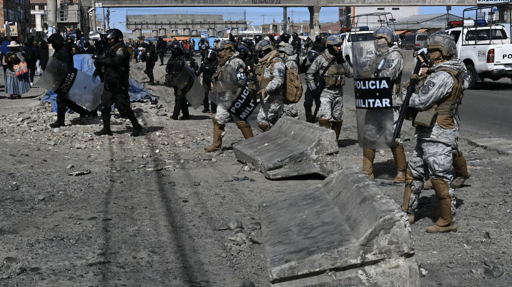
Last weekend, President Rodrigo Paz declared a state of emergency throughout Bolivia, following an agreement with the leadership of the COB, the country’s largest labor federation. That same morning, thousands of police and military personnel left their barracks and headed to areas where protests and roadblocks were taking place, threatening a crack-down. Armored vehicles, infantry, motorcycles, pickup trucks, and drones also advanced through the province of La Paz and along other routes, even resorting to repression.
The objective was clear: to establish a repressive state, where the mobilized people face soldiers armed to the teeth, determined to prevent protests and with a license to kill. Since the government lacks legitimacy and has been unable to silence the fierce mobilizations, it has resorted to treacherous pacts and militarization.
Although the government claims that there is no curfew or ban on gatherings of two or more people, the truth is that the measure does prohibit mobilization, mass gathering, and even publicly expressing support for the protests. And the state of emergency can also be used to repress the “cabildos,” which have been the fundamental form of democratic organization and self-organization for the mobilized and self-convened sectors. This form of democratic organization is even recognized in the Constitution.
In fact, Defense Minister Ernesto Justiniano announced that with just a ministerial signature, the government can implement targeted measures in areas deemed “sensitive,” including restrictions on movement and gatherings. The most serious issue is that these measures will not be announced in advance. In other words, you could be at a meeting or event with other people — even if it isn’t prohibited by the decree — and a police raid could suddenly shut it down.
This arbitrariness is consistent with the government’s policy. In recent days, there have been blackouts in El Chapare, bag searches in “sensitive” areas, and police crackdowns in El Alto and on the roads to Oruro and Cochabamba. The government’s policies also served as a pretext to suspend the Tupak Katari general assembly that was to be held in Ingavi. There have even been threats of an “invasion” of El Chapare and arresting the region’s leader, former President Evo Morales.
Let us recall that Justiniano was appointed just a few weeks ago, following a trip to the United States. He is a man linked to the DEA, a former official under the bloodthirsty Sánchez de Losada (a U.S. puppet), and in constant contact with pro-Trump officials, including Secretary of State Marco Rubio and Secretary of Defense Pete Hegseth.
We must condemn the state of exception they intend to maintain for three months, tying the hands of the mobilized people and militarizing the country in order to impose their neoliberal policies.
Together with all sectors in Bolivia that defend democratic freedoms and the right to protest, we are launching an international campaign:
Repeal Decree 5636!
Get the army and police off the streets and out of our communities! Down with militarization!
Freedom for those detained!
Long live the struggle of the Bolivian people!
Originally published in Spanish on June 23 in La Izquierda Diario
The post Bolivia: Down with Militarization and Rodrigo Paz’s State of Exception appeared first on Left Voice.
From Left Voice via This RSS Feed.