

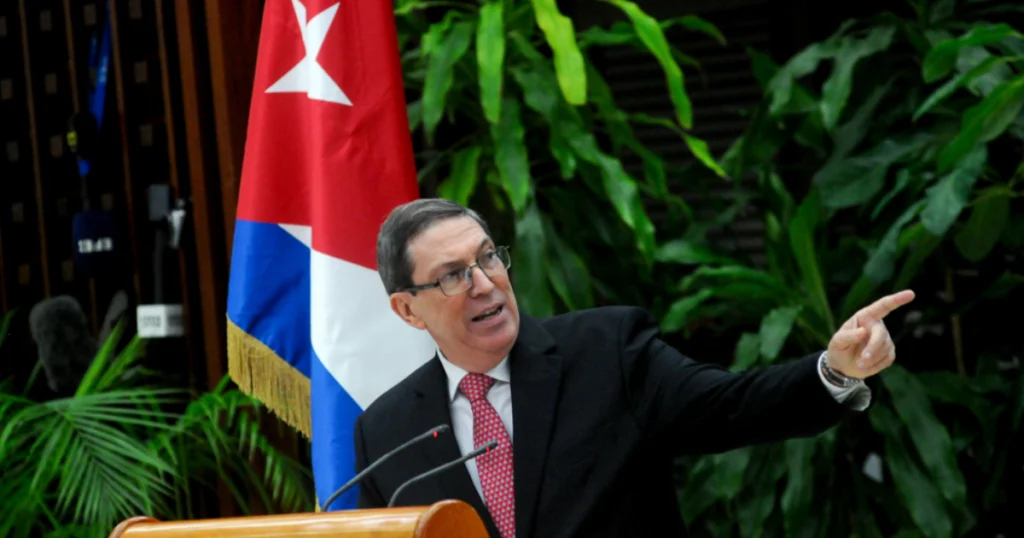
On Tuesday, the Cuban government issued an official response to the new unilateral coercive measures announced by the U.S. State Department. The Caribbean nation has historically faced these restrictive policies. Foreign Minister Bruno Rodríguez denounced that the Trump administration continues to tighten the noose around Cuba’s economy after the island proved stronger, more capable, and more effective than expected in the face of ruthless aggression.
The recent restrictions fall under Executive Order 14404, signed by the U.S. president on 1 May. Through this mechanism, Washington designated five Cuban entities and one specific citizen: the International Financial Bank, Rafin, Almacenes Universales, GeoMinera, Siderúrgica José Martí, and the official Annalie Lilliam Rueda Cardero.
In a message posted on social media, the Cuban Foreign Minister directed his criticism at U.S. Secretary of State Marco Rubio, whom he called “dishonest and mendacious.” Rodríguez emphasized that what this individual is promoting from the world’s greatest power is a crime, referring to the new sanctions and the policy of economic strangulation.
The head of Cuban diplomacy stressed that these actions constitute a collective punishment against the people and their living conditions. This characterization coincides with previous warnings issued by international organizations, including the Office of the United Nations High Commissioner for Human Rights, which has documented the humanitarian impact that the blockade has on the civilian population, limiting access to basic supplies.
The #US government, led by its dishonest and mendacious Secretary of State, continues to take steps to tighten the siege around the Cuban economy, when the latter is proving to be stronger, more capable and efficient than it expected in the face of a ruthless aggression and the… pic.twitter.com/U5hDA7VbYE
— Bruno Rodríguez P (@BrunoRguezP) June 23, 2026
Threats of Secondary Sanctions and Extraterritoriality
The White House maintains its position of accusing Cuba of being a threat to U.S. National Security and Foreign Policy. Marco Rubio warned that, anyone providing services to these sanctioned actors risks being sanctioned themselves, demanding that foreign banks and international companies freeze their activities immediately or face legal repercussions.
This mechanism highlights the extraterritorial nature of the hostile U.S. policy. By threatening international partners, the U.S. Government attempts to isolate Cuba from global trade networks and restrict sovereign nations from engaging in legitimate economic exchanges.
While U.S. officials claim these actions defend Human Rights, Cuba maintains this narrative lacks factual basis. Instead, the unilateral policy seeks to hide the direct humanitarian damage caused to the civilian population by blocking access to international markets.
These statements demonstrate the marked extraterritorial nature of the blockade, a policy that reinforces the embargo and threatens third countries that maintain trade relations with the sanctioned Cuban actors, affecting international financial transactions.
Impact on the Economic and Social Structure
Just weeks ago, Washington blacklisted the state-owned oil enterprise company (Cupet). This aggressive decision directly disrupted energy supplies required for public hospitals, power generation plants, and municipal water distribution systems across the country.
The ongoing blockade prevents the acquisition of basic supplies, fuel, and electrical infrastructure. By targeting these essential industries, the U.S. administration continues to cause deliberate energy shortages and financial instability for eleven million Cuban citizens.
The systematic denial of resources has generated critical blackouts and fuel shortages. The U.S. administration blames Cuban authorities for the domestic crisis, yet it deliberately conceals how its own commercial blockade prevents the purchase of necessary technology.
Consequently, these unilateral coercive measures violate international lawand the sovereignty of the Caribbean island. Cuba continues to demand the immediate end of this financial blockade, which remains the main obstacle to its economic development.
#FromTheSouth News Bits | United States President Donald Trump has once again raised the possibility of military intervention in Cuba, arguing the island’s proximity to the U.S. pic.twitter.com/y6LBnFzon8
— teleSUR English (@telesurenglish) June 23, 2026
From teleSUR English via This RSS Feed.