

Bullets:
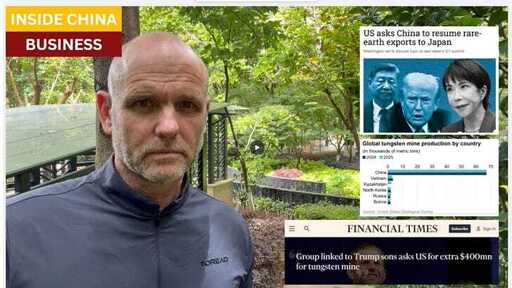
Chinese exports to Japan of tungsten and rare earth metals has collapsed, with trade in some metals dropping to zero.
Japanese manufacturers are snapping up scrap, and investing heavily in new recycling capacity.
China’s export bans to companies with military ties are deeply impacting Japanese factory groups.
The Trump Administration and Pentagon is also investing billions into new mining projects, including a mine in Kazakhstan that is partly owned by members of the Trump family.
Inside China / Business is a reader-supported publication. To receive new posts and support my work, consider becoming a free or paid subscriber.
Report:
Good morning.
The wars in the Persian Gulf and Ukraine are blowing up stockpiles of munitions. And all the supply chains to replace them run through Global South countries, who are shutting off exports to weapons makers.
That poses a major problem for civilian manufacturers, who need those same raw materials to build equipment.
Tungsten is one of those metals that have vast dual-use applications. China produces most of the tungsten in the world, and China has very tight export restrictions on materials that are used by foreign militaries—not just for weapons makers in the United States, but everywhere. Chinese exports of tungsten to Japan have plunged, compared to last year, and in the first quarter of the year, new exports to Japan dropped to zero.
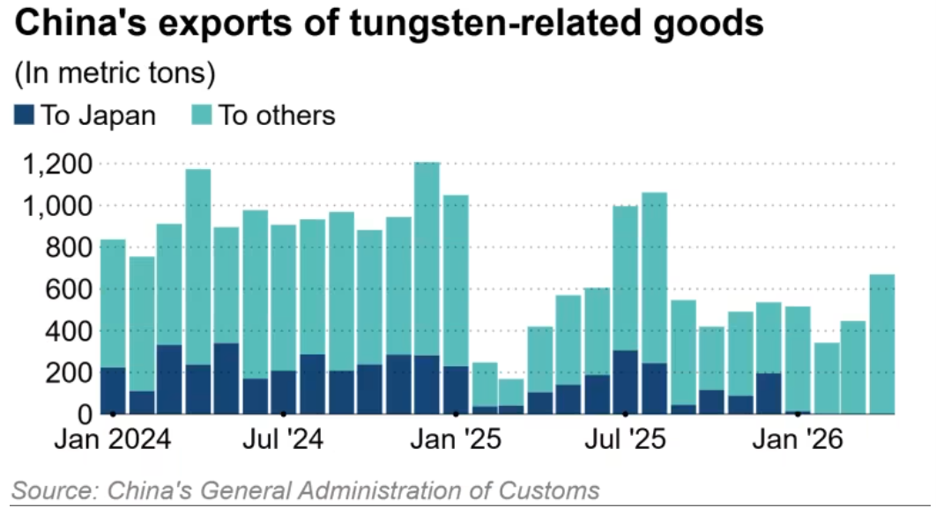
Japanese manufacturing has been deeply impacted. Tungsten prices are soaring, and Mitsubishi Materials is tripling the prices on some of their cutting tools and equipment. Sumitomo Electric is also raising prices. Tungsten is one of several rare earth metals that China has monopolies on, and restricts their exports for military contractors.
The tungsten recycling industry is taking off, and both Mitsubishi and Sumitomo are investing heavily to build recycling capacity in Europe and in Japan. But those are massive companies, and even if they can find new sources for tungsten, for themselves, smaller manufacturers will struggle.
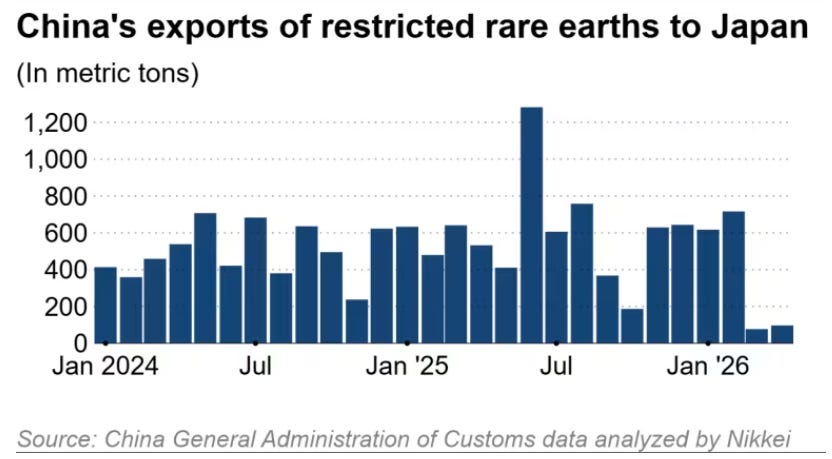
Immediately after China announced new export bans on rare earths, Japanese firms’ imports collapsed. In March and April, Chinese exports to Japan dropped by over 80%. Dysprosium and terbium dropped to zero on the year, and Yttrium imports fell by over 90%. Yttrium is used in medical devices and laser cutting, and chipmaking. But yttrium is also critical in advanced weapons platforms: Shipborne radar systems used by the Navy, precision-guided munitions, and thermal coatings on military jets and missiles.
China is a key supplier of these materials to Japan, while Japan in turn is a major supplier of components and equipment, containing those materials, to the United States. So the Trump Administration requested a resumption of those exports, from China to Japan. “Washington is concerned about the dwindling global supply of Japanese high-tech products”, and at high-level meetings called on China to avoid damage to supply chains for those products.
Japan is a top producer of MRI scanners and other diagnostic equipment, and if Japanese firms can’t source the materials from China, they cannot build them for America, is how the thinking goes there. But Chinese companies also build all that equipment, and American hospitals can simply buy them from China, is how the thinking goes here.
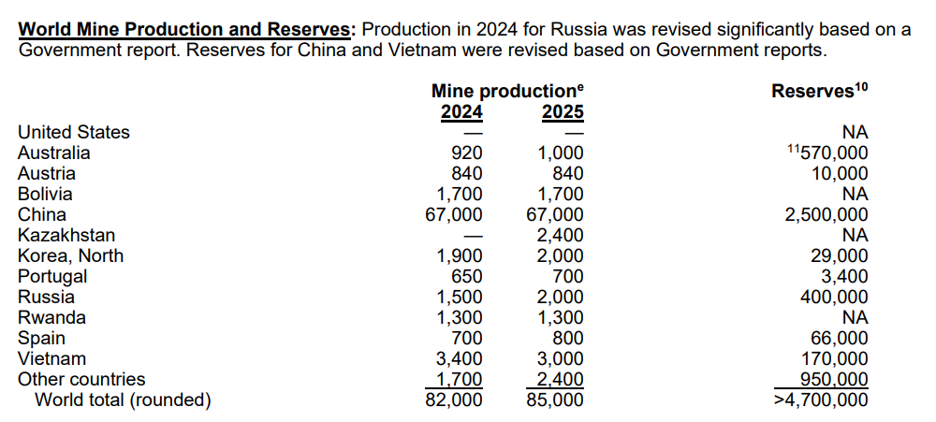
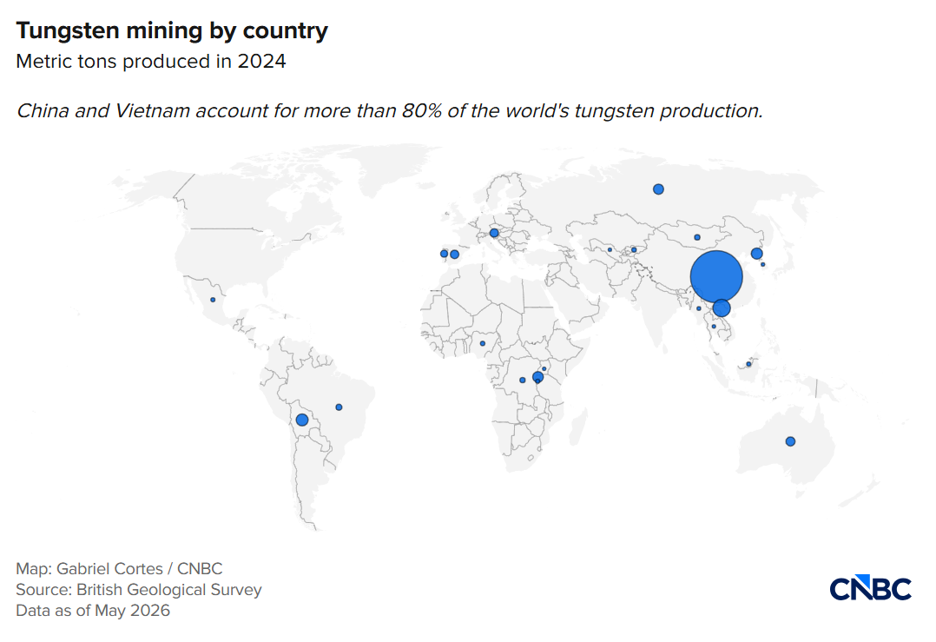
This is from the US Geological Survey. US domestic production of tungsten is zero, since 2015. Globally, China is 80% of tungsten mining, and Japan is also not a producer of tungsten. The top five global producers are China and its neighbors, and they’re friendly neighbors.
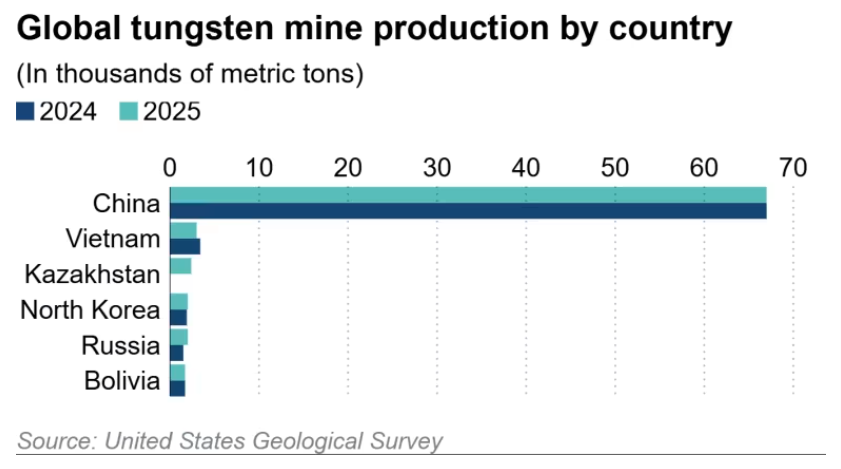
Japan doesn’t have any mines, so they’re stepping up their imports of scrap, from wherever they can get it. There is the chart for US exports of tungsten scrap, and lots of that headed to Japan:
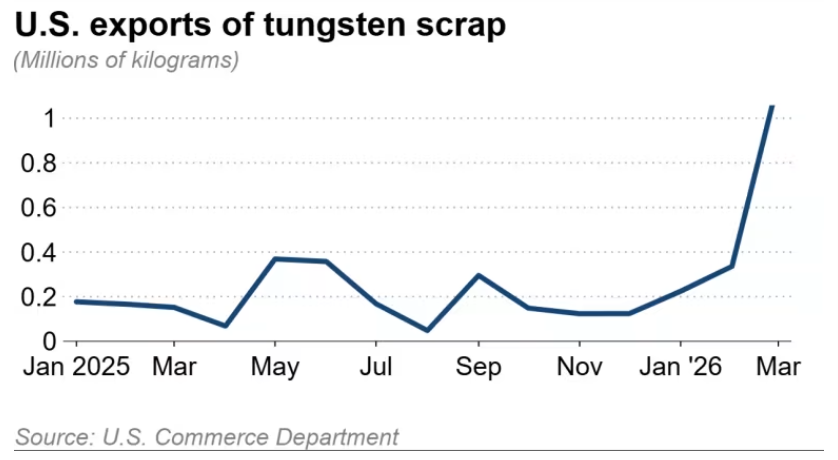
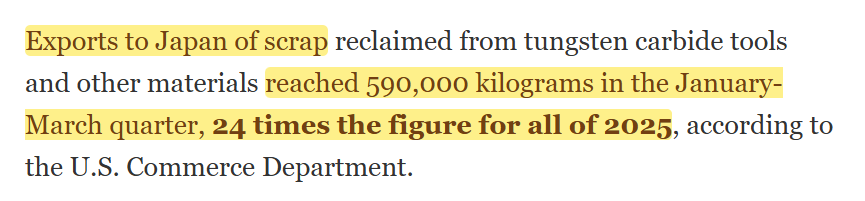
Global demand is soaring because of the war in the Middle East, and anyone who builds electronics, or chips, or weapons, or cutting tools needs tungsten.
China has cut off access to many buyers, so the scrap markets are booming. This is a press release from Mitsubishi Materials Group, part of an outreach to companies across the world to sell scrap to Mitsubishi. Remember that this is the same division of Mitsubishi which increased prices for their products, citing the high cost of inputs.
But Mitsubishi’s real problem is that their other divisions are large manufacturers of munitions.
In February, a group of 20 Japanese companies, including Mitsubishi, were specifically restricted from imports of Chinese rare earth metals. Those companies are deeply involved in the production of ships, planes, radars, and missiles. There is the announcement in Chinese:
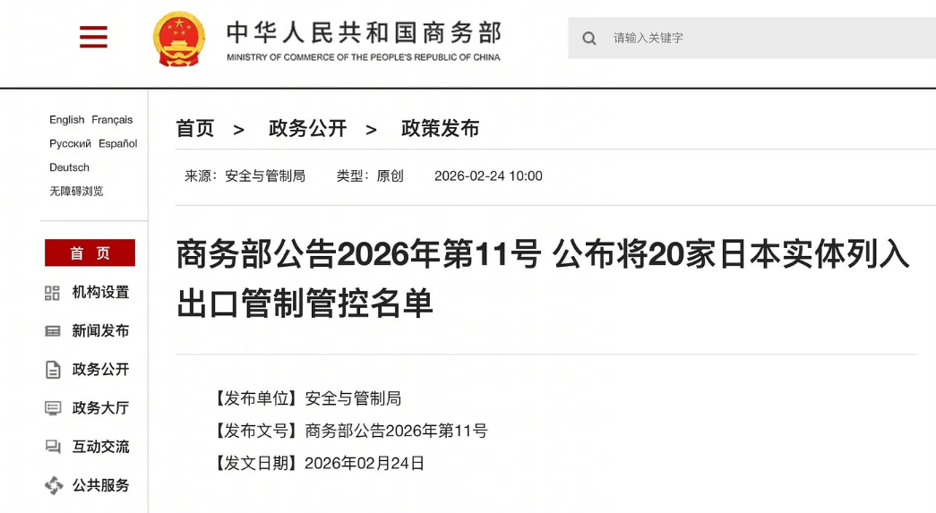
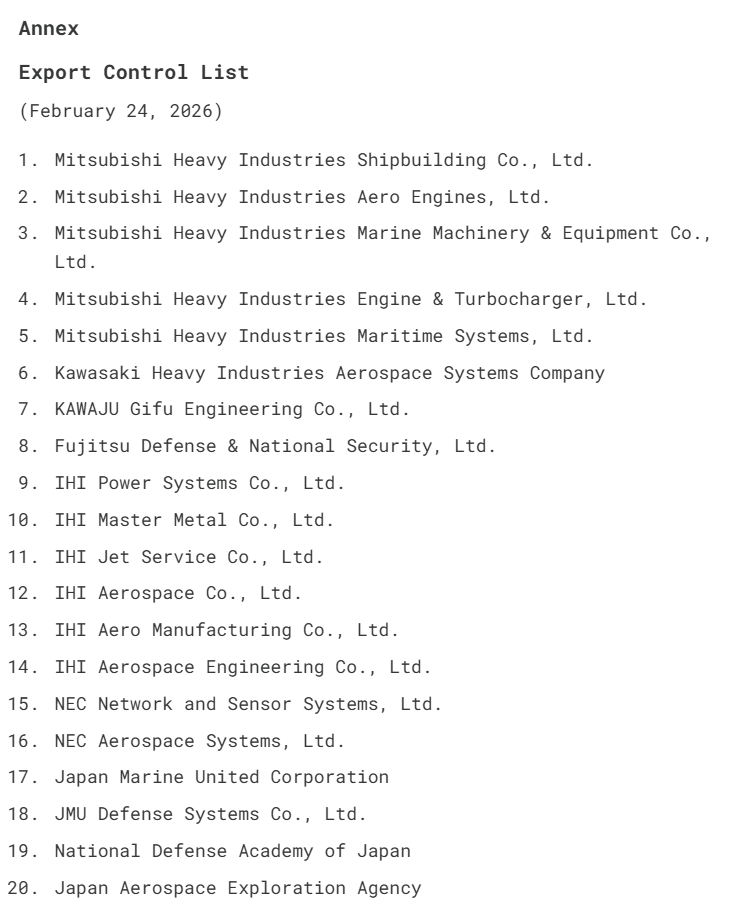
From 24 February, Chinese firms are prohibited from exporting dual-use items to those companies. And the first five, on that list, are divisions of Mitsubishi. Japan is remilitarizing, and doubling their defense spending. Chinese companies exporting to any of the companies on that list needs to apply for an individual license, each time, for any dual-use item—and that means the metals and any other components—and provide a guarantee that whatever is sent to those companies “would not contribute to enhancing Japan’s military”.
That is an almost impossible standard to meet; after the materials leave Chinese jurisdiction, the buyer can do about anything, and sell to about anyone. So this is a hard ban on anything from Chinese companies to those Japanese companies, for anything that conceivably has a military purpose.
And that is the problem for everybody. Every time something blows up in Europe or the Middle East, Pentagon defense contractors scour the world for the materials they need to build more. That’s the problem with all those metals. China and China’s next-door neighbors own the supply chains for tungsten at the same time civilian and defense manufacturers are fighting over the same pile:
There is no short-term answer to the problem, and long term the only way out for Western companies is to mine and refine these metals at home, or in friendly countries.
Kazakhstan is much more friendly with China than with the United States, but optimism abounds that Kazakhstan will one day serve as a profit center for the Trump family, and a supply chain node for the Pentagon. Eric Trump and Donald Jr. are investors in a company that will merge with a mining operation in Kazakhstan, now owned by Cove Kaz Capital, and Cove Kaz just got $1.6 billion in new federal financing to develop new tungsten projects.
Cove Kaz has also asked for $400 million from the War Department. It takes years to bring new mining projects online, and that is only the first step in the process of building usable materials for the Pentagon or the IDF. And the Trump Administration will be gone, and the White House under new management long before any tungsten moves out of Kazakhstan to help out Mitsubishi or Raytheon. If ever.
Lots of money moving right now, though.
Be Good.
Resources and links:
China tungsten exports to Japan halve amid tightened controls
https://asia.nikkei.com/business/materials/china-tungsten-exports-to-japan-halve-amid-tightened-controls
‘Our time is now’: Vietnam tungsten firm rides high on Chinese export curbs
https://asia.nikkei.com/business/markets/commodities/our-time-is-now-vietnam-tungsten-firm-rides-high-on-chinese-export-curbs
China’s rare-earth exports to Japan drop 80%, sending companies scrambling
https://asia.nikkei.com/business/materials/china-s-rare-earth-exports-to-japan-drop-80-sending-companies-scrambling
US asks China to resume rare-earth exports to Japan
https://asia.nikkei.com/politics/international-relations/japan-china-tensions/us-asks-china-to-resume-rare-earth-exports-to-japan
US tungsten scrap exports to Japan soar on Chinese curbs
https://asia.nikkei.com/spotlight/supply-chain/us-tungsten-scrap-exports-to-japan-soar-on-chinese-curbs
US Geological Survey, Tungsten
https://pubs.usgs.gov/periodicals/mcs2026/mcs2026-tungsten.pdf
Special Feature : Delivering to the world the material of possibilities - TUNGSTEN Vol.3
https://withmaterials.mmc.co.jp/en/233
Japanese companies tackle tungsten shortage amid rift with supplier China
https://www.marketscreener.com/news/japanese-companies-tackle-tungsten-shortage-amid-rift-with-supplier-china-ce7f5dd2da8dfe27
China, tungsten and a supply shock in metal critical for war that will last far beyond Iran conflict
https://www.cnbc.com/2026/06/03/china-metals-national-security-defense-weapons-supply-tungsten.html
China imposes export controls on 20 Japanese entities to curb ‘remilitarisation’
https://www.reuters.com/world/asia-pacific/china-adds-20-japanese-entities-export-control-list-2026-02-24/
Mitsubishi Materials to lift tungsten carbide prices on tight China supply
https://asia.nikkei.com/business/companies/mitsubishi-materials-to-lift-tungsten-carbide-prices-on-tight-china-supply
U.S.-Kazakhstan Tungsten Venture Advances as Critical Minerals Cooperation Deepens
https://timesca.com/u-s-kazakhstan-tungsten-venture-advances-as-critical-minerals-cooperation-deepens/
China’s new export ban on tungsten shocks defense contractors as Pentagon races to find new supply
Inside China / Business is a reader-supported publication. To receive new posts and support my work, consider becoming a free or paid subscriber.
From Inside China / Business via This RSS Feed.