

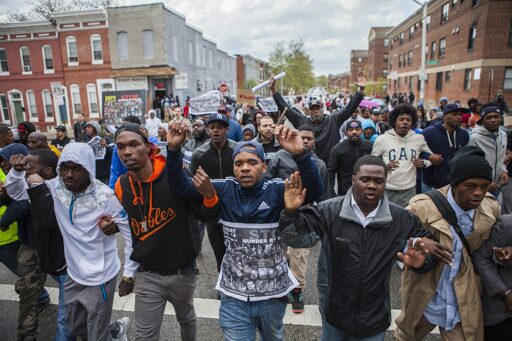
A new, thought-provoking documentary hits theaters this summer. Beyond the Wire, by filmmaker and researcher Dr. S. Rasheem, offers a powerful counternarrative to the popular crime series The Wire. In this exclusive, one-on-one interview between Dr. Rasheem and Rattling the Bars host Mansa Musa, they explore how her background in community organizing compelled her to tell a different story of Baltimore—one focused on the boots-on-the-ground activism that defies the narrative of a hopeless, crime-ridden city in need of over-policing. Premiering this June, Beyond the Wire is already being hailed by critics and organizers alike as an indispensable representation of “The Greatest City in America.”
Credits:
- Producer / Videographer / Editor: Cameron Granadino
Transcript
The following is a rushed transcript and may contain errors. It will be updated as soon as possible.
Mansa Musa:
Welcome to this edition of Rattling the Bars. I’m your host, Mansa Musa. A new documentary Beyond the Why, which provides a powerful counter narrative to the popular crime series, The Wire is premiering this month. Today I’m honored and joined by the filmmaker, Dr. S. Rasheen. Welcome to the show, Dr. Rashid.
Dr. S. Rasheem:
Thank you so much for having me. I’m really excited to be here. All
Mansa Musa:
Right tell our audience a little bit about yourself and more importantly, your background and community organizing.
Dr. S. Rasheem:
Yeah. So my background as it relates to this work, how I came to even being able to a point where I’m doing filmmaking, I’ll also share that. So I am a social scientist by socialization and training. So it just means that I largely study people, large populations of people. The people that I particularly focus on, of course, is like my own people. I focus on black people and the conditions that they’re living in. So for a number of years, I have done a lot of research in Baltimore and around Baltimore focusing on some of the conditions of black people, whether it is things related to them, graduation rates or violence or drug use or just parenting, just a number of different
Mansa Musa:
Things.
Dr. S. Rasheem:
All of the stuff that I was producing or creating or writing was ending up behind an academic paywall. People who were in the ivory tower might be looking at it, people who are … You know what I’m saying? But it was not being able to really connect with the people where it matters the most. So what I decided to do is I want the people who this is their lived experience. I want them to be able to engage with this research, with this knowledge, with this information. And so one of the things that I did was look around and I see what we look at all the time. We looking at YouTube, we got IG, we’re looking at videos. So in order to get the information, the research and to support movements moving, my approach was to put the information on film to make it consumable to a wider audience so more people would engage with the information and the content.
So that’s actually what got me to filmmaking specifically. Now my interest in the population that I’m interested in, I mean, I’m sure that comes largely from I’m a black person, I’m a black woman. I live in Baltimore City in a black city and there’s conditions that are around us that I feel like sometimes we’re experiencing, but some of us may not necessarily have the language to articulate exactly what’s going on and people use that to discount people because you ain’t say it in the right words or it’s not polished in a particular way.
So one of the things that I have always wanted to do and that I continue to do in organizing spaces is I use my brain. One of the things that I was taught very early from a very young age is that my education that I have can’t just be for me. If all I did was go to school to get a degree so that I could get an even better job, that’s a waste. This is supposed to be for the people. So if I’m getting knowledge and information and I’ve studied and go to school where it should show up in community, it should show up as an effort to improve the material conditions in the lives of people. So in terms of organizing, I mean I have been involved in everything from reparations marches, which I’m running the reparations things now. The first film
That I did as part of the Baltimore Legacy Project is Baltimore Still Rising. And that’s a 10-year reflection on the uprising that happened after the incident with Freddie Gray. Because another thing that’s really important right now is narrative. Narrative impacts policy. These stories impact policy. This is why what you guys have here is so good, right? Because you are able to inform and also shape narrative. When you have only one or a few people controlling press or the word that get out, Malcolm X has this quote, the news will have you hating the people. I forgot the-
Mansa Musa:
Yeah, because you talk about John Brown. Look John Brown, make John Brown look crazy. Hey, you hating the very people that’s about to look great. But let’s talk about the project Beyond the Why. And we both was talking off camera. The wire took on a characteristic that was like none of it. It competed with soap opera, like popular, popular things on TV. It became popular, like everybody was rushing to see. One, why did you feel the need to, and you spoke on the narrative, why did you feel the need to do beyond the wire? And two, why do you think this specific perspective is so critical in telling the story?
Dr. S. Rasheem:
Yeah. So many times, whether I’m talking to other Baltimoreians or on my travels, when people learn that you either live in or are from Baltimore, they say, “Oh, the wire.” And the way that they say it is they’re equating it like every time I’m walking down the street, I’m ducking bullets or something like that. You know what I mean? It’s a way in which that particular piece of artwork has kind of flattened the image of the city and just flattened into, this is all we are. Now they aren’t the only one, they aren’t the first television show of their kind. There’s also Corner, there’s also homicide, We Own The City, there’s a multitude, but none of those have the traction of the wire.
Mansa Musa:
So
Dr. S. Rasheem:
That’s one of the things that I just really wanted to articulate. And then I will also say I want it to go beyond … And this film does not say, “Oh, Baltimore don’t have no crime.” It doesn’t say this is Disneyland and everybody is safe. It’s just saying, let’s tell the full story. Let’s talk about how black people got into the conditions that they got into. And it’s beyond redlining. I think a lot of our issues tend to get flattened down into just redlining is that’s what happened to the city. But it seems to forget deindustrialization of the working class black men when Sparrow’s point and those things went away. They skip over the infusion of drugs and crack cocaine and stuff in the neighborhoods and that impact. They don’t talk about the impact of the highway to nowhere that split up over 700 different families displaced.
Mansa Musa:
They
Dr. S. Rasheem:
Don’t talk about the gentrification. They don’t talk about these things. They don’t talk about how there’s more investment, almost three times more investment in white neighborhoods and white home ownership than there is in Baltimore. So you want to come in on a story and you’re telling me the 14th chapter, but you ain’t telling me chapters one through 13 of how it got here. So that’s why I say beyond the why, because one, I want the information to be contextualized of the conditions and also to say we are beyond that and the people who have come back home are beyond that and the people as brother Anthony Muhammad said that was once part of the problem are now being part of solution.
And we need to talk about that more. Particularly, this is also a historic time right now in Baltimore City with this historic drop in homicides. And you have people vying for credit. You had a mayor, you have the state’s attorney, the governor, you know what I mean? Everybody want to get credit for it. But the thing that occurs is you don’t have that level of historic drop without a collective effort. And what seems to happen is the people who get the microphones in front of them and the cameras in front of them and who have clout get to tell whatever story they want. And so my aim and goal and interest is in taking the microphone and the cameras to the streets so that the people could tell their own story. And I think that going beyond the wire and telling some of these stories helped to do that because the truth about how we got this historic drop in homicide doesn’t fit in a cute little bow,
How they want you to fit. They don’t talk enough about the fact that there’s some boots on the ground soldiers, if you will, that are literally stop and beef, that are literally putting their bodies and their life on the line to save lives. You know what I’m saying? At that level, that’s not getting enough attention for people who they hear about a young man who a young person might call them and say, “I’m about to kill this nigga. I don’t know if y’all can say that on the show.” Right. You say whatever you want to say. Yeah, I’m about to kill this nigga. And so at two o’clock in the morning, when you about to do something like that, there’s a lot of these, they’re not up at that time. They don’t get it. They don’t understand. And they’re also not going to be able to relate to the same level and degree that a person who has lived through that has gone through.
So those type of folks are called Credible Messengers. And I feel like it’s really important to highlight the work of Credible Messengers because the term that is largely being co-oped now by nonprofits, it actually came out of the Black Panther Party. There was a person, I forget his name, I’m going to look it up and folks who are listening in, feel free to look it up. But he started something called Credible Messengers in Prison. And that was people who had lived experiences going and trying to communicate with other people who they saw going down a particular path and they started keeping peace. These are people who are now, they started behind the wall peacekeeping and now they’re out here peacekeeping. So Baltimore is not all that you see on television in that particular way. It’s not just the wire. We are so much more than that as a city beyond the wire.
Mansa Musa:
And that right there because, okay, so we know that we know just like you outline that crime is going down not because of the city and money’s being put in the budget for policing. We know that a lot of people that’s like Muhammad say, a part of the one time part of the problem is an empire solution. And in that regard, a lot of people are coming out the system and they’re going back into their community and trying to reestablish a sense of community. But talk about in terms of how do you think the wire overall impacted the perspective of the city? Because like you say, if they say we doing a wide marathon, we ain’t talking about in Baltimore City, say, “We do a wide marathon, people in California, people in the south, people in Canada, people all around the world, because they going to be because of the way it was produced.” Why do you … Talk about that.
Talk about how this present attitude that we see in the city is countering that narrative about this being a drug town. Because remember now up on North Avenue when they had all these and I’m not saying that in contradiction to what you’re saying, I’m saying that we know that we have a serious drug problem. You come out north and Penn and it’s like another world all the way down and you see it, but so it’s saying like, well, the aftermath for the wire, this is what’s been left, the remnants of the wire, the bodies, the drug. Talk about how this what we know now that’s taking place that’s not getting attention. How is it changing that narrative?
Dr. S. Rasheem:
Yeah. So I like that first part of the question too, and I’m going to answer both parts where you asked the question of how has the wire impacted this city? Oh man, it has impacted financially, politically, emotionally, culturally, in so many particular ways. And I’ll be really specific about some of those. Narrative change is very important impacting the narrative because despite the fact that crime could be going down, youth aren’t as engaged in crime as television and news stations want to report that they are, you’ll do a poll or somebody will do a poll and you’ll ask people, they still feel unsafe. That’s because of a narrative. That means you could show them stats and figures and numbers and proof and you just showing them like, look here or look here, this is brown, this is brown. But if I have impacted you emotionally, you’re disconnected from the truth and the truth don’t even matter.
Mansa Musa:
What
Dr. S. Rasheem:
Matters is the story. And the way that I’m saying it impacted financially is, and I believe Mr. Bramble was talking about this as well, he’s a developer, is people not wanting to invest in Baltimore because of the crime and all of that and looking at these images that are portrayed on the wire. So businesses or different things not wanting to come to the city because of that. And another way it impacts us is policy. We have Maryland, despite how black it is from the … We have a black mayor, we have a black governor, we have the largest congressional black caucus and still we are the second, I think we’re only second to Alabama, but one of the states that sends more black kids to adult prison than any other state, but we so black. So it can’t just be in that. The narrative impacts policy for us to be able to look at a young person and just be able to automatically criminalize just youth behavior, whether they’re riding a dirt bike
Or they are trying to make some money with squeegeeing or let’s say they get in a scruffle and they scrap, right? You do that when you young, that does not require a life sentence, you know what I’m saying? Or some of these harsher sentences. But the reason that those policies are able to get those harsher sentences, the reason that money isn’t coming into this space as much is largely because of the portrayal of the image. And what The Wire did is gave the city … And like I said, it’s a good piece of art or it wouldn’t have been effective.
You know what I mean? So it gave that image. Why is this important? It’s important because one, if Baltimore don’t tell its story, we’ve seen time and time again, people will come and tell the story and the story will be told in a way that gets them more and more dollars. And people love crime and violence and sensationalism. So that impacts their pockets, you know what I’m saying in that particular way. So there are folks that do benefit in some ways from this view that Baltimore is crime written, poverty written. Some newsplaces ratings go up even higher or it’s easier to gentrify and get people to like, oh, this ain’t …
For me to be able to take something that I see value in and get it at a low price, I got to convince you that it ain’t worth nothing. And once I convince you that it ain’t worth nothing, you going to give it away for free and then I take it, I could do whatever I want, repackage it and now it’s more money. So this is a thing that’s like, it’s not a new program, it’s not a new approach. It’s something that folks have been doing for years. And I feel like it’s particularly done in Baltimore in a particular way with some news entities because it’s a black-led city and it’s a majority black city. And I feel like anytime people see black-led cities, there’s something that happens in their mind where there’s this concept of inferiority. They can’t lead, they must be corrupt, they’re probably doing
Mansa Musa:
This. It’s called institutional racism.
Dr. S. Rasheem:
There you go.
Mansa Musa:
Bam. It’s called. Talk about this project, right the process of making it, how long did it take and who was on the production team and which grassroot organization did you choose to highlight?
Dr. S. Rasheem:
I’m going to start with that last one first because I love talking about Boots on the Ground and people who are doing the work. So the organizations that are in the film are We Are Us with Captain Andrew Muhammad, Mayor’s Office of African American Male Engagement. That office was actually started under Catherine Pugh, but the person who is leading that right now is Dr. Andre Buntley. Peace Team is EB. Peace Movement is Erica Bridgeford. There’s also Challenge to Change with Uncle T, that is featured in the film. And then they also highlight folks that they’re interacting with. They highlight folks like Lisa Molock. They highlight folks like Mama B. They highlight other people
Mansa Musa:
That’s doing community work.
Dr. S. Rasheem:
Exactly, because this is a collaborative, very collaborative effort. And you said something when we were talking earlier off camera that it was just like, that hits the nail on the head and I started to see a pattern of it. And again, brother Anthony Muhammad highlighted this for me, that this is actually-
Mansa Musa:
That’s nominate them to them.
Dr. S. Rasheem:
Right? This is actually a God-fearing movement. When you look at who is leading it, imams, reverends, bishops. They have people at mosque and synagogues and all of these different places, they coming together to unite and saying, “We want to save lives collectively and together.” And I think that that’s a very important thing to include. So those are the folks in the organizations that are in it, production of it. So I’m thinking about all of the videos,
Mansa Musa:
But
Dr. S. Rasheem:
One of the first people that I talked to that is in the film is I talked to them at 24. Yeah. So I started having conversations with people in 2024. I also wanted to shout out Ray Kelly, who’s over the Citizens Policing Project, who’s also in the film. So I started talking to them then. So I actually thought that I had a good solid amount of people together and I had all of the information together and went through the first round of edits and I watched it and I was like, something is missing. And what was missing were more of the boots on the ground
Mansa Musa:
Because
Dr. S. Rasheem:
I wanted to hear more about the story about how are you saving lives, how are you transforming
Mansa Musa:
The
Dr. S. Rasheem:
Conditions? And I’m so grateful for Captain Andrew who made a lot of the connections for me. He connected me to EB. I want to shout out Davon Love of Leaders of a Beautiful Struggle. He connected me to JT at Rocha. So those credible messengers connected me to other people like, “Oh, you should talk to this person. Oh, you should talk to this person.” And so that was how I got a lot of them involved.
Mansa Musa:
And you know what? I remember, I don’t know if you knew Leon Faru, but Leon Ferreu, he was locked up in the Maryland prisons. He was out initially our district would come. He starled the incredible messages. So when he got out, he was doing a lot of organizing Muslim and so I’m in Supermax and the warden of the Supermax always knew each other. So he walked by, said, “Well, I ain’t going to say nothing to him.” So he came back, said, “Man, you think I’m going to leave without talking to you? ” So we had this kind of relation and so he was telling me about Leon Fari. He said, “Remember Leon Freud?” I said, yeah. He said, well, Leon Fareu is taking a whole block and getting Muslim families to renovate that block. So this is a Christian pastor. So he said that, and Leon, what they was doing was like right on the other side of where his church at, he said, “I never thought about that.
I think I’m going to do the same thing.” To go back to your point is that, and I think that’s the takeaway I want my artist take away from this name is this. Okay, we saying Beyond Y, but we saying that this is Baltimore when people tap into networking, community organizing and building a sense of community, Baltimore had at one point in time, we talked about this off camera, but they had what they call Clean Block and Clean Block was a thing that every community in Baltimore City, all quadrants, north, south, east, and west Baltimore got involved and the African newspaper would highlight the cleanest block and people really wanted to get that be known for that. But what they were really known for was having a clean community, having a sense of community. You couldn’t come on them communities in the neighborhoods and do know anything.
So this is being reestablished by Beyond the Y. But talk about where can people go to watch the documentary and what final thoughts you would have you would like to leave our audience?
Dr. S. Rasheem:
Yeah. So the world premiere of the documentary will be June 18th at the Senator Theater at 7:00 PM. There’s an encore premier that will also be at the Senator Theater at 7:00 PM that’s on June 25th. The 18th is sold out, but tickets are still available for the one on the 25th. If folks are interested, I would suggest they get their tickets now. It’s already over 500 tickets sold just to let y’all know. Next year the plan is for it to be able to be streamed because a lot of people who are from Baltimore but have moved away have asked, “I’m not in town no more, but I really want to see this film about my city. How can I see it? ” So when it’s streamed, I’m definitely going to make sure that I let people know.
Mansa Musa:
If people want to touch base with you or support you.
Dr. S. Rasheem:
Oh yes, please support because this is community supported, community funded.
I will tell you that I feel like I’ve gotten this far with it because I bet on Baltimore and the thing that I would leave with, some of the things that I would leave with people if you’re trying to do something, if you are actually authentic, because people could read that real quick. If you’re actually authentic, if you’re not just coming in and trying to extract from it to get what you want for your own personal self, I feel like Baltimore will support you and I will continually each time bet on Baltimore and every time I bet on Baltimore I win or we win rather. So I’m really grateful for that. What was the other part of the question? Oh, how together get in contact. Right. So this film is part of the Baltimore Legacy Project. So if you go to all of the Ws, you know how I go Baltimorelegacyproject.com on IG it is Baltimore_legacy_project.
And if you go on there, you’ll be able to see information about this film. You’ll be able to see the faces and the names of the people who are on the crew and you’ll also see some of the artists that are in the film, EZ Jackson. He has a song called Be Great. I want you to be great. That’s in the film. Chaotic Couture Provided Music, YNCU Provided Music. We Are Us has a song
That’s in there. Erica Bridgford has a song. This is a very Baltimore.
Mansa Musa:
Oh yah, it’s definitely Baltimore. It’s
Dr. S. Rasheem:
Definitely Baltimore. Very Baltimore film. So those are how to get in contact. Baltimorelegacyproject.com and also go to IG@baltimore_legacy_project.
Mansa Musa:
Nina Simone said Old Baltimore. And I’m going to tell you, I did a lot of time in prison and the majority of my time I did, I did in Maryland Penitentiary and I came to know the Baltimoreans. I came to know the people and Baltimore people are some most loving people, giving people and caring people. If you paint the narrative that they vicious, the savage, then that’s what you going to get in return. But when you paint the narrative as Rasheed has painted it, that this is beyond the Y. This is the Baltimore. This is the Baltimore that supports projects like this Beyond the Y. And we ask that our audience look at this and mainly if you’re a Baltimore, like when they threw the hat up, when they had the fight down in Mississippi or where they was at, they threw the hat up to rally the people, then throw your hands up and rally the people around this film.
So you can see what this film is about, but more importantly, you can get a better perspective of your city. Your city is not what you see every day abandonment. Your city is not what you see every day. People stand on the corner. Your city is people actually doing honest work, squeegee kid. Your city is actually people that’s real creative, riding motorbikes. Your city is all these things. If you invest in these things, you’ll see the flower and see Baltimore go. Thank you, Rasheed.
Dr. S. Rasheem:
Thank you for having me.
Mansa Musa:
And we ask our audience to continue to support the real news and rattling ball because guess what? We’re actually the real news.
Dr. S. Rasheem:
Listen, I believe it. I see it.
Mansa Musa:
Thank you.
From The Real News Network via This RSS Feed.