


This story originally appeared in Common Dreams on June 22, 2026. It is shared here under a Creative Commons (CC BY-NC-ND 3.0) license.
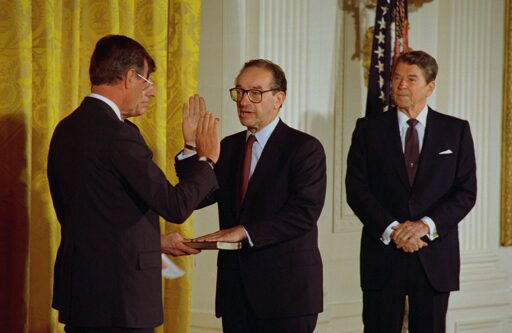
Alan Greenspan, whose policies during nearly 20 years as US Federal Reserve chair fueled soaring economic inequality and helped create the conditions for multiple economic crashes, died Monday at age 100 after a long battle with Parkinson’s disease.
While many corporate media outlets published hagiographic obituaries lionizing the “Maestro” who presided over nearly two decades of low inflation, rising stock prices, and American economic confidence, critics focused on Greenspan’s role in promoting dangerous deregulation and “easy money” policies that inflated financial bubbles, with sometimes disastrous results.
Robert Reich—who served as US labor secretary under President Bill Clinton during all of Greenspan’s tenure—called him “in many ways the most powerful person in America” during that era.
“If any single person was responsible for the financial crisis of 2008, it was Greenspan.”
“He maintained an iron grip over the Fed, and almost single-handedly decided on interest rates,” Reich wrote. “He essentially fired George H. W. Bush by raising interest rates so high (ostensibly to ward off the inflation then threatening the economy) that the economy took a dive, and voters blamed Bush. This was enough to convince my boss, Bill Clinton, to do exactly what Greenspan wanted—which was to reduce the federal budget deficit and thereby destroy much of the agenda Clinton ran on (and I helped create).”
“I don’t want to speak ill of anyone who has passed. Greenspan was an extremely charming, intelligent, and thoughtful man,” Reich added. “But the truth must be told: If any single person was responsible for the financial crisis of 2008, it was Greenspan. That crisis—the worst collapse since 1929, which led to the worst recession in decades, in which millions of Americans lost their jobs, savings, and even their homes—resulted from the deregulation of Wall Street that Greenspan advocated.”
Former Greek Finance Minister Yanis Varoufakis wrote on X: “His epitaph? A singular, glorious confession, ‘I found a flaw in my model of the world.’ A flaw, he said, as though it were a leaky pipe, not a total collapse of the intellectual architecture that anointed him Oracle. For decades, he preached that the self-interest of the predator was the invisible hand of the common good.
“Then, in 2008, the beast devoured the table, and to his credit, he blinked, admitting that his entire worldview—the one that central bankers canonized and the world swallowed—was a fairy tale for rentiers,” Varoufakis added. “He did not, of course, admit to culpability. That would require a moral compass, a device notably absent from his Ayn Randian toolbelt. No, he merely noted the flaw, as a meteorologist might note a gust of wind, and returned to his well-earned silence.”
Alan Greenspan bade us farewell today. A man who was celebrated as the central bankers’ central banker based on the conviction that markets are divine and volatility is a virtue.
His epitaph? A singular, glorious confession: “I found a flaw in my model of the world.” A flaw, he…
— Yanis Varoufakis (@yanisvaroufakis) June 22, 2026
Born 10 miles from Wall Street in Manhattan’s Washington Heights during one of the most infamous economic bubbles of all time, Greenspan was a protégé of libertarian writer and philosopher Ayn Rand and was influenced by the Atlas Shrugged author’s moral defense of capitalism, her fierce advocacy of deregulation, and her insidious insistence that self-interest was socially beneficial.
Their relationship cooled as Greenspan embraced more mainstream economic policies despised by Rand and gradually became a leading steward of the very sort of state-shepherded system she deeply distrusted.
After heading President Gerald Ford’s Council of Economic Advisers, Greenspan was appointed chair of the Fed by President Ronald Reagan in 1987. He would remain in the post well into George W. Bush’s second term.
Greenspan generally favored low interest rates, especially after crises like the 1987 stock market crash, the 1998 Long-Term Capital Management crisis, and the 2001 recession. His fame grew after he suggested that the economy might be experiencing a tech-driven “productivity miracle,” language that many investors took as validation that traditional valuation limits were obsolete.
Critics would later call it a “productivity mirage.”
Staunch devotion to low interest rates by Greenspan’s Fed boosted stock prices and real estate values under “easy money” policies. Many investors came to believe that the Fed would intervene aggressively whenever markets fell sharply—the so-called “Greenspan Put.”
However, since ownership of financial assets (and the firms that sell and promote them) is concentrated among the wealthy, it was the rich who benefited most from Greenspan’s polices. When bubbles burst, as they did after the dot-com boom that ended in early 2000 and during the 2008 global financial crisis, the rich bounced back thanks to their diversified portfolios and bailouts, while middle- and lower-income households were wiped out through asset devaluation, foreclosures, and job losses.
“It is no exaggeration to say the global financial crisis of 2008 had an enormous and lasting impact on American life and the way ordinary people view elites,” New York Times global economic correspondent Peter S. Goodman said on social media. “It is also no exaggeration to say that Alan Greenspan has as much responsibility for the crisis as an individual can.”
“For those not old enough to remember, it is difficult to state his aura during his time of greatest influence,” Goodman continued. “When he told Americans that they should buy houses and use variable-rate mortgages to do it, they listened. Much is made of his econ jargon-laden vernacular that went over the heads of nearly all listeners.”
“That was central to the mystique,” he added. “When he went to the Hill and spoke to Congress, most people had no idea what he was talking about but assumed that smarter kids did. And so his quasi-religious faith in the efficiency of markets as the ultimate insurance against risk went unchallenged and became dogma, and the risks kept building.”
From The Real News Network via This RSS Feed.