

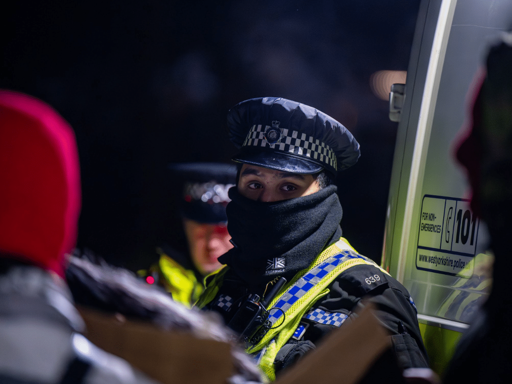
The Metropolitan Police has announced plans to expand its deployment of live facial recognition (LFR) technology in London. The Met Police force is planning on having the intrusive scanning technology set up in Soho and the West End by December 2026. Over the following year, six more areas across London are slated to follow.
However, civil liberties organisation Big Brother Watch has called these plans:
an alarming escalation of an intrusive technology which has already scanned the faces of millions of innocent Londoners.
Likewise, the privacy campaigner also highlighted the recent high-profile case of Alvi Choudhury. The young British-Asian man was mistakenly arrested due to an AI facial recognition error. This sparked conversations around the technology’s racial bias.
Met Police build ‘secretive watchlists’
The Met Police has recorded over 2,000 LFR-assisted arrests since 2024. Human rights organisation Liberty explained that LFR:
usually involves parking vans equipped with the tech on busy shopping streets or outside stadiums and train stations, scanning the hundreds of thousands of us who come within range of the police cameras on the vehicles’ roofs, attempting to match our faces in real time to images on secretive watchlists.
According to the Met Police Commissioner, its new LFR cameras will be fixed in place on lamp-posts and similar vantage points. However, the cameras could also be repositioned if officers notice “shifts in crime patterns or tactics”.
The force has already trialled similar static cameras in Croydon, marking the first such deployment in the UK. It pronounced the pilot a success, with commissioner Mark Rowley claiming that the 6-month test:
delivered over 170 arrests, a reduction in crime, and a significant fall in violence against women and girls. All these results with only one false alert among hundreds of thousands of people. The technology supports officers to target wanted criminals and registered sex offenders. Crucially it is supporting officers – not replacing them.
Rowley framed the technology as part of an ‘arms race’:
We also have to be clear about the threat we face — criminals are not standing still. They are quick to exploit new technology to commit offences, evade detection and target victims at scale. Policing cannot afford to fall behind and this is another step towards tackling that.
Per the Guardian, the Met Police is asking for funding from local councils in order to deploy the static LFR cameras. As such, this claim that the force needs new technology in order to tackle better-equipped criminals sounds awfully convenient.
Big Brother Watch
Responding to news, Jack Coulson, head of advocacy for Big Brother Watch, said:
Forcing people to enter a digital police line-up in the capital’s busiest and most popular destinations is an affront to the idea that you should not have to identify yourself to the police if you have done nothing wrong. To see a play, you must now pay with your privacy.
Facial recognition surveillance makes mistakes. Just this February, Alvi Choudhury was arrested, held for ten hours, and only released at 2 am for a crime committed in a city he’d never visited. It is predictable, given the technology’s racial bias, that Mr Choudhury was confused for another Asian man.
Back in February, police arrested Choudhury for a burglary in Milton Keynes. Racist AI facial recognition technology placed him at the scene, in spite of the fact that he’d never even entered the city. In the end, the culprit bore little resemblance to Alvi beyond sharing Asian heritage.
At the time, Liberty director Akiko Hart explained that racial biases arise because the AI behind facial recognition tech is trained on white faces. As such, you are far more likely to be misidentified if you’re Black or brown, a woman, or young.
‘Policing by consent’?
The Met Police force has claimed that it will avoid LFR’s notorious racial bias problems by turning down the sensitivity of its algorithm. Likewise, it also claimed that it will make passersby aware of the LFR when it’s active. It will also delete any faces it scans immediately, in the event they don’t match a suspect.
However, in Alvi’s case, law enforcement already had his face on file for the facial recognition software to match. This was due to a custody photo taken four years prior. When that too turned out to be a wrongful arrest, officers assured Alvi that they would delete his information. Obviously, they lied.
Given these issues, it’s unsurprising that Big Brother Watch’s Jack Coulson called for a pause on the Met Police’s new deployments:
Legislation to regulate the police’s use of facial recognition is expected in the Autumn. Yet the police are rushing ahead with AI monitoring of the public under their own rules.
We are calling on the Met to stop this experiment until, at least, Parliament has spoken. Policing by consent is a cultural inheritance we must protect. Permanent biometric surveillance of the public square is incompatible with that ideal.
However, given Labour’s incessant calls to increase the use of AI in both policing and the court system, we’re not exactly going to hold our breath. We will not wait for Parliament to speak out against the Met Police’s escalation of the UK’s surveillance state.
Featured image via Barold / the Canary
By Grace
From Canary via This RSS Feed.