

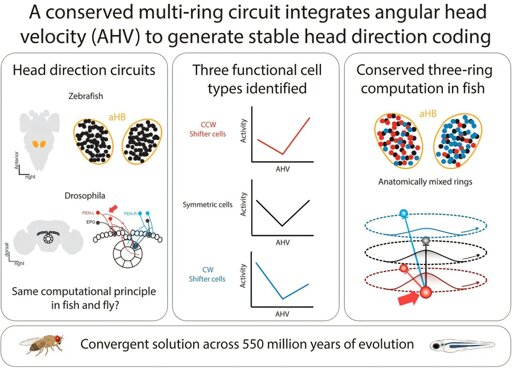
Even in darkness, many animals retain a sense of orientation because their nervous system sustains a memory of heading encoded by the activity of head-direction (HD) cells. Animals continuously update this internal compass by temporally integrating angular head velocity relayed by vestibular, optic flow and motor efference signals. External cues, such as visual landmarks, are used to counteract cumulative integration errors.
From Biology News - Evolution, Cell theory, Gene theory, Microbiology, Biotechnology via This RSS Feed.
You must log in or # to comment.