

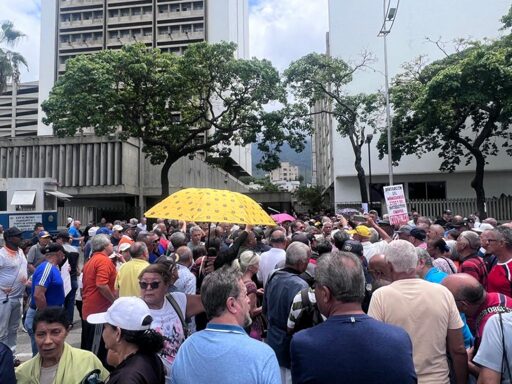
Caracas, June 23, 2026 (venezuelanalysis.com) – Thousands of retired workers from Venezuelan state telecommunications company CANTV have staged protests in recent days to demand the restoration of a monthly “income complement” payment.
On Thursday, CANTV suspended the US $200 monthly payment with no prior notice. The measure prompted emergency rallies outside the firm’s headquarters in Caracas, Barquisimeto, Valencia, and several other Venezuelan cities on Friday.
Active workers received the bonus as scheduled, though many joined the protests in solidarity.
The cutback reportedly affected around 10,000 retirees for whom the bonus represents over 70 percent of their monthly income. Many told reporters that the unjustified cutback placed an immediate strain on day-to-day survival, especially for those suffering from chronic illnesses.
The swift grassroots response prompted the company to backtrack and pay the retired workers $150 over the weekend. The CANTV retired workers’ plight also drew support from the World Federation of Trade Unions.
“The company thought that we would be the weakest link in their bid to cut costs at the workforce’s expense,” retiree Arturo Morgado told Venezuelanalysis. “But the protests all over the country told a different story.”
Monday saw around 300 workers demonstrate again outside CANTV headquarters in Caracas. A commission from FETRAJUTEL, a trade union representing the firm’s retired workforce, met with the CANTV board but received no commitment that the remaining $50 will also be paid.
The announcement led protesters to temporarily block Libertador Avenue in central Caracas, vowing to maintain the pressure until the full bonus is restored.
“We are going to continue fighting, for the entire bonus and for other rights established in our collective bargaining agreement, including financial support for medical expenses and incomes that cover the cost-of-living,” Morgado added. “The company put these commitments in writing in a meeting with unions in late 2023.”
The former CANTV technician highlighted the “moral strength and honesty” of the retired workforce and warned that the present bonus-over-wage government policies leave workers vulnerable to discretionary cuts. Morgado’s social security pension is worth 570 bolívars per month, less than $1 at the present exchange rate.
With the Venezuelan economy heavily sanctioned by the US, the Nicolás Maduro government increasingly turned to non-wage bonuses while letting the minimum wage continuously devalue. Trade unions have criticized the policy for cheapening labor costs for employers and contravening the existing labor law.
Since taking over in January, after the US kidnapping of Maduro, Acting President Delcy Rodríguez has maintained the policy. On May 1, she increased the minimum monthly income for public sector workers to the official bolívar-equivalent of $240 a month, while pensioners received $70. Public sector retirees are entitled to $170 monthly, but in certain cases, like CANTV, they have secured improvements in direct negotiations with the company.
The labor dispute comes amid a controversial effort by the Rodríguez administration to “reengineer and restructure” the Venezuelan state, including public companies such as CANTV. The state telecoms provider was privatized in 1991 under the terms of IMF-imposed structural adjustment and partially acquired by a consortium headed by GTE, today Verizon. CANTV was re-nationalized by the Hugo Chávez government in 2007 and is currently under the purview of the Ministry of Science and Technology.
Education Minister Héctor Rodríguez, tasked by Miraflores with leading the state reform commission, recently sought to allay fears of massive public sector layoffs. He instead suggested that workers might be “strategically relocated and retrained” in order to improve the public sector efficiency.
The acting administration has likewise launched a process to determine the “strategic” value of state-owned assets. A commission, featuring government officials and private sector representatives, will recommend whether the state should retain ownership of firms, land estates, and other assets or open them for privatization.
Financial advisory group Orinoco Research identified CANTV as a prime candidate for privatization, while libertarian think tank CEDICE Libertad called the prior sale of the telecom company a “model to replicate.” The 1991 privatization was followed by a process of asset stripping that dismantled the firm’s regionally advanced technical base and institutionalized outsourcing and arbitrary firings.
Edited by Lucas Koerner in Caracas.
The post Retired Venezuelan Telecom Workers Demonstrate Nationwide to Demand Bonus Restoration appeared first on Venezuelanalysis.
From Venezuelanalysis via This RSS Feed.