

Drop Site is reader-funded — no corporate owners, no outside influence. Your support is what keeps this journalism independent and free. Please consider making a tax-deductible donation to support our work.
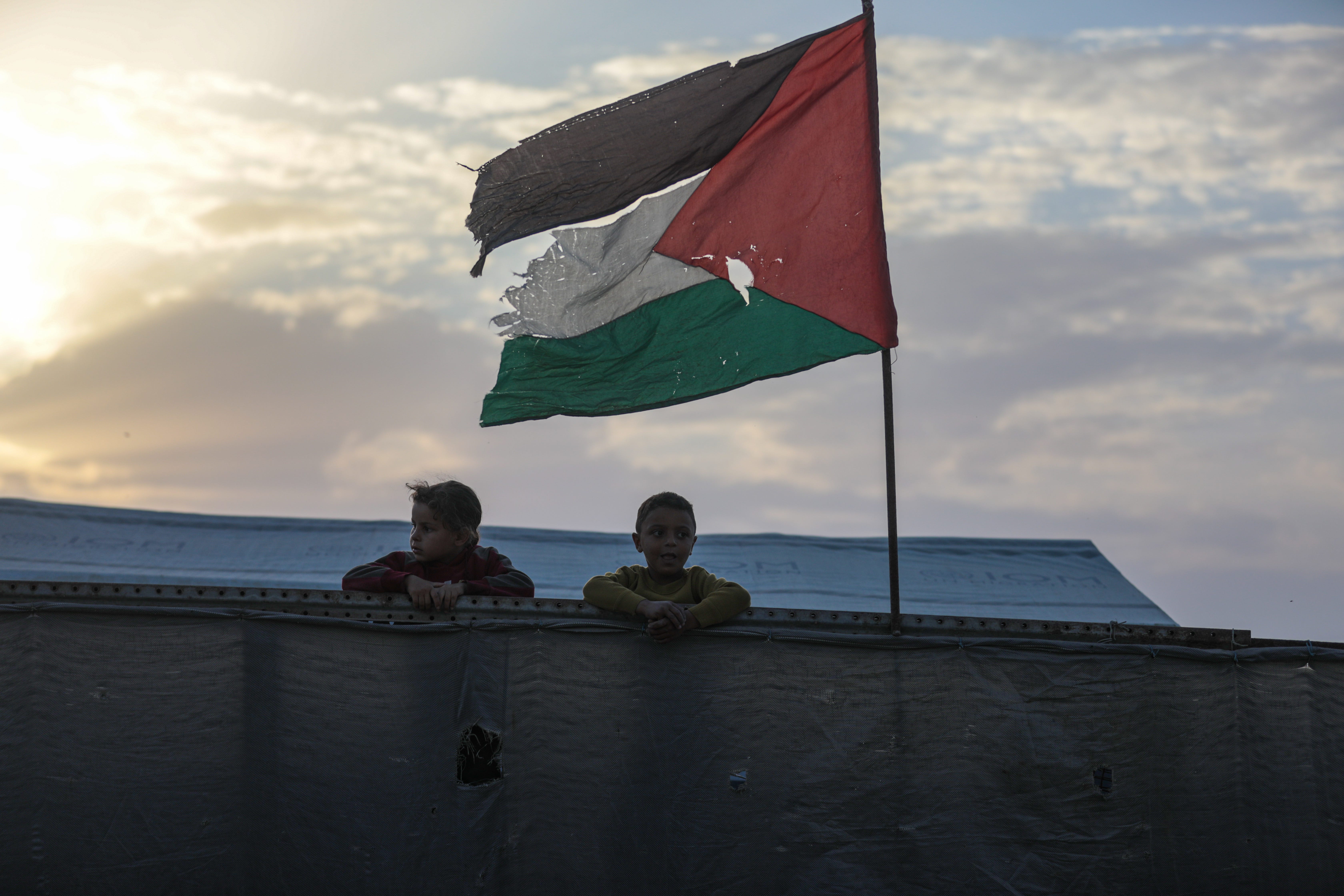
Palestinians living in Al-Shati refugee camp in Gaza City, Palestine on May 14, 2026. Photo by Anas Zeyad Fteha/Anadolu via Getty Images.
Soon after President Donald Trump’s self-congratulatory tour for “ending” the Gaza war last October, replete with ceremonies in which various kings, emirs, and presidents praised him, Israel made clear it had no intention of respecting the terms of the deal. It continued to kill Palestinians on a near daily basis and began limiting the entry of the agreed upon life essentials to the Strip stipulated in the ceasefire agreement.
Nonetheless, Trump pulled off a coup the following month when he got the UN Security Council to endorse his Gaza plan. In an unprecedented move, the council endorsed the deployment of an international force that would not operate under the banner of the UN, but would instead be commanded and controlled by Trump and his private “Board of Peace”—to which states could buy in for $1 billion and receive permanent membership. In the big picture, Trump could wrap the future edicts of his board in the veneer of UN legitimacy.
As Israel steadily expanded its military attacks on Gaza and pushed its occupation forces deeper into the enclave instead of withdrawing and repositioning them as agreed, Hamas officials told Drop Site that they heard nothing from the Board of Peace until March.
Since then, the negotiations over Gaza’s future have been stuck in a diplomatic netherworld. Despite the pomp and circumstance manufactured by the White House after the signing of the deal and Trump’s promise to guarantee it, the U.S. has refused to hold Israel to any of its obligations. While Hamas fulfilled its part of the deal and handed over all of its captives to Israel, both alive and dead, Israel has repeatedly violated nearly every term of the agreement and has killed more than 1,000 Palestinians since the signing of the deal in Sharm El-Sheikh, Egypt.
The talks that have taken place have overwhelmingly centered on attempts by the board to force through changes never agreed to by Palestinians, and effectively transforming a limited ceasefire agreement into a broader political settlement premised on the disarmament of the Palestinian resistance and the abandonment of its national liberation struggle. In a report to the UN Security Council in May, the board called disarming the Palestinian resistance “the single factor that unlocks every other element of the plan.” The BoP’s proposal, if enacted, would leave Gaza with only a local police force tasked with internal law enforcement and no resistance forces capable of defending Gaza against Israeli occupation or ongoing attacks.
Now, with Western and regional media coverage firmly focused on Iran and the Israeli assault on Lebanon, the current negotiations between Palestinians and the BoP have been almost entirely ignored.
But the Board of Peace is continuing to try to chisel away at any possibility of Palestinian statehood through a 15-point “roadmap” it first presented to Hamas and other Palestinian resistance factions in April. Drop Site News obtained two documents from the latest round of negotiations between the Palestinians and Trump’s board. The first is the full text of the Palestinian negotiators’ proposed amendments to the board’s roadmap for addressing a range of issues, including the demand that Hamas, Palestinian Islamic Jihad, and their allies submit to total disarmament. The revised document was delivered to the board on June 13. The second document is the response delivered to the Palestinian side last week by Nickolay Mladenov, the BoP’s “High Representative.”
Taken together, the two versions of the roadmap offer detailed insights into the extent to which Trump’s board is trying to erode Palestinian insistence that any long term deal must include a clear path to statehood, that Gaza and the occupied West Bank be treated as a single Palestinian territory, and that the rights of the Palestinian people to resist Israeli occupation and annexation be preserved.
“What we’re seeing is an attempt, in the shadow of a genocide, to dismantle the Palestinian resistance through all of these kinds of preconditions,” said Abdullah Al-Arian, an associate professor of history at Georgetown University in Qatar. “The interpretation of this agreement is in the hands of actors who are, for the most part, beholden to prioritizing Israel’s security.”
Mladenov, Bulgaria’s former Defense and Foreign Minister, served as UN Special Coordinator for the Middle East Peace Process from 2015 to 2020. He serves as director general of a research academy that trains diplomats from the United Arab Emirates, Israel’s closest Arab ally. Until his appointment to Trump’s board, Mladenov was also a visiting fellow at the Washington Institute for Near East Policy, a pro-Israel think tank established by veterans of AIPAC.
In some recent negotiations with Hamas, Mladenov has been joined by a senior Trump advisor, Rabbi Aryeh Lightstone, a hardline supporter of Israel who played a key role in the 2020 Abraham Accords.
In their draft, the Palestinian negotiators insist that resolving the issue of weapons can only be addressed as part of a “process that guarantees the Palestinian people’s right to establish a Palestinian state and exercise their right to self-determination.” The board’s draft says only that Palestinian disarmament “shall create conditions for a credible pathway.”
The documents also reveal how Trump’s board has embraced a decadeslong Israeli tactic of demanding detailed commitments from Palestinians on issues of security and weapons, while offering only vague suggestions of potential Israeli commitments and providing the Palestinian side no substantive recourse when Israel violates the terms.
“Mladenov’s latest response reflects the occupation’s unwillingness to reach an agreement, despite the movement’s compliance with all the demands placed upon it and the significant flexibility it has demonstrated across various issues, including the question of weapons,” a senior Hamas official told Drop Site. He requested anonymity because the Palestinian factions have not delivered their official response to Mladenov. “In its current form, this paper is unacceptable and cannot serve as a basis for agreement.”
In a statement provided to Drop Site after this article was published, a spokesperson for the Board of Peace said the organization “rejects the characterization that its efforts are designed to advance the interests of one side over another.” He added, “The roadmap is designed to transform a fragile ceasefire into a durable reality that allows Palestinians in Gaza to live in safety, dignity, and stability. This requires progress in governance, humanitarian relief, reconstruction, economic recovery, and security arrangements capable of preventing a return to conflict.”
Hamas officials say the Palestinian factions are currently reviewing Mladenov’s reply to their proposed terms. Hazem Qassem, Hamas’s spokesperson in Gaza, said the amendments proposed in the Palestinian draft and in a series of recent meetings in Cairo were welcomed by regional mediators from Qatar, Egypt, and Turkey. “The mediators expressed clear satisfaction with the Palestinian factions’ responses and viewed them as positive positions that could serve as a foundation for reaching a comprehensive agreement,” Qassem said in a statement. “Mladenov continues to approach the file from a perspective close to the Israeli position, a view that was reflected in the proposals he presented during his recent meeting,” he argued, saying that Mladenov’s attempts to alter terms previously agreed upon with the mediators has “hindered efforts to reach a final agreement.”

President Donald Trump holds a gavel during a signing ceremony at the inaugural meeting of the “Board of Peace” at the U.S. Institute of Peace in Washington, DC, on February 19, 2026. Photo by SAUL LOEB / AFP via Getty Images.
A Framework for Surrender
Palestinian negotiators have maintained that since the signing of the October agreement, Israeli Prime Minister Benjamin Netanyahu and board officials, particularly Mladenov, have introduced new conditions that were never part of the original terms, including demands that Palestinian resistance factions relinquish their weapons as a condition for reconstruction to proceed and before Israeli forces complete their withdrawal from the Gaza Strip. In May, Mladenov and Lightstone threatened in a letter to Palestinian officials that if Hamas refuses to capitulate to the disarmament edict, the ceasefire terms would be deemed “null and void,” paving the way for Israel to resume its large-scale military operations and halting aid deliveries to Gaza.
“It is clear that Mladenov is conveying the Israeli vision of the agreement and attempting to impose it on us—under the threat of renewed war—the continuation of the current humanitarian catastrophe, and ongoing killings,” said the senior Hamas official. “This document is not a framework for an agreement; rather, it is an attempt to impose the surrender that Netanyahu failed to achieve through war.”
Israel has committed at least 3,338 ceasefire violations since the October 2025 agreement, according to Palestinian reports shared with mediators and obtained by Drop Site—an average of roughly 13 violations per day. More than 1,000 Palestinians have been killed and over 3,200 wounded in Israeli attacks on Gaza since the agreement entered into force. Israel has also continued to target and assassinate members of the Palestinian resistance, including the commander of Hamas’s military wing and his successor within ten days of one another. It has severely restricted the movement of Palestinians and the entry of humanitarian supplies into Gaza, permitting only 36 percent of the agreed quantity of aid to enter the Strip. Israeli forces have also continued expanding the “yellow line” separating the areas they occupy in Gaza further westward. Netanyahu recently pledged to expand Israeli occupation to 70% of Gaza and said the ultimate aim is to conquer the entire territory.
“There’s so much that could have been done since October of 2025 to stop Israel. We were, back in October of 2025, the only people in the world that had to negotiate an end to genocide. And here we are now in June of 2026, still negotiating an end to genocide,” Diana Buttu, a Palestinian Human Rights lawyer who served as an advisor to the Palestine Liberation Organization during the Oslo negotiations from 2000-2005, told Drop Site. “The amazing thing this time is that it’s not even that we’re negotiating an end to genocide with the country that’s perpetrating genocide. It’s that we are now negotiating an end to genocide with a subcontractor.”
In public—and in their meetings with Mladenov and other Board officials—Hamas and other Palestinian factions consistently point to the fact that the October 2025 agreement narrowly focused on a ceasefire, exchange of captives, the entry of humanitarian supplies and basic life essentials, and phased Israeli redeployments. Since last October, Hamas negotiators have maintained that they do not have the sole mandate to negotiate on issues that strike at the core of the Palestinian liberation struggle. They argued that discussions over the fate of the weapons held by resistance groups and Gaza’s long-term political future must be negotiated with all Palestinian political factions through a democratic process.
Although it was not a requirement of the original text of the ceasefire agreement, Hamas formally agreed to relinquish governing authority in Gaza to the National Committee for Gaza Administration (NCAG), a technocratic committee composed of non-partisan Palestinian experts. Hamas and Palestinian Islamic Jihad formed working groups in Gaza to facilitate the transfer to the NCAG. Israel, however, has blocked the committee from entering Gaza and has falsely claimed the deal mandates that Hamas completely disarm as a condition for the terms of the original deal to be implemented.
“We want to see this administrative committee present in Gaza and carrying out its work there. Everything that needed to be prepared for this committee to function has already been done,” Osama Hamdan, a prominent Hamas leader, told Drop Site in May. He added that Hamas created a mechanism for handing over power, guaranteeing the security of the Committee members, and facilitating them assuming control of the police. “Despite it being formed and approved, Israel still refuses to allow it to enter, and Mladenov has failed to convince the Israelis or compel them.”
In the revised document, Mladenov makes the entry of the NCAG into Gaza and the assumption of its duties contingent upon Palestinian acceptance of the “roadmap” and the completion, within 14 days of an agreement, of the second phase’s timeline and implementation mechanisms, particularly on Palestinian disarmament.
Israel insists it retains authority to assassinate Palestinian leaders and fighters simply because they are senior members of Hamas or were involved in the October 7 attacks. “I promised that every single architect of the massacre and the hostage-taking would be eliminated down to the last one, and we are very close to completing this mission,” Netanyahu proclaimed two days after Israel assassinated Izz Al-Din Al-Haddad, commander of the Qassam Brigades, Hamas’s armed wing, on May 15.
Neither Mladenov nor any other board officials have condemned Israel’s ongoing assassination of officials from the very party it signed a ceasefire with. Despite Israel’s open assassination campaign against Hamas leadership in Gaza, Palestinian resistance factions have continued to respect the terms of the ceasefire.
Although both Hamas and Israel signed the October 2025 document obliging both parties to stop “all military operations, including aerial and artillery bombardment and targeting operations,” Mladenov singled out the Palestinian side in his revised document, stating that “Hamas and the Palestinian factions shall immediately cease all military activities.”
Instead of holding Israel accountable, Mladenov’s public references to ceasefire violations generally avoid any mention of the perpetrator. The ceasefire “is holding in a way that is not perfect. There are violations. Some of them are serious. They mean civilians are still being killed,” Mladenov told the UN Security Council in a report on May 26, avoiding mention of Israel, before drawing an equivalence between the October 7 attacks and the subsequent genocide in Gaza that, by conservative estimates, killed more than 80,000 Palestinians.
“At this stage, the principal obstacle to full implementation remains Hamas’s refusal to accept verified [weapons] decommissioning, relinquish coercive control, and permit a genuine civilian transition in Gaza,” Mladenov added.
“The High Representative has consistently raised concerns regarding violations of the ceasefire and the humanitarian consequences of continued hostilities,” the Board of Peace official asserted. “The Board’s role is not to assign blame, but to help ensure that commitments undertaken by all parties are translated into realities on the ground.”
On April 19, Mladenov presented Hamas with a 15-point “roadmap” he said was intended to govern the next phase of implementation of a broader deal. While he has publicly described the proposal as a mechanism for stabilization, verification, and institution-building, Palestinian officials contend that it effectively rewrites the terms of the original agreement by conditioning reconstruction, self-governance, and Israeli withdrawal on Palestinian disarmament, while failing to compel Israel to fulfill its first-phase obligations, including ceasing attacks, allowing the agreed quantities of aid into Gaza, fully re-opening the Rafah border crossing, and allowing early reconstruction efforts.
“They’ve effectively made it so that Palestinian life is only about security for Israel and that’s it and nothing else. And it’s going to continue to go down this path endlessly,” said Buttu. “Even if the [Palestinian] factions signed a blank piece of paper and said, ‘Tell us what you want,’ the Israelis are still going to be negotiating over that blank piece of paper.”
The most consequential issue addressed in the exchanged documents obtained by Drop Site concerns the future of Palestinian weapons. Trump and Netanyahu have falsely claimed that Hamas is violating the deal by not immediately surrendering its weapons and Israel has, at times, cited this as a justification for continuing its attacks against Gaza.
In their June 13 response to Mladenov, Hamas and the Palestinian factions proposed a gradual process for the registration and storage of heavy weapons in parallel with Israeli withdrawal from Gaza and contingent upon the completion of the first phase of the agreement, the entry of the National Committee for Gaza Administration (NCAG), the deployment of the International Stabilization Force (ISF), and the dismantling of Israel-backed armed militias in the Strip. Mladenov’s revised text, however, substantially altered both the scope and sequencing of the process.
The Palestinian proposal is limited to “heavy weapons” and focuses on their registration and storage according to an agreed timetable under the joint supervision of the NCAG and Palestinian factions and organizations. Resistance leaders have told Drop Site that Israel is aware that they do not possess powerful weapons and charge that Israel is using the issue of disarmament as a proxy for demanding a public surrender ritual. According to both Israeli and U.S. assessments, the rockets and missile stockpiles of Hamas and Palestinian Islamic Jihad have been largely spent or destroyed during the war.
“There’s practically no heavy weapons in Gaza,” Netanyahu acknowledged in February. “There’s no artillery. There’s no tanks. There’s nothing.” As part of his campaign to entirely strip Palestinians of any weapons that could be used to defend Gaza from Israeli attacks, Netanyahu portrayed assault rifles as the greatest threat. “The heavy weapon, the one that does the most damage, is called an AK-47,” he declared. “They did the worst massacre of the Jewish people since the Holocaust with AK-47s.”
Senior resistance officials have repeatedly expressed willingness to “freeze” and store weapons as part of a long-term truce that would ultimately lead to the establishment of a Palestinian state with its own army.
In its official response to Trump’s initiative leading to the October 2025 ceasefire deal, Hamas argued that neither it nor any single faction possesses the authority to negotiate away the weapons of the Palestinian people, maintaining that resistance is a right guaranteed under international law and that any future arrangements concerning weapons must be reached through Palestinian national consensus. “The weapons present in Gaza are primarily weapons of willpower,” Mohammed Al-Hindi, the co-founder of Palestinian Islamic Jihad, told Drop Site at the time.
In his response to Hamas last week, however, Mladenov expanded the provision on disarmament into a process to “store and decommission” weapons. His text also broadened the scope beyond heavy weapons to include weapons depots, tunnels, military production facilities, and the weapons stored within them. More significantly, it added a final condition stipulating that, upon completion of the process, Hamas and other Palestinian factions would no longer “hold, store, control or have access to any weapons.” The revisions transform the provision from a mechanism governing specific categories of weapons within the context of a long-term truce into a roadmap for the comprehensive dismantlement of Palestinian armed resistance.
“Security is not an Israeli demand in the roadmap; it is a Palestinian necessity,” asserted the Board of Peace official. “No reconstruction effort, governing authority, humanitarian recovery program, or international investment can succeed if Gaza remains vulnerable to renewed conflict.”
Mladenov’s changes to the disarmament clauses become even more significant when read alongside his revisions to the provisions governing the International Stabilization Force (ISF), the multi-national troops that would be commanded and overseen by Trump’s Board of Peace, and the withdrawal of Israeli forces.
Hamas’s draft envisioned the ISF primarily as a buffer force separating Israeli troops from areas administered by the NCAG, monitoring compliance with the ceasefire, and protecting the delivery of life essentials. Mladenov retained those functions but significantly expanded the force’s mandate. Although the proposal states that the ISF would not conduct policing operations or engage in matters related to Palestinian society, it simultaneously assigns the force a role in training Palestinian police as well as “support[ing] the decommissioning process.” Mladenov’s draft does not explain what that support would entail, but several nations that Trump and the Board have sought to enlist as participants in the ISF have explicitly said that they would not participate in a mission to disarm or confront Palestinian resistance forces.
Hamas proposed that Israeli forces withdraw in phases “until they are outside the borders of the Gaza Strip” with the ISF assuming positions in areas vacated by Israeli forces. Hamas said that in parallel to verified stages of Israeli withdrawal, it would implement the agreed upon terms regarding its weapons. Mladenov’s response, however, limits Israeli withdrawal only to “Gaza’s perimeter” and says it would occur only with “verified progress” in the weapons decommissioning process.
As these negotiations have proceeded, Israel has expanded its occupation of Gaza and has completely bulldozed and razed the area east of the “yellow line” it controls. As Drop Site reported in May, Israel has built and fortified 38 military bases in eastern Gaza, paved roads leading to the bases, and erected 25 kilometers of massive earth berms to physically divide Gaza. From the perspective of Palestinian negotiators, these are not the actions of a party that is planning to withdraw, but the re-establishment of a long-term occupation.
Read more: In Campaign to Seize More of Gaza, Israel Expands Attacks on Palestinians Near “Yellow Line”
“The mediators and the American guarantor must ensure that the occupation abides by the agreement it has already signed,” said the senior Hamas official. “Mladenov, for his part, should step outside the sphere of Israeli influence, adopt a more objective approach, and demonstrate greater adherence to international law.”
Al-Arian said that the Trump administration has largely abandoned the Gaza negotiation process and U.S. officials almost never mention it publicly. This has allowed Israel to set the agenda, not only through its representatives on the board, but by rejecting terms the Palestinians and mediators embrace. “We’re talking about a process that’s essentially on autopilot—there’s not a lot that’s being driven principally at the elite levels of American policy making or decision making,” Al-Arian said. “A lot of this does get outsourced to elements of the Israel lobby, to the Israeli government itself and to their most ardent defenders within the U.S. government.”
Despite the dire humanitarian reality, Israel’s public statements of intent to occupy Gaza, and the pervasive violations of the original ceasefire agreement, the central focus of the negotiations remains disarming the Palestinian resistance. “This is so indicative of the approach that the Americans have taken, that the Israelis have taken, and that effectively the world has taken, which is that it’s all about front loading Israeli security. And then who cares about Palestinians in the end?” said Buttu. “They’ve completely ignored genocide, they’ve completely ignored the bigger picture of what’s happening to the two million people that are in Gaza. And if we don’t agree on every single word and every single I that’s dotted and T crossed, then Palestinians are just going to continue to starve.”
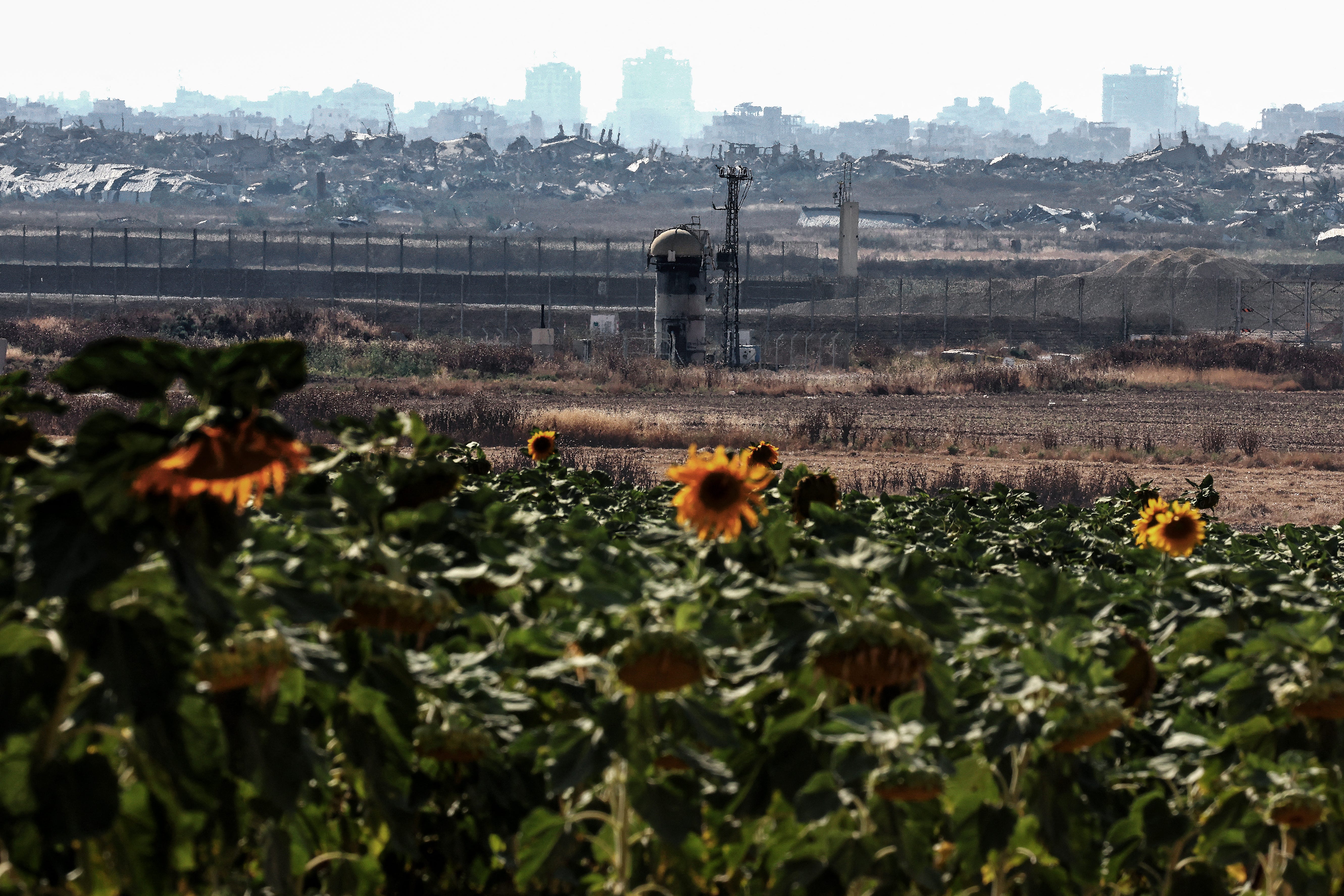
This picture taken from a position in southern Israel, on the border with the Gaza Strip, shows destroyed buildings inside the beseiged territory on June 10, 2026. Photo by Jack GUEZ / AFP via Getty Images.
Israel’s Forever Veto
While both Palestinian negotiators and Mladenov identify President Trump’s 20-point “Gaza Comprehensive Peace Plan” and UN Security Council Resolution 2803 as the framework guiding implementation, Hamas’s version places greater emphasis on Palestinian national objectives and political participation.
Hamas’s draft states that the process should lead to self-determination and Palestinian statehood “in accordance with international law and relevant United Nations resolutions.” Mladenov’s version removes both references, instead describing the outcome as “creating conditions for a credible pathway” toward self-determination and statehood.
Differences also emerge in the provisions governing postwar administration. Hamas’s draft states that governance in Gaza shall be conducted according to the principle of “One Authority, One Palestinian Law, and One Weapon.” The NCAG, Palestinian negotiators wrote, “shall guarantee the fundamental rights and public freedoms—both individual and collective—enshrined in international conventions and human rights principles, including equality and non-discrimination on the basis of gender, religion, color, race, or political affiliation.”
Mladenov’s response retains the language of unified authority and arms control but removes the reference to “Palestinian” law, replacing it with a commitment to operate in accordance with “relevant Palestinian laws, relevant international standards, and principles of good governance.” It also removed the Palestinian negotiators’ references to respect for human rights and non-discrimination and stated bluntly, “Only personnel authorized by the NCAG may possess weapons.”
Mladenov’s revised text recasts the agreement from a roadmap toward Palestinian political objectives into a framework centered on administration, oversight, and security arrangements. Where Hamas’s proposal repeatedly links implementation to Palestinian self-determination, statehood, and nationally led governance, Mladenov’s version largely frames those outcomes as conditional possibilities dependent on Palestinian compliance with a series of security and governance benchmarks.
The Palestinian negotiators made clear they want the NCAG Palestinian technocratic committee recognized as a transitional governing authority that will remain in power until elections are held across all Palestinian territories. “Hamas and the Palestinian factions agree to hand over and transfer governance in Gaza to the National Committee for Gaza Administration. The Committee shall enjoy full independence in carrying out its duties, and there shall be no interference in its affairs during the transitional period,” they wrote.
In their draft, the Palestinian negotiators suggested that the NCAG be empowered to “fulfill all legal obligations and commitments arising from the current administration of the Gaza Strip.” Mladenov’s draft excises this phrase, stating instead that the NCAG will be “responsible only for financial liabilities incurred on or after the date it assumes control.”
Mladenov’s amended draft relegates the Palestinian committee to a role as an administrator working on behalf of the Board, saying NCAG “shall, upon assuming responsibilities and where possible, preserve continuity of essential civil and administrative functions and civil-registry records.” According to Trump’s 20-point plan, the NCAG will not be an independent governing body, but will operate under the “oversight and supervision” of Trump and his board. The BoP “will call on best international standards to create modern and efficient governance that serves the people of Gaza and is conducive to attracting investment,” the plan stated.
The Palestinian negotiators put forward a clear proposal to reunite the governance of Gaza and the West Bank, writing that the Board of Peace would be responsible for “overseeing the orderly transfer of governance” to the NCAG, which would ultimately hand power back to the Palestinian Authority as part of a process “leading to the establishment of a Palestinian state and the realization of self-determination.” They included language calling on the Board to cooperate with the United Nations to ensure Israeli withdrawal from Gaza and reiterating that the Board’s mandate expires at the end of 2027.
Mladenov’s draft ignores all of these points entirely, stating only that Hamas and other Palestinian factions agree to hand over power to the NCAG and they “shall not intervene in NCAG affairs.”
Mladenov’s draft does not mention the Palestinian Authority at all. “Even the one entity, the one Palestinian political body that has achieved international legitimacy and that has worked directly with Israel is being ignored in this agreement as part of that strategy to ensure that there’s no continuity with any kind of Palestinian body,” said Al-Arian. “What we have is a process that is essentially attempting to ensure Israel’s interests and to ensure a kind of frustrated process with no end in sight, similar to what we saw for three decades with Oslo,” he added. “This largely does come down to something we’ve seen historically, which is that Israel has maintained a major veto power over any negotiation process.”
Trump’s 20-point plan stated that his private Board would rule Gaza indefinitely until a reformed Palestinian Authority “can securely and effectively take back control of Gaza.”
The two texts also differ on who will oversee Gaza’s reconstruction. Hamas’s proposal places reconstruction under the supervision of the NCAG and explicitly ties it to plans adopted by the Arab League and the Organization of Islamic Cooperation, embedding the process within broader Arab and Islamic political frameworks. Mladenov’s revision replaces those references with a reconstruction plan jointly developed by the BoP and its subordinate NCAG, reducing the role of regional Palestinian and Arab-backed institutions while expanding the influence of newly created mechanisms tied to Trump and his Board.
Alongside its continued bombardment and territorial expansion, Israel has increasingly relied on a network of Palestinian militias operating in areas under Israeli control in Gaza. At least five such groups, established between April and September 2025, have emerged across the enclave, collectively numbering a few hundred fighters. Operating largely behind the “yellow line,” these militias have received Israeli weapons, intelligence, logistical support, and, in some cases, medical treatment inside Israel.
Israel’s support for the militias was publicly acknowledged by Prime Minister Benjamin Netanyahu last June, when he said the government had “activated” powerful local clans in Gaza on the advice of “security officials” to assist in the fight against Hamas.
Among the most prominent groups are the Popular Forces, originally led by Yasser Abu Shabab before his death in December and now headed by Ghassan al-Dahini in eastern Rafah; the Strike Force Against Terror, led by former Palestinian Authority security officer Hussam al-Astal in Khan Younis; and the Free Homeland Forces under Shawqi Abu Nuseira in central Gaza. Several of the militia leaders and members have a history of criminal activity, looting and smuggling aid, including during the genocide, collaboration with Israel, as well as ties to extremist groups, among them ISIS.
The militias have increasingly carried out raids, assassinations, and abductions, while establishing armed checkpoints in coordination with Israeli forces. Palestinians traveling through Rafah since the ceasefire have reported being stopped by gunmen affiliated with the Popular Forces and subjected to harassment, beatings, and theft. In recent months, the militias have launched repeated operations into areas near the “yellow line,” including targeted killings of police officers and attacks conducted under Israeli air cover. In April, fighters linked to Abu Nuseira’s Free Homeland Forces carried out an assault on Al-Maghazi refugee camp that killed at least ten Palestinians. Another raid on the same camp in May killed five Palestinians.
Some of the militias have said they aim to establish enclaves where civilians would live under their rule, in areas under Israeli control in the east of the Gaza Strip. In practice, however, the vast majority of Gaza’s approximately two million residents remain concentrated in roughly 30 percent of the Strip bordering the sea. One militia leader previously told the Times of Israel that the militias envision themselves as part of a “new Gaza” that would emerge after the end of Hamas rule.
Hamas’s proposal calls for the immediate dismantling of the militias and the confiscation of their weapons upon implementation of the agreement, with an International Verification Committee responsible for confirming completion of the process. Hamas’s draft further includes provisions aimed at regularizing the status of militia members who wish to reintegrate into Palestinian society. Mladenov, however, proposed approaching the disarmament of these Israeli-sponsored forces, which many Palestinians view as criminal death squads, in a similar manner to Palestinian resistance movements. His proposal would permit the Israeli-backed militias to gradually decommission and store their weapons according to an agreed timetable under the authority of the NCAG.
Hamas officials say they do not know when the Palestinian factions will deliver their response to Mladenov, but Qassem stated they are “formulating a unified and responsible response that prioritizes the interests of the Palestinian people and supports efforts to end the ongoing genocidal war in the Gaza Strip.”
Buttu said history shows that regardless of how the Palestinian negotiators respond—and even if they reach an agreement with Mladenov and Trump—Israel will continue to set its own rules and launch attacks whenever it pleases. By forcing the Palestinians into a labyrinthine bureaucratic process subject to ongoing Israeli veto, the fundamental realities of life in Gaza will continue to deteriorate.
“Israel can keep going for months and months and they will continue to be in the driver’s seat and they don’t care. And in fact, it’s kind of better for them if this continues to go on for months and months because then they can just continue their attacks with the excuse that there’s still discussions happening,” Buttu said. “It’s as though nothing has happened over the course of the past two and a half years. They’re still using food as a weapon. They’re still using healthcare as a weapon. Everything is still happening. So the status quo, it’s not like it’s dynamic. It’s actually getting worse over time. To whose benefit is that other than Israel’s?”
As the negotiations continue, Israel has forged ahead with constructing military infrastructure in the east of Gaza. Al-Arian believes that the central Israeli aim remains the total erasure of the Strip as a Palestinian territory, so Israel’s position on prolonging the negotiations is aimed at ensuring that agenda advances.
“All of this serves the Israeli interest, which is in the long term to find a way to either ethnically cleanse the population and to reoccupy it and possibly resettle it,” Al-Arian said. “Unfortunately it’s quite grim absent any kind of external intervention.”
Update, June 23, 2026: This article has been updated to include comments from the Board of Peace that were received after publication.
From Drop Site News via This RSS Feed.