

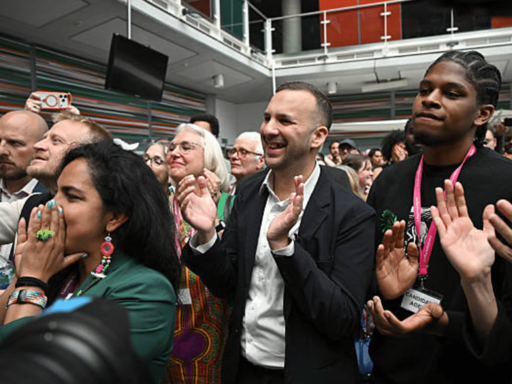
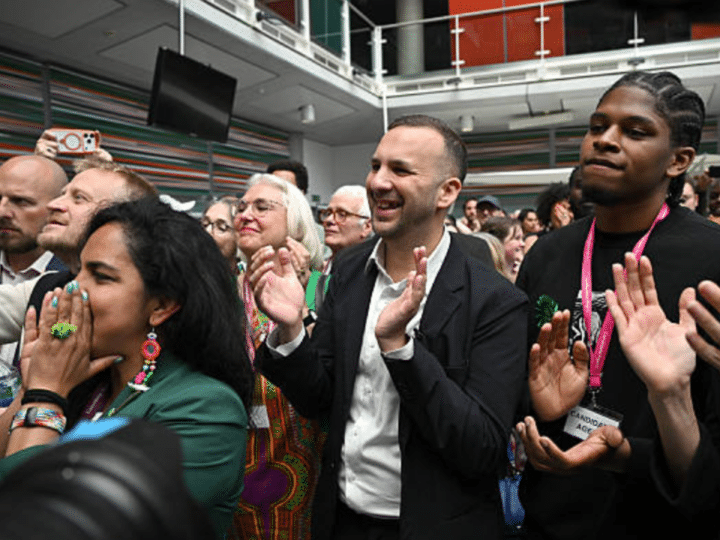
Perhaps the biggest Green wave in the 2026 local elections was in the London borough of Hackney. And ahead of two local by-elections on 25 June, Greens are hoping to keep that momentum going.
Ahead of May’s elections in Hackney, collaboration between Greens and local independent socialists built a cooperative spirit from early on. And Heather Mendick from the Hackney Independent Socialist Collective (HISC) told the Canary about why she remains hopeful about where things are going.
Hackey Greens connected with local working classes
Hackney Greens ran a strong campaign in May which saw a massive swing away from Labour. Zoë Garbett became the UK’s first Green mayor via a direct election, and the party also took control of the council.
At the first full council meeting following the Green win, Garbett reiterated her promise of a “worker-led administration”. And overall, her positions and messaging are easy to understand. In her acceptance speech, for example, she said:
Poverty isn’t a fact. It’s a political choice. And Hackney says no.
Her local working-class running mate Dylan Law, meanwhile, was an important part of the campaign too. Now deputy mayor, he has asserted that:
Before this, politics for a 20-year-old Black individual wasn’t feasible. Now it is visible.
He added that:
one of my main tasks is to increase the quality of council housing over a period of time and to better use green space around estates…
How we communicate with residents is also a big thing, and being a presence in the estates.
Increasing Green visibility in (and focus on) more working-class areas of Hackney seems to have had an impact too. As Mendick told us:
in contrast to the beginning of the campaign, where I think the Greens were stronger in their traditionally white middle-class areas, by the end of the campaign, I think that had flipped, and actually it was the estates that were more resolute for the Greens…
the Labour vote was more secure in those middle-class areas than it had been initially, and it was completely devastated in the estates. So that was an interesting event, and really, I think that was quite optimistic.
Running for the council herself as a HISC candidate in collaboration with the Greens, Mendick highlighted that:
what I saw a lot of times was [people saying] ‘we’re not voting Labour again’, that repetition, that feeling like Labour has just sold everyone out and particularly sold out the people they are supposed to represent.
Hackney Greens collaboration
The Canary has held Greens to account in areas where their failure to cooperate with left-wing independents has allowed Labour to keep more seats than they should have. We’ve also praised them where cooperation has worked. But in Hackney, it seems clear that the Green message really cut through.
Although HISC and Green candidates made history with a joint campaign in Hackney, the lesson was that a different strategy may have worked better.
In Mendick’s ward of Homerton, for example, three seats were up for grabs. And while HISC’s two candidates got almost 900 votes each, the Green candidate got 2,141. Labour’s candidates, meanwhile, picked up the other two seats (despite being over 500 votes behind the Green frontrunner).
Unfortunately, this played out elsewhere too. In Victoria ward, for example, two HISC candidates got around 1,000 votes each, but the Green winner got 2,090. And Labour again came through the middle to win the other two seats.
Reflecting on these results, it seems clear that:
- The nature of our hyper-competitive elections didn’t leave much space for a collaborative joint campaign.
- The Greens stepping aside to allow a full HISC slate in some wards may have made it clearer to voters who the left-wing challengers to Labour were.
- HISC stepping aside to allow a full Green slate (even if they were paper candidates) may have reduced the number of Labour candidates who came up through the middle.
- HISC candidates may have stood a better chance of winning if they’d stood as Green candidates.
Mendick’s own analysis is that collaboration was a tough message to get across because it’s so rare in the UK. As she told us:
We didn’t get a bad response on the doorstep when we said ‘we’re working with the Greens’, ever… I think the issue was just people not knowing they had three votes till they got in there, not knowing there was one Green and two independent socialists, and so going and expecting to vote for three Greens, and then getting confused.
That was my reading of it. It was a very, very complicated message to get across – that collaboration – because we’re so competitive… that is a sad thing about our electoral system.
I think that we did pretty well, all things considered, for a new socialist party, which is less than a year old.
She still thinks the precedent of collaboration was positive, though. And she insisted that:
I think we have to get past this competitive thing on the left. And we have to allow plurality on the left… I believe in a united left – I believe in a strategic left.
Apathy and voter disillusionment
In both Homerton and Victoria, meanwhile, voter turnout was around 40%. And this was fairly representative of Hackney in general. Although turnout was up from 2022’s elections, there was still no ward where turnout went above 50%, and in some places it remained as low as 31%.
Mendick said ordinary people’s lack of trust in politicians is palpable. Among other issues coming up on the doorstep during campaigning, she insisted that:
mistrusting politicians was up there… It was huge. And people are just not voting… the predominant pattern was not voting… So that disillusionment with politics is huge, and that’s uniform…
Having worked closely with the Greens, she thinks they’re intent on transforming strong campaigning into real, meaningful change locally that can inspire greater trust in residents again. As she explained:
That massive swing to the Greens, I don’t think it happened on such a scale anywhere else. And that’s partly a tribute to Hackney residents, and partly Hackney Greens who’ve worked really hard…
We don’t know whether a council that does change things, if that happens in Hackney, will start to restore people’s faith in politics – whether that can shift. I think the Greens are very conscious of that responsibility – not just rebuilding faith in politics but also showing that Greens in power can do things. It’s a massive responsibility… that’s a thing which will keep them focused…
They want to be held accountable, they’ve asked to be held accountable, repeatedly, because they want to not let go of that base of activism, which kind of got them to where they are.
Greens are hoping that the 25 June by-elections in Dalston and Hackney Central will continue on from Green successes in May. But they’re also aware that a difference in turnout could have an impact. As they’ve said:
with turnout being so low in by-elections, every door knocked and every voter we get out can truly make the difference.
Judging by the strength of local campaigning ahead of May’s elections – which made history by giving Greens the mayoralty and council majority for the first time, by-election wins in Dalston and Hackney Central definitely seem possible. Because the excitement and mobilisation are already there. And the Greens have proven they can win.
If the Green majority in Hackney increases further, though, there will be even more pressure for the Greens to push forward and actually make a real difference. For the sake of local people, we truly hope that happens.
Featured image via the Canary
By Ed Sykes
From Canary via This RSS Feed.