

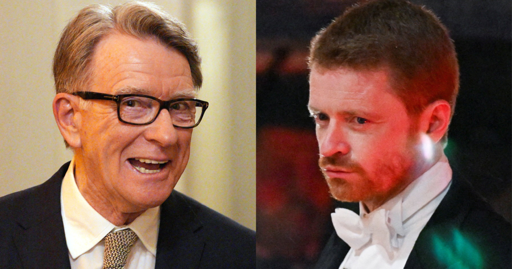
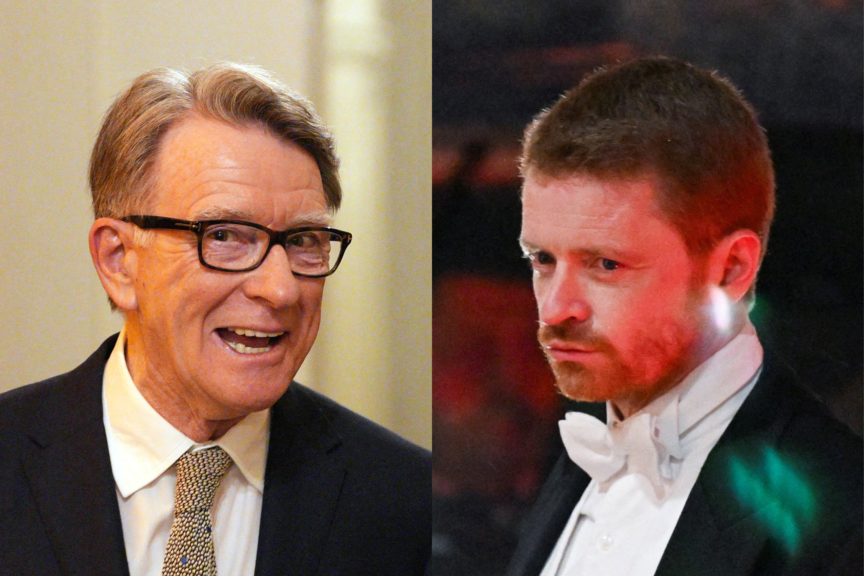
As the political post-mortems for Keir Starmer are being written, Novara Media can shed new light on the relationship between the behind-the-scenes figures who built Starmer – and whose relationship ultimately hastened his demise.
In late March 2020, shortly before Starmer was elected Labour leader, Peter Mandelson emailed Starmer’s chief fixer Morgan McSweeney asking for advice on an article he was writing about the end of Jeremy Corbyn’s leadership of the party.
He wrote: “Morgan, hope you and your family are suitably well and isolated. Politics Home have asked me to write about the end of Corbyn. I have done so to the extent I can bear talking about him then turned to the future.
“Let me know if any amendments are desirable. Happy to take on board.”
The email seen by Novara Media forms part of a subject access request by Corbyn to the think tank Think Labour, formerly known as Labour Together. It was sent from an address related to Global Counsel – Mandelson’s lobbying firm which has now gone bust.
At the time the email was sent, McSweeney was heading up Starmer’s leadership campaign. The email raises fresh questions over the length and closeness of the relationship between McSweeney and Mandelson (who, despite some differences, are viewed as part of the same Labour right clique), suggesting Mandelson collaborated with Labour Together to get Starmer elected – something McSweeney has previously denied.
That factional unity is one explanation for Mandelson’s appointment to ambassador to the US on the advice of McSweeney – a decision which cost him his job as Downing Street chief of staff and badly damaged the public’s view of Starmer.
After Mandelson was forced to resign that role in disgrace over his close links to paedophile financier Jeffrey Epstein, McSweeney spoke to the foreign affairs select committee, claiming he only “started to try to engage with him [Mandelson] for advice in about late 2020, early 2021” – months after Mandelson’s email asking for his steer on the Politics Home article.
“I can’t remember when. I was thinking about how do we win the next general election … because I wanted to know what a winning campaign would look like and he had been part of one in 1997,” McSweeney said, adding: “There was no closeness of a relationship prior to then whatsoever.”
The subject access request doesn’t show whether or not McSweeney replied to Mandelson’s email. But the email suggests that Mandelson at least perceived some “closeness” with McSweeney, with the wording indicating a casual ease in asking for direct influence in his public written output.
McSweeney also claimed that Mandelson was not involved in Labour Together, a once non-factional think tank, which under McSweeney’s leadership became a vehicle for the Labour right to get rid of Corbyn. McSweeney told the select committee: “Mandelson did not like Labour Together at all. He was not a fan of what I was doing. He was not interested in it. He broadly didn’t agree with it.”
This claim too would appear to be brought into question by the email, which seems to show a very close political alignment shortly before the Labour leadership election ended.
Mandelson’s Politics Home article was published three days after his email to McSweeney. In the article, Mandelson criticised Corbyn for failing to “keep the party united”, saying: “Although Tony Blair and Gordon Brown had no time for the kind of politics practised by Corbyn, his sort of intolerance and factionalism was something they never pursued. This should be the template for the future.” Three days later, Starmer was elected Labour leader, and in the subsequent months orchestrated a ruthless cull of leftwingers from the party.
Hatred of the Labour left is what united McSweeney and Mandelson. As director of Labour Together, McSweeney plotted a route back to power for the Labour right after what he saw as the disastrous Corbyn years. Mandelson said he worked “every single day” to get rid of Corbyn.
As the Mandelson scandal intensified, friends of McSweeney briefed the press that he was “irritated” by being described as Mandelson’s “protege” – an image they claimed Mandelson himself had seeded, wishing to portray himself as a bigger part of the Labour Together project than he really was.
McSweeney has been approached for comment.
After McSweeney quit as director of Labour Together, that role was taken up by Josh Simons MP. Simons quit as a minister after it was revealed that under his tenure, Labour Together had paid a PR firm to launch a smear campaign against journalists.
Simons then resigned from his Makerfield seat in order to give Andy Burnham the chance to return to Westminster and to become Labour leader – and thus the UK’s next prime minister. Simons is now being talked of as a “key figure” in Burnham’s inner circle.
From Novara Media via This RSS Feed.