

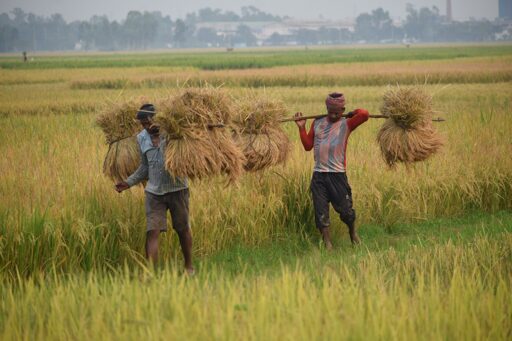
The distance between farmer Sudhin Chandra Das’s home and his 150-decimal (0.6-hectare, or 1.5-acre) paddy field in Bangladesh’s northeastern region of Sylhet is more than half a kilometer (0.3 miles). During the boro rice harvesting season, usually mid-April, when thunderstorms are common, he cannot afford to stay at home, he said: He has to go to the vast open field to harvest the ripe crop, even though there is no shelter when lightnings strike. “It’s scary. I don’t know how to protect myself, and I fear I could be killed by a strike at any moment,” Sudhin told Mongabay. Sudhin lives in the Shalla subdistrict, Sunamganj district, in the Sylhet region, one of South Asia’s most lightning-prone zones. According to lightning data for the decade of 2016-25, Bangladesh’s northeastern zone witnesses 64 to 96 fatal lightning events per square kilometer (about 0.4 square miles) annually. Sudhin said he considers himself fortunate to be alive. But he recalled news reports on people in Sunamganj being killed by lightning strikes this year and in previous years. On April 18 this year, at least 13 people, including five in Sunamganj, died by lightning strikes across Bangladesh. An average of 300 people die from lightning strikes every year in the country, with the highest number of fatalities reported in the northeastern districts. According to Meherunnesa, a coordinator at the Disaster Forum, a Dhaka-based national disaster preparedness network, Bangladesh witnessed the deaths of at least 218 people by lightning strikes between January and mid-June this…This article was originally published on Mongabay
From Conservation news via This RSS Feed.