

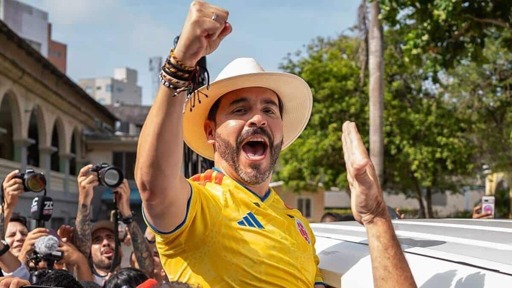
Abelardo de la Espriella appears poised to become Colombia’s next president. At the time of writing, he maintains a narrow lead over Iván Cepeda, a member of outgoing president Gustavo Petro’s Pacto Histórico (Historical Pact) party. De la Espriella, a far-right millionaire, is the latest candidate in a recent wave of Trump allies in Latin America to make significant electoral gains.
With nearly all ballots counted in one of the most hotly contested elections in the country’s history, de la Espriella has won 49.6 percent of the vote compared to Cepeda’s 48.6 percent. Just 250,830 votes currently separate the two candidates, according to this preliminary tally, and 1.6 percent of Colombians cast a blank ballot.
Both President Donald Trump and Secretary of State Marco Rubio have already congratulated de la Espriella. However, the final, official outcome may differ. Indeed, in the 2022 election, Pacto Histórico gained half a million votes compared to the preliminary count. In this sense, U.S. imperialism is clearly trying to put its finger on the scale, prematurely calling the election for its ally before the outcome has been finalized.
Nonetheless, whereas Cepeda appears to have won in the Caribbean, Pacific, and southern regions — areas historically affected by conflict between guerilla groups and the state, and with a strong presence of social movements — de la Espriella swept the bastions of traditional economic and political power, including Antioquia, Santander, the Eastern Planes (Orinoquia), and coffee region.
As we await the final outcome, one thing is clear: Sunday’s results demonstrate that the right-wing wave in Latin America continues.
The Far Right Sweeps Latin America
De la Espriella’s campaign was inspired by those of other far-right leaders in the region, including Javier Milei in Argentina, Nayib Bukele in El Salvador, Daniel Noboa in Ecuador, and José Antonio Kast in Chile. These sectors, in turn, are linked with the international Right — particularly President Trump, who has turned the United States’ imperialist sights back to the Western Hemisphere as part of its National Security Strategy. Some of the de la Espriella’s supporters even don MAGA-like red caps that read, “Make Colombia Great Again.”
Like these other right-wing figures, de la Espriella has positioned himself as a “tough-on-crime” candidate. Whereas Petro came to power pledging “total peace” with Colombia’s armed groups, de la Espriella has vowed to scrap negotiations and instead use the military to restore order. At one point, he claimed he would “disembowel” Colombia’s Left, and has promised to build megaprisons, attack “gender ideology,” “put God back” in schools, and crack down on “narcoterrorists.”
And, like his fellow right-wing leaders in the region, de la Espriella will enforce anti-worker austerity policies on the masses if he takes power. While boosting Colombia’s energy sector, he wants to lower taxes and shrink the state by up to 40 percent.
Unsurprisingly, Colombia’s conservative and reactionary forces rallied behind de la Espriella, including business sectors, major media outlets, the Religious Right, and a large part of the political structures that governed the country for decades, including supporters of former right-wing president Álvaro Uribe. These sectors hope to regain political control after four years in which Petro’s government raised expectations of change among broad sectors of the population, though without touching the pillars of Colombian capitalism.
Paving the Way for the Far Right
The Far Right’s gains can’t be separated from the weaknesses of Petro’s four-year rule. While his project promised profound transformations in Colombia, it did not alter the fundamental structure of economic power in the country. Rather, it ended up merely managing Colombian capitalism by taking a conciliatory approach toward business sectors and the traditional parties.
This contradictory strategy led to growing frustration among broad sectors of the population that had placed their hopes in the progressive government without getting a solution to the economic and social crises facing the country. As a result, many in Colombia turned their hopes toward an ostensible outsider, de la Espriella.
The Colombian and Latin American Right will understandably feel emboldened by this election result, but it does so on much shakier ground than that which underpinned the administrations of previous presidents, including Álvaro Uribe and Iván Duque. If de la Espriella is declared the winner, his victory will be far from a landslide: nearly half the country voted against his far-right agenda, revealing that the new government will take office amid intense social and political tensions.
Preparing the Resistance from Below
While the ruling classes can win elections and take control of the government, they have not resolved the balance of forces with the masses. As always, regardless of who takes power, class struggle will be decisive in shaping Colombia’s future, just as the masses are currently rising up in Bolivia.
The only force capable of stopping the Far Right’s resurgence is the independent mobilization of the working class and popular sectors. We don’t need to look far back in the past to see evidence for this: Duque saw his neoliberal agenda and political capital buried due to heroic uprisings in 2019 and 2021. But the demands from these uprisings were never achieved — these social forces remain present, and they have the power to win.
These popular sectors can build a response to de la Espriella’s reactionary offensive in the streets and workplaces to stop his capitalist agenda in its tracks. Mobilizations by the working class and the poor — the bases of capitalists’ profits and power — can defeat the oncoming attacks, and forge their own path out of the crises facing Colombia. These sectors can in turn establish a genuine political alternative for the exploited and oppressed.
Adapted from an article published in Spanish on June 21 in La Izquierda Diario.
The post Elections in Colombia Signal Another Victory for the Right in Latin America appeared first on Left Voice.
From Left Voice via This RSS Feed.