

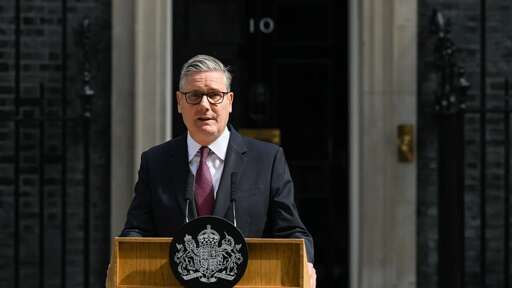
Keir Starmer announced on Monday that he will step down as prime minister and leader of the Labour Party. His departure comes just two years after a historic election victory, making him one of the leaders to have fallen from grace most rapidly in Britain’s modern history. Starmer will remain as interim head of government until the party elects his successor in September.
The Causes of a Foreseeable Failure
Starmer’s downfall comes as no surprise to those who have long denounced his shift to the right. His tenure was marked by the implementation of what many call “austerity 2.0.” Among his first measures were limiting family benefits to households with no more than two children — a policy that keeps one million children in poverty — and cutting winter heating subsidies for ten million retirees.
In addition to these economic attacks, Starmer advanced a racist and xenophobic agenda, pursuing openly anti-immigrant policies with a hate-filled message and the closure of hotels for asylum seekers.
Added to this is his explicit support for the genocide in Gaza. He went so far as to declare that Israel “has the right” to cut off energy and water supplies to the Palestinian civilian population. He delivered this speech in one of the epicenters of the pro-Palestine movement, amid massive demonstrations by protesters — many of whom were part of Labour’s electoral base — who grew increasingly hostile toward Starmer’s government. His administration responded by criminalizing activists and organizations showing solidarity with Gaza in the midst of the genocide.
This combination of authoritarian, xenophobic, and right-wing policies caused his popularity to plummet and ultimately strengthened Nigel Farage’s far-right Reform UK, which is ultimately the party that best embodies these policies.
The Specter of Reform UK and the Burnham Factor
Within the Labour Party, concern grew over the rise of Reform UK and a potential Labour defeat in the upcoming general election. Starmer’s paralysis and his austerity policies have served as a breeding ground for Farage’s racism to present itself as an “anti-establishment” option.
The crisis was precipitated by the recent victory of Labour’s Andy Burnham in the Makerfield special election, where he managed to defeat the Reform UK candidate.
This is why Burnham — who is the current mayor of Greater Manchester and a longtime rival of Starmer — was immediately seen by the party establishment as the best option to try to reconnect with the Labour voter base and with working-class sectors in the north of the country that Labour has been losing in recent years.
However, despite his “progressive” rhetoric, there are no signs that Burnham represents a break with Starmer’s neoliberalism. Burnham has already assured the financial markets that he will respect the “fiscal rules” imposed by Labour, thereby guaranteeing the continuation of austerity. In fact, he surrounds himself with economic advisors linked to the Bank of England and Goldman Sachs to signal “credibility” to the City of London.
On social issues, Burnham has followed the same line as Starmer, supporting stricter immigration controls and turning his back on the trans community.
Against this backdrop, many point out that it is unlikely Burnham’s candidacy will serve as a bulwark against Farage; rather, it may become yet another government that, amid Britain’s deep political crisis, acts as an incubator for far-right ideas.
This rightward drift of the Labour leadership had already sparked several splits in recent years; the most recent was the formation of the neo-reformist “Your Party” by Jeremy Corbyn and Zarah Sultana, which today also faces its own crisis of identity and strategy, amid personality-driven politics and the lack of an independent, class-based strategy and program that resolutely confront the Far Right.
The Path to Succession
Starmer’s announcement does not mean his immediate departure. The process to elect the new prime minister begins on July 9, when nominations for the new Labour Party leadership officially open. Then, in mid-July, if a consensus candidate emerges (as Burnham’s candidacy seems to suggest), the transition could be immediate. If discussions continue and a decision is not reached by mid-July, the deadline for a new prime minister to take office is September.
While names are being bandied about in the corridors of Westminster, the reality is that replacing one centrist figure with another does not seem likely to offer solutions to the millions suffering from the rising cost of living and xenophobia, or to those fighting against the UK’s support for Netanyahu’s criminal policies. On the contrary, a Burnham government could prolong the long-running political crisis that has plagued the United Kingdom for the past 10 years — a period marked by alternating Labor and Conservative governments, which bear the responsibility of paving the way for the rise of far-right movements.
This article was originally published in Spanish on June 22 in La Izquierda Diario.
The post Keir Starmer Resigns After Two Years of Austerity, Unpopularity, and Powerlessness Against the Far Right appeared first on Left Voice.
From Left Voice via This RSS Feed.
The only thing I know about the UK right now is that they’re labeling people as terrorists for speaking out against Israel and tripling down on their draconian surveillance state.
Nothing progressive about this clown at all.
