

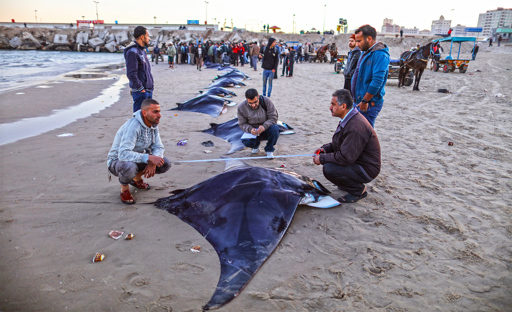
On the messaging platform WhatsApp, Mohammed Abu Daya’s profile picture features an aerial view of Gaza City before the current war. A clutter of high-rise buildings rises against the sky; at their feet, a strip of sandy beach, bathed by the sun, and the dark blue sea, dotted with small fishing boats. The photograph bears witness to a landscape that no longer exists — aside from the sea. “Gaza is now a big prison, with two million people living among rubble and destroyed infrastructure,” the Palestinian marine ecologist told Mongabay in May 2026 over the phone. “Life in the Gaza Strip is miserable.” For many months now, he has been unable to go out to sea to carry out research in his field. Before the war, Abu Daya was a lecturer at several Palestinian universities including the University of Palestine in Gaza and a researcher at the now-shuttered National Research Center in Gaza. His research focuses on spinetail devil rays (Mobula mobular), sometimes called giant devil rays, a critically endangered species that can reach up to 3.5 meters (11.5 feet) in width. The Gaza-based conservationist is one among a handful of scientists worldwide who study this species. Historically, it was thought to be endemic to the Mediterranean Sea, until taxonomic revisions in the late 2010s led scientists to consider the Mediterranean populations as genetically connected to others in the Atlantic Ocean, the Caribbean Sea and the Indo-Pacific region. The majestic rays are thought to roam the entire Mediterranean, from the…This article was originally published on Mongabay
From Conservation news via This RSS Feed.