

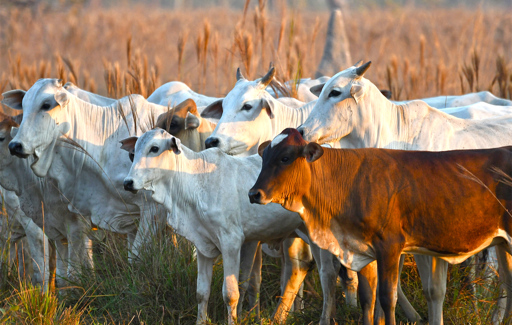
A crackdown by the Brazilian government on land-grabbers who cleared primary Amazon forest for ranching and other agricultural activities in the Piripkura Indigenous Territory is yielding some results, with satellite analysis by Mongabay indicating a decline in deforestation. But one tricky problem remains, according to government agents and Indigenous rights organizations: removing their cattle. The 242,405-hectare (598,995-acre) Piripkura Indigenous Territory in west-central Brazil’s Mato Grosso state is home to the last two — known — Indigenous Piripkura people in voluntary isolation. According to Jair Candor, the coordinator of the Funai unit that protects isolated Indigenous groups, a third Piripkura person left the land and married into another tribe, the Karipuna, several decades ago. Funai, the country’s Indigenous affairs agency, has not yet ruled out the possibility that more isolated people live there. Ranchers coming in with their cattle to graze land have contributed to a large share of forest loss here. According to data from Global Forest Watch, the area lost a total tree cover of 1,769 hectares (4,371 acres) in 2021 — equivalent to 2,500 soccer fields — representing the largest increase since 2004, when the area lost was almost double (3,276 hectares, or 8,095 acres). Since the spike in 2021, due to successful operations by government agencies, deforestation has declined substantially, and despite a slight increase in 2023, losses remained far below 2021 levels and continued to decrease in 2024 and 2025. By 2025, tree cover loss had fallen to 106 hectares (262 acres). While deforestation has slowed…This article was originally published on Mongabay
From Conservation news via This RSS Feed.