

Between June 11 and 14, thousands of workers and union activists gathered in Chicago for the biennial Labor Notes Conference. At the conference, we spoke with Kieran Knutson, the president of CWA Local 7250, based in Minneapolis Minnesota, and Lori Wolf, a telecom worker and shop steward for the same local, on the experience of fighting against Operation Metro Surge in Minneapolis, and the lessons for the labor movement.
***
Sou Mi: Can you tell us who you are?
Kieran Knutson: My name is Kieran. I work in the call center for a big telecom corporation, and I am the president of CWA Local 7250 based in Minneapolis, Minnesota.
Lori Wolf: I’m Lori. I work in the same call center. I’m a steward for the CWA and the chair of the Human Rights and Equity Committee.
SM: Here at Labor Notes, the experience of Minneapolis is very present. There have been many panels talking about Minneapolis and the fight against ICE. Can you tell us why you think Minneapolis is such a significant experience for the labor movement?
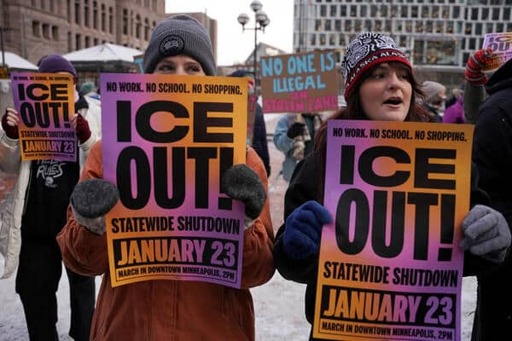
K: I think the the reason that it’s so important for people to think about and talk about and learn about is both the level of repression that was that was laid out against the people of the Twin Cities in Minnesota and especially the immigrant working class. And it is also significant because of the resistance: because of the mass quality of the resistance. It was multifaceted and also because of course it involved the January 23day of action where there was “no work, no shopping, no school” that shut down business all across the Twin Cities and all across the state.
L: I think it’s important cause it’s important to everyone. It should be. This is this experience of what we’re dealing with between ICE and the administration. What we’re currently involved with, history has seen it before and we’re just repeating it. We need to show them that it can’t be repeated. We can’t let the same things happen. Somebody has to stand up.
SM: There were reports — and you mentioned in the panels too — how 80 percent of your local walked out on January 23. There have been so many examples of rank-and-file organization out of Minneapolis, with people organizing in their neighborhoods, but also in their workplaces. And then we saw the expression of that organizing in the day of action. Can you say more about how so much of the rank and file of the union walked out?
K: We started doing some anti-ICE education directed towards our members after two Laotian men were abducted from a factory where they worked in St. Paul, Minnesota. They were part of a union — a CWA union. It was a different local than us, but was a sister local of ours. They were both men who lived in the United States for their entire lives. They came here in preschool. They had worked in this factory for over 20 years. So, we made the flyer with their GoFundMe on it and distributed that to our membership as a way of showing people what ICE was actually doing and to counter the lies that the Trump regime was saying, like “the worst of the worst” and all that.
My experience was that, as we were flyering and handing this information out to people, people started showing me their whistles, and started telling me how they were already getting involved in the resistance. It showed to me that, okay, this is outside of the normal “lefty” bubbles — this is starting to reach regular working-class folks. It also showed me that our members were already thinking and getting active and, of course, gives us more room to do things and push things a little further too.
We had already been in conversations with different unions about the possibility of trying to do something using our labor power as a weapon. When Renée Good got killed, we decided that it had to be done now. We couldn’t wait any longer. We felt like there was enough momentum in society as a whole. There were signs up all over. People all over the Twin Cities were upset and mad and outraged, so we felt like there was room for us to take action and to push further. We just started getting the word out to our members through our steward networks and through meetings. Both the executive board and the membership voted to be a part of it.
We ran into some problems in some of our retail stores where management said that they would be investigating people who called out that day. Right away, we responded and let them know that if they wanted to have this fight, we were more than willing to. We let them know that we were taking it very seriously. I think they understood that we were serious and backed off. So, within 24 hours, they did a complete 180. They were now opening up the vacation board, or telling people that if they didn’t want to burn a vacation day, they could have an excused [absence] on pay day. We were able to take that to the rest of the corporations and other titles we represent and say, this is what you need to do for everybody. They did, because a lot of the corporations in Minnesota sort of summed it up that they didn’t want the smoke.
L: It’s easier at that point because there was enough of the people, because we’re stronger together. Other people were already willing to do it, no matter what. It was easier to support us than to fight us.
SM: Going back to the day of “no work, no school, no shopping,” looking from afar, beyond the small businesses shutting down, and students staying out of school, one of the big things that tipped the scales were the unions joining, especially with the teachers unions, CWA, and others. It was such an important demonstration of labor power in Minneapolis. Can you tell us what is the role you see for the labor movement in the fight against ICE and against repression?
K: I think it’s easy to see Trump as out of control, or as a crazy leader who acts impulsively and is only steered by his own interest. There’s certainly some truth in that. But I think there’s also a bottom line that he still answers to the big bosses in the society. Part of the logic [of the mobilizations] was that we were going to put the pinch on the people that control Trump, who are ultimately responsible for this terror that he was organizing against us.
We made it clear that we were going to start impacting them economically. It’s not a moral persuasion that changes these people’s minds. it’s when they start to feel some pain, and that pain being profits being cut into their pockets. We showed them that we can do it. I don’t think it is any coincidence that it was after that that they started to deescalate.
SM: It was really significant to see how the mobilizations forced ICE to retreat. Of course, ICE is not off the streets yet — they’re still abducting people across the country, some are still in Minnesota too. Something that was inspiring for us in Left Voice, following the days of action in January, that coincided also with ICE’s partial retreat, was the emergence of some self-organization in the Twin Cities, especially with the workers’ assemblies that brought together unions, community organizations and activists who’ve been fighting against ICE. In panels at the conference, you’ve highlighted the significance of that experience. Can you elaborate?
L: I think the biggest lesson that anyone can take away from any of this is that we are stronger together. When we stop worrying about the little things that make us different, and remember that we are all in this together. That’s what the assembly created for me: it was this sense of community that I’m not alone, trying to understand all of this. I’m with all these other people, from all these different walks of life.
I personally got to participate in creating some training material for the assembly, to help us organize and get people out for May Day. Some of the people, I had just met. There were so many types of people doing that. It’s really empowering to realize people really do care.
K: I totally agree with that. I also think, we don’t want a labor movement where the big decisions are just being made by a few leaders who are separated off from the rest of the rank-and-file. I think we want a movement just like we want a society that’s controlled by regular working-class people. The movements that we build have to be that way too. The assembly was a sort of an experiment and a first run of trying to do that. I think we learned a lot. It definitely had a positive impact and we made a lot of contacts.
In the assembly in February, there were 30 different unions represented. In the March assembly too, there were dozens of unions represented. It was very empowering and inspiring.
SM: How did meeting people through this experience, of even organizing the assemblies, shape your organizing?
L: Before all of this, I was not an organizer. I was a quiet person, who went to work and went home and took care of my family. It’s a complete 180 from my life. This is the first [Labor Notes] conference I’ve ever been to. It’s empowering to feel like you’re making a difference, that you can be a part of something right now.
SM: Finally, we’re at the Labor Notes conference with thousands who are organizing their workplaces and are playing a role in shaping the future of the labor movement. Any parting thoughts about all those who want to organize against Trump and towards a new future?
L: I would say, have genuine conversations. Get to know people on a personal level and find your commonalities. Once you do that, all the organizing stuff will just come naturally.
K: We’re up against a vicious and deadly enemy and I think that really hit home this last year in the Twin Cities. I think it shows us what the stakes are and how important it is that we do what Lori is talking about, that we start building that solidarity into our relationships; that we also start using our muscles that maybe we haven’t used in a long time — maybe generations — and get in fighting shape.
The post Reflections on Minneapolis from Labor Notes appeared first on Left Voice.
From Left Voice via This RSS Feed.