

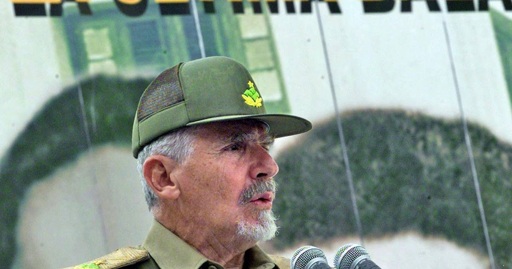

The leadership of the Communist Party of Cuba announced with profound sorrow the death of Commander of the Revolution Ramiro Valdés Menéndez, one of the most historic figures of the Cuban Revolution, Hero of the Republic of Cuba and Hero of Labor.
He passed away on the morning of June 21 at the age of 94, leaving behind an extraordinary legacy of service to the Cuban people and the revolutionary cause.
Born in Artemisa on April 28, 1932, Ramiro Valdés came from a humble family background. Guided by his mother, who instilled in him patriotic and nationalist values inspired by Cuba’s independence struggles and the ideals of José Martí, he learned from an early age to confront the hardships and inequalities of the capitalist system.
As a young man, he worked as an apprentice lineman and became involved in defending the rights of electrical workers. Following the 1952 coup d’état led by Fulgencio Batista, Valdés quickly joined the struggle against the dictatorship under the leadership of Fidel Castro. He was among the young revolutionaries who participated in the assaults on the Moncada and Carlos Manuel de Céspedes barracks on July 26, 1953, actions that marked the beginning of the Cuban revolutionary movement.
From that moment onward, Valdés remained on the front lines of the revolutionary struggle alongside Fidel Castro and Raúl Castro, demonstrating unwavering loyalty and commitment to the cause of building a better Cuba. He endured imprisonment on the Isle of Pines, exile in Mexico, and later took part in the historic Granma expedition. During the revolutionary war, he served as second-in-command of Column No. 8 under Commander Ernesto Che Guevara.
Following the triumph of the Revolution on January 1, 1959, Valdés, who had already attained the rank of Commander during the guerrilla struggle in the Sierra Maestra, assumed a series of key military and political responsibilities. Among them were serving as deputy chief of La Cabaña fortress, military commander in Cuba’s central region, and head of State Security during crucial moments such as the Bay of Pigs invasion.
Over the following decades, he held numerous senior positions in the Cuban state and armed forces. These included Minister of the Interior, First Deputy Minister of the Revolutionary Armed Forces, aide to Fidel Castro, President of the Industrial Electronics Group, Minister of Informatics and Communications, Vice President of the Councils of State and Ministers, and Deputy Prime Minister, the position he held at the time of his death. He was also a founding member of the Communist Party’s Central Committee and Political Bureau, as well as a deputy to the National Assembly of People’s Power.
Valdés also carried out important official, political, and economic missions, including leading efforts to locate, exhume, and repatriate to Cuba the remains of Che Guevara and his comrades from Bolivia.
In recognition of his distinguished service, he received numerous orders, medals, and decorations throughout his lifetime.
The Cuban leadership described Ramiro Valdés as a revolutionary, combatant, and patriot whose example will continue to inspire future generations. He was remembered as a man of firm convictions, unwavering dedication, and limitless commitment to his people.
Cuban President and First Secretary of the Communist Party, Miguel Díaz-Canel Bermúdez, paid tribute to Valdés in a message published on X, expressing his profound grief at the loss of the veteran revolutionary leader.
“The physical departure of Commander of the Revolution Ramiro Valdés Menéndez hurts deeply, like the loss of a father,” Díaz-Canel wrote. He praised Valdés for his support, advice, discreet collaboration, and exemplary devotion to the service of the homeland.
The Cuban president emphasized that every act of Valdés’ life was marked by absolute loyalty to the leadership of Fidel Castro and Raúl Castro, to his comrades in struggle, and to the ideals of the Moncada Program. According to Díaz-Canel, Valdés defended those principles from the assault on the dictatorship’s fortress in 1953 until his final breath.
Concluding his tribute, the president bid farewell to the historic revolutionary with the words: “Until victory always, Commander.”
From In Defense of Communism via This RSS Feed.