


By Phill Gittins, World BEYOND War Education Director, June 21, 2026
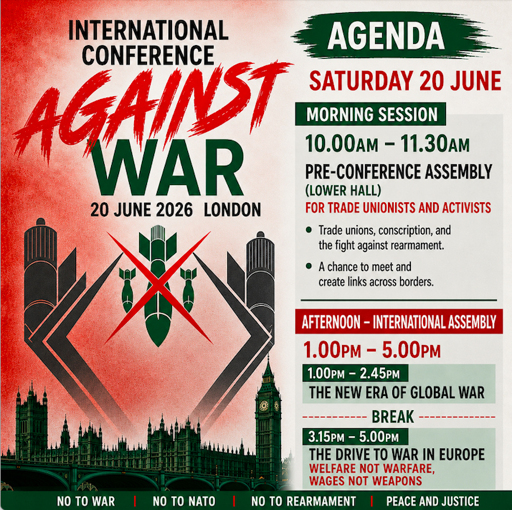
On 19 and 20 June 2026, anti-war activists, trade unionists, parliamentarians, student organisers, campaigners and civil-society representatives gathered in London for the International Conference Against War. Organisers reported that more than 2,000 people took part across the two days.
The conference took place against a backdrop of escalating wars, renewed rearmament, debates over conscription, and pressure to increase military spending while public services, housing, health care, wages and climate action remain under strain.
Saturday’s gathering was held at Central Hall Westminster, where the first meeting of the United Nations General Assembly opened on 10 January 1946. The setting gave the conference symbolic weight: eighty years after the creation of an international system founded on the determination to “save succeeding generations from the scourge of war,” movements are still organising against war, war preparations and the wider culture of militarism.
The London conference followed the Paris anti-war conference of October 2025 and carried forward efforts to deepen international anti-war cooperation.

Aims of the conference
The organisers framed the conference as part of a wider effort to renew cooperation between anti-war movements, trade unions and social movements. The Friday delegate meeting focused on future coordination and possible joint action; Saturday’s pre-conference assembly and main conference brought the discussion to a wider audience of activists, trade unionists, parliamentarians, international guests and members of the public.
Across both days, the aim was to strengthen practical links among those opposing war, rearmament and conscription while defending public services, wages, democratic freedoms and working people’s lives.
Who took part
The conference brought together anti-war organisations, trade unions, dockworkers, student organisers, MPs, campaigners, peace organisations and international solidarity groups. Publicly announced speakers and participants included Mustafa Barghouti, Medea Benjamin, Jeremy Corbyn, Diane Abbott, Richard Burgon, Zarah Sultana, Jon Trickett, Lorena Delgado Varas, Jérôme Legavre, Fran Heathcote, José Nivoi, Tariq Ali, Felix Kreklow Rojas and Andrew Feinstein, among others.
A key feature of the conference was its international character, with contributions and perspectives connected to Palestine, Sudan, Cuba, Norway, Venezuela, Italy, Germany, France, Spain, Sweden, Greece, the United States and the United Kingdom. That mix matters. Anti-war organising is strongest when it connects people organising from places directly affected by war and militarism with those building pressure through workplaces, schools, universities, parliaments, trade unions and local communities.

Key themes and discussions
War, rearmament and austerity
A central thread running through the conference was the connection between war, rearmament and everyday life. Speakers linked current conflicts and rising military budgets to militarisation, arms production, military alliances, geopolitical rivalry and pressure on public services. The official invitation framed this in direct social terms: money needed for health care, transport, education, housing, decent jobs and wages is being redirected toward military spending and arms production. Together, the slogans “welfare not warfare,” “wages not weapons,” and “jobs not conscription” captured one of the conference’s clearest arguments: choices about war are also choices about social priorities.
Palestine and international solidarity
Palestine was a major focus of the conference, both as an urgent struggle in its own right and as a point of connection with occupation, imperialism, racism, international law, arms transfers and global solidarity. Speakers linked Palestine to the complicity of western governments and the failure of international institutions to halt mass violence. The strongest contributions did not treat Palestine as separate from other anti-war concerns, but as part of a broader challenge to militarism, selective accountability and the systems that enable war and occupation.
Conscription, youth and the militarisation of education
Young people, student organising, opposition to conscription and the militarisation of education were recurring concerns. In countries where many families have had no living experience of conscription for generations, renewed calls for young people to prepare for war are politically and socially significant. In the UK, the Defence Universities Alliance sharpens this concern by formalising links between universities, the Ministry of Defence, the Armed Forces and the “defence” sector. Rearmament is not only a budgetary or diplomatic issue. It is also a social, cultural and educational project.
A consistent anti-war position
Lindsey German, Convenor of the Stop the War Coalition, put the point sharply: “The answer to US imperialism is not European imperialism.” The warning matters. Anti-war politics is weakened when it opposes one military bloc while excusing another. A consistent anti-war position has to challenge occupation, domination, rearmament and militarised security wherever they appear. Opposition to war cannot depend on who is doing the bombing, occupying, arming or threatening.
Common security and alternatives to war
Several contributions moved from opposition to war toward deeper questions of what security means, what it is for and whose security counts. Sean Conner of the International Peace Bureau spoke about common security: the idea that the security of one people or state cannot be built at the expense of another. That idea points beyond protest alone and toward practical alternatives, including diplomacy, demilitarisation, arms control, peace education, nonviolent resistance and forms of security rooted in cooperation rather than domination. This is the kind of approach World BEYOND War sets out in A Global Security System: An Alternative to War.
From shared analysis to coordinated action
The test of an international conference is whether it produces more than strong speeches. Across both days, the need for practical coordination kept returning: across countries, movements, workplaces, schools, universities, parliaments and local communities. The challenge now is to turn shared analysis into shared work: follow-up mechanisms, joint campaigns, educational resources, youth and student organising, trade-union mobilisation and practical collaboration around rearmament, conscription, military spending and Palestine. International anti-war cooperation cannot remain only a slogan. It has to become organised practice.
World BEYOND War participation
World BEYOND War participated across both days. Education Director Dr Phill Gittins made a brief contribution during the conference discussions. His remarks connected opposition to current wars with the need to understand war as part of a wider system, recognise the full costs of militarism, and build credible alternatives to militarised security (see full remarks below).

Reflections for anti-war education and organising
For World BEYOND War, the conference brought several questions to the forefront that sit at the heart of our work and matter for the wider peace and anti-war movement.
The first is how to hold the immediate and the systemic together. Movements must respond to the urgent realities of bombing, occupation, displacement, repression and genocide. But they also need to confront the structures that prepare for, profit from and normalise war: arms production, military alliances, military bases, vast military budgets, public narratives of threat, and the assumption that security depends on domination. If we focus only on particular wars, each crisis can appear exceptional. If we speak only about the system, we risk losing contact with the suffering and political urgency of specific struggles. Strong anti-war work needs both.
The second is how to connect resistance with replacement. Saying no to war, rearmament, conscription and militarism is essential. But anti-war movements also need to show what they are for: common security, demilitarisation, diplomacy, nonviolent resistance, unarmed civilian protection, civilian-based defence, peace education, ecological stewardship, and public investment in the things that make people and the planet safer. Alternatives to war already exist, but they remain too often treated as marginal, unrealistic or poorly understood. More work is needed to make them visible, credible, teachable, usable and scalable.
The third is how to turn breadth into coordination. One of the strengths of the conference was the range of people, countries, organisations and traditions represented. But breadth only matters if it becomes shared work. The next task is to strengthen follow-up mechanisms, joint campaigns, educational resources, youth and student organising, trade-union mobilisation and practical collaboration across borders.
A related task cuts across all three: bringing more people into active anti-war work. The movement needs committed activists, but it also needs teachers, students, workers, artists, researchers, faith communities, parents, carers and people from all walks of life. Peace and anti-war work should be natural allies, but they do not always overlap in practice. Some people and organisations speak powerfully about peace while remaining vague, selective or silent about particular wars, rearmament, militarism and the wider war system. This is why World BEYOND War argues for an approach that is both pro-peace and anti-war: a pro-peace stance cannot stop at hoping for a more peaceful world; it must also confront the systems, institutions, investments and assumptions that prepare for, profit from and prolong war.
Peace education has an important role to play here. It can help people connect values and hope with analysis, organising and action. It can help debunk the myths of war — that war is inevitable, necessary, just and beneficial — while teaching proven nonviolent alternatives and building the capacity needed to move from a culture of war and militarism toward a culture of peace and nonviolence.
The conference was a reminder that anti-war work is not only about resisting today’s wars or preventing the next one. It is also about building the relationships, ideas, institutions and movements capable of making war less likely, less legitimate and ultimately less possible.
Organisers and supporters
The conference was convened by the Stop the War Coalition, with support from the Campaign for Nuclear Disarmament, trade unions, campaign organisations, elected representatives and international partners. The formal invitation was issued by John Rees of the Stop the War Coalition, Kate Hudson of the Campaign for Nuclear Disarmament and Fran Heathcote, General Secretary of PCS. World BEYOND War was listed among the supporting organisations

Date and venue
Friday 19 June 2026: International delegate meeting, Hamilton House, National Education Union headquarters, Mabledon Place, London WC1H 9BD.
Saturday 20 June 2026: Pre-conference assembly and public conference, Central Hall Westminster, Storey’s Gate, London SW1H 9NH.
Resources and links
International conference call / statement
Conference details — Stop the War Coalition
Conference booking/details — Ticket Tailor
Defence Universities Alliance — GOV.UK
First UN General Assembly at Central Hall Westminster
World BEYOND War — Declaration of Peace
World BEYOND War — A Global Security System: An Alternative to War
Text of Phill Gittins’s contribution
The following is the text of Phill Gittins’s brief contribution during the conference discussions, lightly edited for clarity.
Thank you.
Let me begin by thanking and congratulating the organisers and everyone involved in this important gathering.
Yesterday’s delegate meeting was extremely valuable. I agreed with much of what was said, and I want to add some wider considerations that may help strengthen our work together.
Through our work at World BEYOND War, and through collaboration with people, organisations and movements across the globe, three lessons have become increasingly clear.
First, we need to understand war as a system, not only as a series of separate conflicts.
We rightly focus on the wars of the day: the bombing, killing, destruction and displacement.
But behind each war lies a wider architecture: the arms trade; military alliances and bases; vast military budgets; the influence of weapons companies; and the belief that military force is the ultimate source of security.
By the time the bombs are falling, prevention has already failed.
So we must oppose today’s wars. But we must also confront the structures, interests and assumptions that prepare for, profit from and prolong the wars of tomorrow.
Second, we need to recognise the full costs and dangers of militarism.
Three interconnected threats are especially urgent.
The first is nuclear annihilation. Nuclear arsenals leave humanity exposed to deliberate use, miscalculation and escalation.
The second is climate breakdown. Militaries consume vast quantities of fossil fuel; war destroys ecosystems; and military spending diverts resources from climate action.
The third is the militarisation of artificial intelligence. AI-enabled weapons and military decision-making may accelerate conflict, obscure responsibility and weaken meaningful human control over decisions about life and death.
These dangers are not inevitable. They are shaped by human choices. But the longer we delay, particularly in regulating military AI and reducing nuclear risks, the more difficult meaningful restraint may become.
They also sit alongside war’s enduring consequences: death, injury and trauma; mass displacement; destroyed homes, hospitals and essential services; deepening poverty and instability; and damage that can continue across generations.
Third, we need to make the alternatives to war more visible, credible and properly resourced.
We hear constant discussion about military spending and percentages of GDP. We hear far less about whether that spending makes people safer—against which threats, for whom, at what cost, and compared with what alternatives.
Those alternatives already exist. They include diplomacy, mediation, arms control, unarmed civilian protection, nonviolent resistance, peace education and civilian-based defence.
Civilian-based defence means preparing people and institutions to resist invasion, occupation, coups and repression through organised noncooperation: strikes, refusal to collaborate, independent communication, protection of essential services and mass civil resistance.
This is not passive, and it is not naïve. It requires preparation, organisation, courage and strategy.
Abolishing war is not simply about opposing something. It is a practical project of replacement: building institutions, capacities and forms of security that make war less necessary, less legitimate and less possible.
If these ideas resonate with you, please connect with World BEYOND War: sign the Declaration of Peace, join or create a chapter, or encourage your organisation to become an affiliate.
Let us oppose the wars of today. But let us also dismantle the system that keeps producing them—and build forms of common security capable of replacing it.
Because, in the end, none of us is safe until all of us are safe.
Thank you.
The post World BEYOND War Takes Part in International Conference Against War in London appeared first on World BEYOND War.
From World BEYOND War via This RSS Feed.