

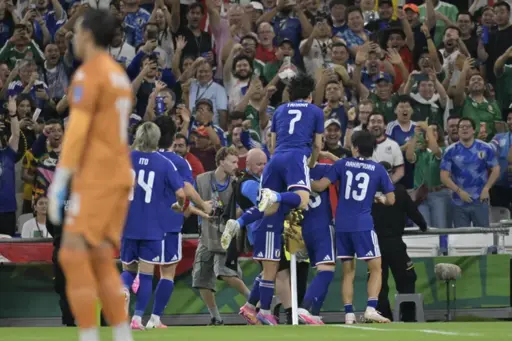
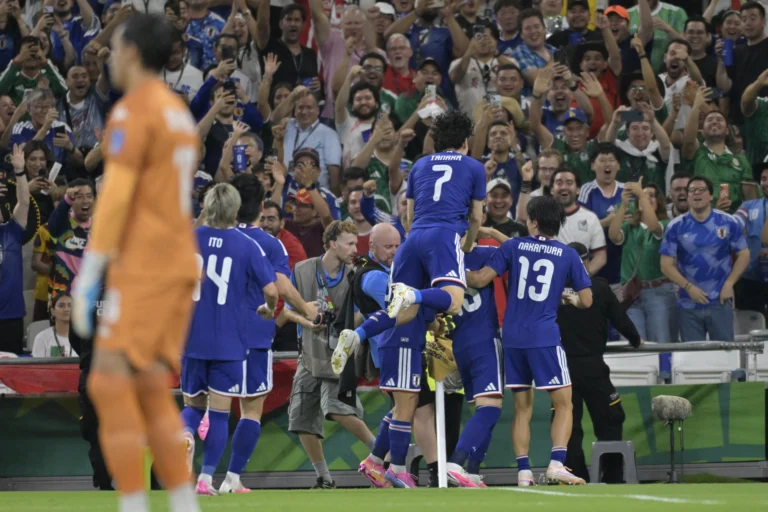
Japan vs Tunisia made World Cup history in match No. 1,000 as Japan won 4-0 in Monterrey, controlling possession and securing second place in Group F.
Related: Brazil Defeats Haiti 3-0 to Secure First World Cup Victory
Japan vs Tunisia made World Cup history as the 1,000th match in the tournament’s long legacy ended with a dominant 4-0 victory for Japan in Monterrey. The result confirmed Japan’s strong start in Group F and left Tunisia with no consolation goal despite tactical adjustments.
Japan vs Tunisia and the historic 1,000th World Cup match
Japan controlled the game with 55% possession, 10 shots on target, and a defense that kept its goal untouched. The Japanese side quickly imposed its rhythm, and the match followed the expected script as Japan moved into second place in Group F behind the Netherlands.
The breakthrough came early, when Daichi Kamada opened the scoring in the 4th minute after an assist from Keito Nakamura. Ayase Ueda made it 2-0 in the 31st minute, giving Japan a comfortable first half and forcing Tunisia into a reactive role almost from the start.
Japan kept that control after the break. Junya Ito and Ueda’s second goal completed the 4-0 scoreline, sealing a clear victory over the “Carthage Eagles.” Tunisia made technical changes during the match, but they were not enough to stop Japan’s attacking pace or produce a consolation goal.
Tunisia coach Hervé Renard, who took over after the dismissal of Sabri Lamouchi, admitted after the loss that his team was facing a side “well above” them. His words reflected the scale of the challenge Tunisia faced against a more organized and more efficient opponent.
The match also stood out for its ceremonial detail. The refereeing crew, led by Romania’s Istvan Kovacs, wore special uniforms with gold details and a commemorative patch marking the 1,000th World Cup match. That symbolic touch highlighted the historic nature of the occasion.
Japan vs Tunisia and the Group F race
The victory placed Japan in second place in Group F, just behind the Netherlands, who had earlier beaten Sweden 5-1. That position gives Japan strong momentum heading into the next round of group play and confirms it as one of the more composed teams in the tournament.
For Tunisia, the defeat leaves the team at the bottom of the group, with a difficult road ahead and a need to recover quickly. The next match will be even tougher if the defensive problems and limited finishing continue, especially against a higher-ranked opponent.
Japan’s next game will be against Sweden, which is coming off a heavy loss to the Netherlands. That matchup now looks like another key test of Japan’s consistency and ambition in the competition. If Japan maintains the same balance of control, pressure, and efficiency, it could keep pace with the group leaders.
The statistical difference in Monterrey showed why Japan won so comfortably. With far more possession, more shots, and more control of space, Japan dictated the match from start to finish. Tunisia, despite some short spells of adjustment, never found a sustained answer.
Geopolitical context
Japan vs Tunisia also reflects how World Cup football continues to connect different regions through performance, identity, and global visibility. Japan’s dominance underscores the rise of Asian football on the world stage, while Tunisia’s struggle shows the uneven competitive landscape facing African teams in elite tournaments.
The match is also part of a broader story about global football balance shifting beyond Europe and South America. When teams like Japan impose themselves with discipline and structure, they challenge older assumptions about where football power comes from. That matters not only for the tournament but for how the sport is understood internationally.
This dispute now sits at the intersection of sport, regional representation, and competitive inequality. If Japan continues advancing and Tunisia cannot recover, the result will reinforce the idea that modern World Cups are shaped as much by infrastructure and preparation as by tradition. That is why this 1,000th match was more than a statistic; it was a snapshot of football’s changing map.
No te pierdas este 20 de junio “La Cancha ES NUESTRA”, un análisis futbolístico desde América Latina. Marina Aguirre, Jeanneth Lozada, Viviana Vila y Nany Flórez ofrecerán una perspectiva profunda del Mundial 2026.https://t.co/gcNbckjMph pic.twitter.com/p9989O6ArI
— teleSUR TV (@teleSURtv) June 20, 2026
From teleSUR English via This RSS Feed.